Monday, October 1, 2012

Tour Du Iowa Gulch

I thought it'd be a good idea to log at least one 20 mile run before my marathon next month-- even though the plan (such as it is) is to basically run the marathon on the fumes of my training from the summer. For me, the Bay State Marathon is more of an experiment in how my Leadville training translates into a flat, sea level road marathon-- not what is the ideal way to train for a flat, sea level road marathon when you live way up in the mountains.

For a while now I had considered stitching together several of my regular short midweek runs into a longer route that would take me around Iowa Gulch-- a sort of farewell tour before the snow sets in. At first I had planned to start/finish the run from my house, but that plan was more logistically difficult than simply driving to the halfway mark so that I could stash extra food and water in my car. The one drawback of doing long runs on the east side of town is that, due to all the mining activity, I don't really trust any of the water sources. Thus, I tend to run my long runs on the west side of the valley (near the Colorado Trail) where I can stop and restock on water whenever I cross a stream.

This run would also be a test to see how my IT band reacted to running for 4+ hours. It has been holding up well on my 5-6 mile runs, and it's even survived a 12 mile run, but I had yet to challenge it with anything longer than 2 hours. Occasionally I can feel it ache a bit on gentle uphill sections, but it fades away and never alters my stride. It's strange: my previous IT issues have always manifested themselves on downhills-- not uphills. I wonder what's different this time?

So, the weatherman lied. Saturday was supposed to be the cloudy day and Sunday was supposed to be clear. Instead it was the reverse. There were uncharacteristic dark, gray rain clouds hovering over the Mosquitoes when I started out at 10am. If there is any overcast in Leadville, it generally doesn't arrive until well past noon. To wake up to clouds is rare. Since I'm a chicken when it comes to dark clouds above tree line, I knew this would probably put a damper on my plans to summit Mt. Sherman. But, I'd see how far I'd make it before I talked myself into retreating back down into the valley.

I drove 5 minutes up California Gulch and parked my car at the pull off at the top of Printer Boy. (Where the first major aid station is on the Silver Rush 50 course.) I decided to tackle the high road up the gulch first (2B).

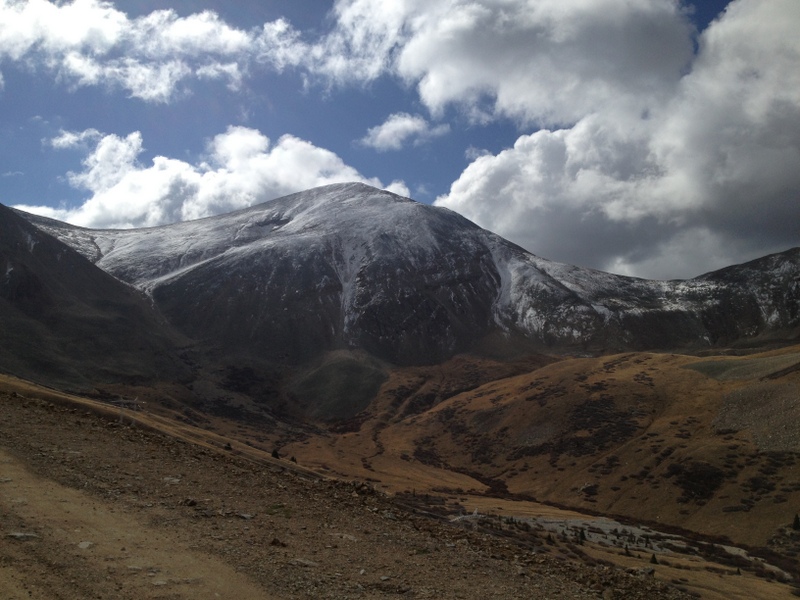
Mt Sherman is the snowy ridge in the distance.
Mt Sheridan. The trail climbs up the notch on the left.

A view of West Sheridan across the gulch.
Nearing the end of the road and the Mt Sherman trailhead.
I climbed up the road fairly well, though I was actively trying to keep my HR low. The road gains about 1,000 ft in 3.5 miles. It was chilly and windy on the way up. I knew it'd only get worse the higher I got. (Dammit, I should have run this yesterday!) At the junction with the trail to the summit, I took stock of things and decided, what the hell, I'd climb up to the saddle and see how things looked from there. I felt surprisingly good on the way up the trail, running a few of the flatter sections, and power hiking through the steep fields of scree. My mind drifted towards potential Hardrock training next year...

At the top of the pass, looking towards Mt. Sheridan.

Looking north towards the summit of Mt. Sherman.

Looking east at some unfriendly clouds.
Once I crested the pass, I could see a few different groups of climbers descending off the mountain to the east. The sky really hadn't cleared up much and a patch of dark clouds was blowing in from the northwest. It was quite chilly even in the rare patch of sun that I was standing in. And I was running a little low on water. After considering the pros and cons I finally overcame my strong peak bagging instinct and turned around and re-traced my steps back down into the gulch. I had climbed up to 13,200 ft and I was exactly 5 miles from the car. The trip back went quickly, and I had a few opportunities to practice my scree-skiing technique on the way down. Once back at the trail head I took the rougher, low road (2) back down the valley, past the remnants of the Black Cloud mine, and back up Printer Boy hill to my waiting car. There I restocked on water and fuel and headed off down the Elk Run trail.

Don't shoot! I'm not an elk!
 The next ~10 miles would all be on a dense network of twisting trails built and maintained by the local bike club. They're only a mile from my house and they've become my favorite place to run during the week. The trails are super scenic, weaving in and out of sage brush, pines, and groves of aspens, with a fair amount of elevation gain, but nothing too steep. They loop and weave so much that it's a little hard to build up any speed, but that's a very minor complaint.

From Elk Run over to Upper Deck.

Down Wedgie.

Down Cold Feet.

Gel was losing its appeal, so I decided to eat elk instead.

Gold Digger with a view of Mt. Elbert.


Most of the aspen leaves have fallen by now, but I found one grove with its leaves still intact.

The sage hill on Wheeler's Way. This is the first section of trail to melt out in the spring.

A skull marks the trail on Wheeler's Way.

Back up Old Chub to the intersection of Elk Run and Boulders.

The ramshackle bridge across the stream on Boulders. This was the low point of my run, it's all uphill from here.

The boulders which give Boulders its name (I assume).

A vertigo-inducing mine shaft that plunges 100 ft into the darkness.

The beavers have been busy and this river crossing is now knee deep!

A view back up Iowa Gulch towards Mt. Sherman.
The tangled, circuitous route I took never retraced its steps. I eventually ended up on the Boulders Trail and headed slowly back up the valley to my car, eventually connecting with a rough, dirt road (6A) after 8 miles of beautiful single track. I was having a great time, though my energy levels were very low. I couldn't quite put my finger on why I was slowing down so much... In retrospect, I was probably a little dehydrated. I'm not sure that completely explains it, though. My stomach felt fine, but my legs were a bit tired and I just felt generally fatigued. Ah, well. Just because you run a 100 miler doesn't mean 20.5 miles with 4,400 ft of vertical suddenly becomes easy. Looking at my training log afterwards, I ran my last 22-miler (which had equivalent elevation gain) at almost exactly the same pace. I remember feeling pretty tired on that run too.

Despite the initially sketchy weather and my eventual exhaustion, I had a great time out on the local trails. (And no ITBS despite 4+ hours of running!) It's amazing that this kind of stuff is right out my front door. It's good to be reminded of that. Thanks to my wife for watching the kids and letting me indulge in what will probably be my last 20+ mile training run of 2012!

The Tour Du Iowa Gulch. It would be easy to tack on another ~3 miles and 2,000 ft of vertical by summiting Mt. Sherman and running the upper Boulders Trail up Long and Derry Hill...

Not much flat.


Friday, September 28, 2012

Training 2012 Analysis

"Law 6: Achieve As Much As Possible on a Minimum of Training" -- Tim Noakes

I've been taking it super easy since the 100. Only last week did I actually begin to really exercise regularly again. Up until that point I only went on a few, scattered 5 mile runs to test out my legs. My left knee is still a bit creaky, but I've reached the point where it doesn't affect my stride. I'm foam rolling it and stretching my hips every day. In addition to my knee, I was sidelined for a few days due to a random head cold and for a week due to my hernia surgery. Thankfully that's all behind me now and I've returned to the trails to enjoy the beautiful fall foliage up here in Leadville. We just got two cords of firewood delivered, and the snow is starting to stick above 12,000 ft...

My general plan for the off season (from now until February) is to average around 20-25 miles a week. Why? Insurance mileage, I guess. Just in case I actually get selected for Hardrock next year! (I should have 2^3 tickets, if my calculations are correct...) After much agonizing, I decided not to run the Devil Mountain 50 this weekend in Pagosa Springs. I ran it last year and it was a lot of fun, but my training has been too inconsistent since the 100 and (more importantly) my knee hasn't fully recovered yet. So, instead of running a 50 miler with 10,000 ft of vertical, I've registered for a much more terrifying race: a totally flat road marathon at sea level! Ahhh! The race coincided nicely with my next business trip to Boston and I'm really curious to see how I do on a more traditional marathon course. It's totally out of my comfort zone. I've never run a marathon below 7,000 ft or with less than 5,000 ft of vertical. Pavement? What's that? I didn't even own a pair of road running shoes until yesterday. However, at the risk of sounding cocky, I'm going to go out on a limb and say that a PR for the distance is pretty much in the bag. It gave me a chuckle to see that on the front page of the race's website they advertise how fast (i.e., easy) the race is ("Selected by Runner's World as one of the 10 Fastest Marathons")! Funny... I don't think I've ever seen any Colorado race make such a claim... (Don't get me wrong: running a fast marathon is insanely difficult! I'll be lucky to break 4 hours next month. However, a 4 hour marathon would be a 1 hour and 34 minute improvement for me. I suspect I'll be the only runner wearing a SJS50 t-shirt and carrying a hand held water bottle during the race. Gotta represent.)

Anyway...

Continuing in the spirit of number crunching, I thought I'd take a moment to summarize my training for the 100 this year. I don't really consider myself a "hard core" runner who regularly logs huge mileage. I try to focus on quality, rather than quantity-- though I could certainly improve in that area. (It's also possible that I'm just lazy.) I'm sharing this data not because I think I have all the answers when it comes to training for a 100 miler (far from it!), nor because I think my training is especially remarkable, but because hopefully someone out there on the interwebs will find it helpful/useful as an example-- just another data point to take into consideration.

I've never really followed a specific training plan per se. I certainly look at various plans to get a feel for what other folks think constitutes good training, but I never pick one particular plan to follow religiously. The training plans I refer to most often are Bryon's. I guess the biggest distinguishing features of my training are:

  • 90% of my training is above 10,000 ft. Very few runners can say that. (There are certainly pros and cons to training so ridiculously high...)
  • I almost always run on trails. I log very few paved miles.
  • I average around 10,000 ft of vertical/week from May-August.
  • I'm slow (see above). My average pace for a month is typically only ~11:00 min/mile.
  • I incorporate biking during the winter (on the trainer) and for recovery after long runs. 1 hour bike = 5 mile run.
  • I race a lot, though I don't really have a separate "racing gear". I run races as training; to test out gear and to practice various nutrition strategies and general race management. Plus, they're fun.
  • I try to run about 15 ~20+ mile runs. About half these are races.
  • I try to climb a few 13ers/14ers every month from May-August.
  • I don't do any speed work. (I probably should.)
  • I like to think I pay proper attention to post long run recovery (e.g., getting enough protein, icing my legs in mountain streams, etc.) though I need to get better at regular stretching/foam rolling.
  • Living in Leadville, I am completely familiar with all the Leadville race courses. I regularly train on the more scenic sections during the course of the year.

The Spreadsheet of Truth

 So, some explanations about the spreadsheet:

  • Yellow cells are bike rides-- generally an hour on the trainer.
  • Green cells are my ~20 mile runs (or, more generally, runs that take 4+ hours).
  • Purple cells are vacation/business trip runs (which generally means sea level).
  • Red cells are injuries.
  • Mileage in bold (generally in green cells) are races.
  • YTD = from the week following LT100 '11. I train from Leadville to Leadville. :)
  • I consider "serious" training to begin at the 24 weeks until Leadville mark-- which corresponds nicely with the week of the Salida marathon. The SUM/AVE at the bottom are for that 24 week period.
  • The green/red columns on the right are the difference of my weekly mileage compared to Bryon's 50 and 70 miles per week training plans. Despite some fluctuations, I came out 36.3 miles ahead of Bryon's 50 mpw plan and a mere (ha!) 212.7 miles below his 70 mpw plan (which I would consider the minimum for trying to break 25 hours and big buckle, fwiw).

Weekly Mileage
The graph above represents my weekly mileage in the 24 weeks leading up to the 100. Some observations:
  • I consider a week of training to begin on Monday and end the following Sunday.
  • I came down with a case of ITBS which severely limited my running during weeks 4 and 5. Luckily I was able to recover quickly and jump up to 50 mpw.
  • The dip in week 12 was because I was tapering for the Sage Burner 50K on the following Monday. Thus the spike in mileage in week 13.
  • Weeks 16 and 19 are my 50 mile races: the San Juan Solstice 50 and the Silver Rush 50.
  • I like the consistency of my weekly mileage from weeks 6-11. After that I start see-sawing as I race, taper, race, taper, etc. I don't think that's ideal... There are just too many fun, local races to run!
  • I missed one 20+ mile run on week 21 when my son was born. It would've been hard to explain to my wife why I needed to do a double crossing of Hope Pass while she was in labor. :)
  • I started tapering for realz at week 22.
  • Week 24 was the 100.
I feel that training-- particularly for an ultra-- just sets you up for success-- it doesn't guarantee it! Injuries and/or poor nutrition on race day can completely negate/overwhelm all your hard work. For example, after training basically the same as I did last year, I managed to finish the 100 one hour faster this year simply because of improvements I made to my race nutrition. That was by far the most important change I made in 2012 even though it may seem so simple/trivial. Your #1 training priority should be: don't get injured. And I'd venture to say that your #2 priority for success in 50+ mile races should be: learn how to eat/drink adequately while racing. Once you've mastered that, then you can focus all your efforts on total mileage, proper intensity, course specificity, hill work, speed work, fiddling with gear, shoes, etc.

So... there you have it. There are certainly things I'd like to change about my training for next year. (I've started compiling a list.) But I'll refrain from rambling on about that until my plans for next year firm up. Certainly, like almost every other ultra runner in Colorado-- or at least every other Colorado runner in the blogosphere, Hardrock is the ultimate goal. Being selected for that venerable race would certainly push my training about a month forward and kick it into high gear. Failing that, another Leadville finish (in 27 hours, dammit!) is my default goal, though we have plans to visit my wife's parents in France and Switzerland next August/September... UTMB, anyone?

Wednesday, August 29, 2012

LT100 Race Analysis

So, being the OCD runner that I am, I grabbed all of the race results (with splits) off of the website and threw them in a spreadsheet. After massaging the data a bit (e.g., calculating cumulative time columns for each racer at each aid station), and sorting it in a variety of ways, I was able to create the following tables.

Why bother? Well, mostly I'm just curious. But I also find it helpful to write down a few details about each split, along some thoughts about how I might be able to improve, before my memories of the race start to fade.

2012 Results vs. 2011 Results

2012 Results vs. 2012 Goals

2012 Results vs. 2012 Average

The tables above compare my splits from this year to my splits from last year, my goals for this year, and the average splits for this year. So, for example, I ran from the start to May Queen 13 minutes faster than last year, 3 minutes faster than my goal for this year, and 5 minutes faster than the average.

A few clarifications: Obviously, my results from last year were on the shorter course. Also, I didn't adjust my goals for this year when I found out that the course was going to be ~3 miles longer. Once I heard about the extra mileage I knew I probably wouldn't be hitting my goal splits from Twin to Winfield and back (and I let my crew know as much). I try to be as brutally honest as possible when I set my goal times for each aid station. My goal times aren't when I hope to be an aid station. They're not best case scenarios. They're my best guess as to when I'll actually be at an aid station. My crew rely on these times and I owe it to them to try to be as accurate as possible. If I've done my job right, it should be as likely for me to arrive at an aid station 10 minutes ahead of schedule as it would be for me to arrive at an aid station 10 minutes behind schedule. Of course, during the race there are a million variables that I can't predict or control, but that's what makes running ultramarathons so interesting, right?

I should also note that the average times were calculated from all of the runners who completed the split-- regardless of whether or not they ultimately finished the race. So, they're almost certainly a bit slower than the average split times for just the finishers because they will include the split times where folks blew up and DNF'ed at the next aid station. Finally, I want to point out that these are the average times-- not the median times. I'm guessing the median times are slower... maybe?

2012 Results vs. 2012 Median
Actually, no. It looks like the median times are actually faster than the average overall. I'm no statistician, so I'm not sure which one is more "correct" in this case. I think I prefer median because it's more "real". Someone actually ran the split in that time and half of the runners ran it faster and half of the runners ran it slower.

-160 places in 40 miles! That's -4 places/mile...
The table above tracks my place for each section of the race (and how much it changed from the last section). Also, my time for each split is ranked. So, for example, when I arrived at Half Pipe (inbound) I was in 288th place. From Twin to Half Pipe I passed 53 runners, and my time for that split was the 157th fastest. (As a reference point, I counted 796 people starting the race.) Again, as far as place and rank go, I'm considering all the runners who completed the split-- not just the finishers. There are a few minor holes in the data because a couple of split times weren't recorded (meaning that I couldn't calculate cumulative times for absolutely everyone). I really finished in 183rd place, so the numbers might be off by one or two places-- with slight errors being more likely for the later splits.

Start to May Queen

Not much to improve upon here. If I want to run this split faster I, um, need to run this split faster. The question is: can I do that without it coming back to hurt me later in the race? The fastest I would probably ever feel comfortable running to May Queen would probably be around 2:05-- and even that would make me a bit nervous. I mean my PR for the Turquoise Lake Half is 1:56. I'm just not that fast. In a lot of ways, I feel like your precise time to May Queen is a bit beyond your control due to the conga line effect around the lake. You can jockey for position before the mini-powerline climb, but after that you're kind of stuck. I certainly don't think it's wise to try to pass folks in the dark on the single track. My philosophy is that if you're ever forced to go slower than you'd like, don't get frustrated; just take the opportunity to eat more.

May Queen to Fish

Again, not much to improve upon here. Just like the first split, I know I could run this split faster, but it's probably not a good idea. Maybe I could run this section in 2:00 without killing myself? Doubtful. If I'm going to push a bit harder in the first 23 miles, maybe it makes more sense to push during this section rather than to May Queen? I'm not sure... I don't want to waste too much energy pushing uphill this early in the race.

Fish to Half Pipe

I might be able to shave a minute off of my stop at Pipeline, but I couldn't run through the Fish aid station any faster than I did. I don't think I want to run this split any faster-- certainly not to Pipeline. Maybe I could shave off a minute or two from Pipeline to Half Pipe-- but that's insignificant in the big scheme of things.

Half Pipe to Twin

Hey, here's an idea: don't get ITBS and stop four times to stretch for ~10 minutes on the way to Twin! Oh, and actually run the downhills faster than limping at a 12:30 min/mile pace! Now that I have more confidence in relying solely on energy drink for calories, I could definitely move through the Half Pipe aid station 5-10 minutes faster. So, there's lots of room for improvement for this split. This was my worst split, but it's also the split that I have the most confidence in improving upon. (Last year I ran it 24 minutes faster.)

Twin to Winfield

So, this split includes the time I spent at Twin and the time I spent at Hopeless (about 10 minutes each). Plus, it includes the ~3 minutes or so I spent icing my knee in Lake Creek. I could certainly move through the aid stations faster. I also feel like I got a little behind on calories/fluid during this section. I was really surprised how strong my split from Hope to Winfield was. I was expecting it to be much worse given my ITBS. So, I think 3:55 should be possible for this section. I've never broken 4:00 for this section (even on the shorter course), so that would be a big psychological boost.

Winfield to Twin

This split includes the time I spent at 3 aid stations: Winfield, Hopeless, and Twin (because I stopped to meet my crew before crossing the timing mat). I easily spent 10 minutes at each of those aid stations. It also includes the time I spent puking right after leaving Winfield. What a waste of time: eating for 10 minutes at Winfield only to spend 5 minutes puking it all up! If I had stayed on top of my nutrition/hydration during the previous section that probably wouldn't have happened. I spent a few minutes at Hopeless icing my knee (to no avail). Limping from Hope down to the river crossing sucked-- I lost a ton of time. I'd really like to run from Winfield to Twin faster than I run from Twin to Winfield. I'd also love to arrive at Twin before sunset. I think both of those goals are within my reach as long as I can keep my stomach and my IT band happy.

Twin to Half Pipe

Here's where I started clawing my way back into the race. At Twin, I was 41 minutes behind my time from last year; at Half Pipe I was 4 minutes ahead! Could I run this split faster? Probably, but not by much. There were several sections where I had to walk a bit due to knee pain and/or to settle my stomach (so that I could swallow Advil). I spent no time at aid stations during this split, so there's no room for improvement there.

Half Pipe to Fish

My strongest split, surprisingly. And my time includes 5+ minutes changing into long pants and different shoes (my Hokas) at Pipeline. I don't realistically think I could run this section much faster.

Fish to May Queen

This split includes the time (approximately 5 minutes) that I spent at Fish. It also includes the time I spent walking the road to Powerlines (and puking). I was severely limited by my IT band on the way down Sugarloaf. So, even though I set a PR for the section, I think I could possibly run it 10-15 minutes faster. That seems pretty fast to me, but it appears to be doable.

May Queen to Finish

This split includes the time I spent at May Queen-- where I had to spend some time (~5 minutes) in a porta potty. Strangely, I felt like I was moving faster during this section than I had in the past, but the results show otherwise. (My best time for this leg was in '10 when I was terrified of not making the 30-hour cut-off. I blew through May Queen without stopping, which made all the difference.) My ITBS almost completely limited my running except for a couple of miles on the Boulevard. I probably should've taken more Advil for this section, but I was worried about my kidneys. Assuming my knees are okay, I believe that I could run this section much faster. I don't think 3:20 is out of the question. There is a lot of room for improvement here. I would guess that the final 13 miles of the race hold the most room for improvement for almost everyone. In my opinion, too many racers kill themselves trying to shave 10 minutes off their time over Hope when it'd be much easier to make up that time (and more) in the final miles.

Best Decision

To blow through Half Pipe (inbound) without stopping. I recognized that stopping to eat "real" food was unnecessary, just slowing me down, and causing my knee to lock up. (And Pipeline was only 2.5 miles away.)

Worst Decision (Tie)

To not mix more energy drink at Hopeless (outbound). I needed those extra 300 calories and I puked shortly after Winfield as a result.

To chug a full bottle of 5-Hour Energy while approaching Powerlines. God, that stuff tastes awful! Next time: dilute it!

Hardest Decision

To stop and stretch for ~10 minutes on the way to Twin (outbound) to try to combat my emerging case of ITBS. I don't regret it, though I'm not sure it did anything meaningful, but it definitely meant sacrificing my short term goals for the long term.

Biggest Regret (If Time Travel Were Possible...)

If I had just continued to stretch/strengthen my hips in the 3-4 weeks leading up to the race I firmly believe ITBS wouldn't have been an issue. The score so far: ITBS: 2, Me: 1.

Conclusions
  1. Don't get ITBS and limp all the downhills!
  2. Spend less time at aid stations!
    1. Trust in energy drink to provide almost all of my calories. Cut back on stops for soup/potatoes.
    2. Don't fiddle with gear so much. Don't waste time changing shoes.
  3. Umm... puke less?
While I don't think there are enough savings to be had to go sub-25 and big buckle, I do think that a 26-27 hour finish is within my reach-- and without altering my training, except to include more time stretching/strengthening my hips (to prevent ITBS).

My knee pain has mostly faded, but I can still feel my left Achilles tendon. That's going to take a while to heal. I'm icing the tendon once or twice a day and I'm beginning to stretch and strengthen my hips and calves. I haven't run since the race. (I don't think I could run without tendon pain altering my form, which is not advisable.) Last week all I did was bike around the Mineral Belt Trail, hauling my daughter in the Chariot (and setting a PR for the route!). I think the bike really helped my recovery. I may try another bike this week and maybe a short run on the weekend if I'm feeling limber enough. I have surgery scheduled for mid-September to repair an epigastric hernia, and that'll knock me out of commission for 2 weeks or so. (Yes, I ran the 100 with my guts bulging out of stomach! How awesome is that?) I'm not precisely sure when I came down with the hernia, but I noticed it a few days after the Silver Rush 50, I think.

I guess you could say I ran my guts out this summer. :)

As for the fall, I'll probably be taking it pretty easy. Part of me really wants to continue to race because I'm at peak fitness right now, but another part of me is content to simply be done for the season. I'll probably run casually in September, enjoying the fall colors when I can. Maybe a marathon in November? Who knows? I've got to complete my recovery before I make any serious plans...

Tuesday, August 21, 2012

LT100 Race Report

On Thursday I went for my last training run, an easy 3-miler on the course around Turquoise Lake. I love the feeling of finishing that final pre-race run. 52 weeks of training: done. Race preparations kept me busy almost all week-- running around to local stores to buy last minute supplies, writing up detailed notes for my crew and pacers, and organizing all my food and gear. I always underestimate how much time this takes! Nothing felt rushed, exactly, but I never seemed to have any down time to relax. I slept reasonably well the night before the race, curled up in a sleeping bag out in "the shack" to escape the noise of Ethan's nighttime nursing. (I felt a little guilty about that, but I needed every minute of sleep I could get!) I woke up shortly before my alarm at 2am. I ate my traditional fruit smoothie for breakfast (~850 calories) and walked to the starting line with my sister-in-law, Jennifer. Everything felt very casual and relaxed. No pre-race jitters. I chatted with my friend, Alex, at the start and waved to my crew-- my dad and my brother, Tim. A few minutes before the gun went off I handed Jennifer my down jacket and extra water bottle and made my way through the crowd to the middle of the pack. My goal was to run the average finisher's race, so it seemed like a logical place to start!

Start to May Queen

The first 12.5 miles (yes, that's all it is) felt totally automatic. I doubt my heart rate even made it into the 130's. I jogged along through the dark listening to my Juno Reactor mix. I must have been very well hydrated, since I stopped to pee approximately 4 times before Tabor! (I would break that PR on the way back.) My goal was to reach May Queen in 2:20. I made it there in 2:17 and met my crew. I swapped hydration bladders, dropped some warm clothing, and picked up my sunglasses and hat. During this leg I probably consumed 700-750 calories-- mostly my homemade energy drink and a few gels.

May Queen to Fish

I jogged from the aid station to the trailhead and then hiked/jogged up to Hagerman Road. Again, taking it pretty easy. I jogged up Hagerman Road and then started hiking at the first switchback, where I puked for the first time due to coughing on some phlegm. Annoying, but something that happens occasionally when I drop from a run to a hike at the top of a climb early in the morning. Runner's cough, I guess. I hiked all the way up Sugarloaf and then started running the descent. I wanted to take the descent a little easier than I did last year, but I felt good and I got carried away by the excitement of running downhill, logging at least one <8:00 mile. I ran strong on the rolling road into the cheering crowds at Fish. My goal was 2:10 and I arrived at 2:09. Another 700 calories of energy drink and gels. I was actually feeling full.

Climbing up Sugarloaf

Fish to Pipeline

My transition at Fish couldn't have been faster. I blew through the aid station, took off my hydration pack and arm warmers on the move, and threw them at my crew, grabbing a water bottle full of energy drink for the next leg. No time lost. I cruised through the next section, listening to my iPod and passing folks left and right. My new Hokas felt good on the asphalt, though I was starting to feel a little tweak in my left knee. Once I hit the dirt road to Pipeline I slowed down a bit, and arrived in 53 minutes. I had planned on 45, but the new route for this leg was about half a mile longer. Another 300 calories.

Pipeline to Halfpipe

At Pipeline I met my crew and family and switched to two handheld water bottles (full of energy drink) and my running vest. I stuffed more energy drink powder into my vest to use at the next two crewless aid stations. So far my nutrition was going perfectly. In fact, I might have been eating a little too much! I felt a bit full at times, but better safe than sorry, I suppose. I jogged/hiked to Halfpipe at a relatively easy pace and arrived there in 33 minutes. I had planned on 1:30 for Fish to Halfpipe (a tad slower than last year's 1:27), so 1:26 put me there ahead of schedule (with an extra .5 miles thrown in for good measure). The tweak in my left knee had not gone away.

Halfpipe to Twin

I sat down at Halfpipe and took the time to eat some Ramen and some potato that I was carrying with me. Then I set off for Twin. This had been my strongest leg last year (I ran the 90th fastest split) and I was hoping for it to be a strong leg this year as well-- though, I planned to run it 5 minutes slower (1:55). However, as I jogged out of the aid station my left knee got my attention. This nagging little tweak was not going away and it was starting to feel unmistakably like a case of ITBS. No, no, no... I had cured that in April! I hadn't felt anything wrong with my IT band in what? Three and a half months? I had run 2 25 milers, a marathon, a 50K, and 2 50 milers and felt great! 2 50 milers! No pain! WTF?! Why was it acting up now at mile 30?! I was pissed. I was distraught. I stopped for three minutes by the side of the trail to stretch. I ran a bit more. Nope, no better. I stopped to take my first Advil. I ran a bit further. Stretched again. Ran a bit further. I knew the 3 mile downhill into Twin was coming up. That would be murderously slow with my IT band flared up. I stopped and took a second Advil in anticipation. To understand my state of mind, you've got to know that I battled through a pre-existing case of ITBS the first time I ran the LT100 in 2010. I limped for 70 miles, from Halfmoon to the finish, popping 2 Advil every 6 hours. In 2011, ITBS was never an issue and I ran the entire race without taking a single painkiller. So, for me to be staring at a tiny brown pill of ibuprofen in my hand, and contemplating the 70 miles to go... well, it was hard. I knew how this played out. I knew I could finish, but it would be painful and there would be very little running involved. This was not the race I had trained for! I limped into Twin Lakes in 2:14, 19 minutes slower than I had hoped.

Twin to Winfield

At Twin I met my crew and family again and told them the bad news. They had all been with me in 2010, so they knew what this meant. In a move of desperation, I switched from my Hokas back to my MT101s, hoping that might change something. I grabbed my hydration pack and set out for the river, contemplating the climb to come. I knew the uphill wouldn't be an issue, but I was dreading the downhill into Winfield. I sat down in the river for a minute or two in an effort to cool off my knee and then headed off for Hope.

Icing my knee in Lake Creek

I climbed well, even running the one flatish section on the way up. The perverse logic of ITBS is that it makes the "easy" downhills hard, so you have to really push on the uphills to make up for lost time. I arrived at Hopeless a few minutes slower than I had planned, but that was probably due to sitting in the river to "ice" my knee. I sat down at ate some of their delicious mashed potato/soup mixture while a helpful volunteer refilled my hydration bladder. I remembered to tighten the laces on my water logged shoes in preparation for the downhill. (That oversight cost me a big toe nail in 2011.) After a 10 minute meal, I set off for the top of the pass. I remember stopping to catch my breath a few times on this last section of the climb last year, but not this time. I was slow and steady. Continuous forward progress. Now came the downhill. It wasn't as bad as I had feared. Sure, I could feel my knee complaining, but I don't think it was slowing me down much. The south side of Hope Pass is so steep that it's more of a controlled fall rather than a run. I turned onto the new section of trail to Winfield excited to see what it was like. Sure, it was longer and slower than the road, but I loved it. A very pretty, well-built trail with great views. There were some rollers, but nothing serious. I was still jogging the uphills, which gave me confidence that my nutrition plan was working. My energy levels were solid. I jogged into Twin in 4:21, which wasn't too bad considering the extra mileage. Certainly not a PR, but not bad considering the state of my knee.

At the top of Hope Pass

Winfield to Twin

I weighed in at 177, down from 180, but nothing shocking. Hell, 3 lbs could easily be attributable to random scale variance. I was eating and drinking well. I met my crew and family and sat down to try to eat something. The place was a circus! I don't know what changed about the layout (or maybe it was the hundred extra runners this year), but it felt much more crowded than I remembered. Justin, my pacer, organized all our gear and we set off after a 10 minute break. I told my crew that my plan of 3:45 for the return trip was definitely not going to happen given my knee and the extra mileage. My revised goal was 4:15-- who knows? I was just making this sh*t up as I went. Shortly after the aid station I puked for a second time. I'm not sure why... I shrugged it off and continued on. I'm sure it didn't inspire confidence in Justin! One of the best dynamics of coming into/leaving Winfield is that you get to see all your friends headed in the other direction. I was exchanging hellos at a rate of least once a minute: "Hiya Woody! You're killin' it, Mike! Way to go Smokey! Hey, Craig! How's it going, Brian? Hiya, Nick! Hey Christopher! Yeah, Lisa! Lookin' good, Molly! Hey, Alex!" I loved it. It's one of my favorite aspects of this out and back race.

Still... running... uphill.

So, onward and upward. I was jogging on gentle uphills on the new section of trail and limping on the downhills. When we intersected with the main trail, the climbing began. I had seriously bonked during this climb last year, stopping a half a dozen times to try to gather my strength. I was determined not the let that happen again: 300 calories/bottle of energy drink to the rescue! We settled into a long train of runners and relentlessly ground up the mountain. Justin and I stopped at treeline so that I could pee and take some Advil in anticipation of the upcoming downhill, but that was our only stop. Solid. Justin ran ahead to the aid station to grab some soup and refill our water bottles as I staggered down. My left knee was killing me. I would often shout out in pain and swear loudly.

Hopeless is such an idyllic aid station: llamas grazing about, majestic, towering peaks, a blue alpine lake beckoning, tents nestled in among the weathered trees. It made me long for camping out under the stars. The thought of calling it quits here and helping out for the rest of the race actually crossed my mind... What can I say? The downhill into Twin sucked. Darkness fell before we had even finished descending. One of our headlamps was almost completely dead, which led to some comedy as it basically forced Justin to stagger down the rocky, ankle-busting lower sections of the trail in almost complete darkness. He joked that the beam was almost powerful enough to light up his shorts. My ITBS prevented me from running the gentle downhill flats to the river. This is where I first uttered the word "DNF" to Justin. I had been in this exact position in 2010. I knew what lay ahead of me. I was confident I could finish, but what did I have to prove? Been there, done that. It's not exactly fun-- especially without the novelty of it being your first 100-mile race to push you. Justin would have none of it. He coaxed me onward with words of encouragement and simply jogged ahead, forcing me to jog to follow him.

And, somehow, it felt a little better.

Maybe in those few minutes the pain of the steep descent off of Hope faded and my knee recovered a little bit. Maybe it was because it was ever-so-gently uphill from the river to Twin, but I jogged and it didn't feel too bad. I recalled that I was too exhausted to jog this little section last year. But here I was, at mile 60, and I could still jog uphill... maybe it wouldn't be a complete repeat of past years?

Twin to Pipeline

I was more than an hour and a half behind my goal, arriving at Twin 40 minutes later than I did last year and 10 minutes later than in '10. The race was not going as planned. A couple of more missteps and I might have to actually start worrying about cut-off times! I met Matt, my next pacer, and Terra, who had taken over crewing responsibilities. I was still warm, so I just tied a light jacket around my waist. We switched headlamps, I changed into my second (dry) set of MT101s, and we headed off into the night with a Redbull in hand. Matt was carrying a ton of gear for me-- he looked like he was headed off on expedition, which I guess isn't that far from the truth! We had extra warm clothing, all kinds of food options, multiple energy-drink filled water bottles, and my hiking poles. I think there might have been a kitchen sink in there too. I talked pacing strategy with Matt on the way up out of Twin. The section Matt was pacing was what I considered to be the crux of the race for me: Twin to Fish. In the past, this is where my race has devolved into walking, stopping, resting, nibbling on various unpalatable snacks, shivering, throwing up, and watching hundreds of headlamps pass me in the night. Historically, my pace drops way off the average for this section. Somehow I seem to "recover" from Fish to the finish, but I think that's mostly just because everyone else has blown up by that point as well, so my times return to the average. My goal this year was to make it through this section at least 40 minutes faster. Was that possible? The climb up from Twin seemed... easy, really. I barely even used my poles. I guess everything seems easy after you've climbed up the south side of Hope Pass. Once past the Mt. Elbert mini-aid station I started to experiment with jogging. And... I could do it! I could feel my left knee complaining, but it wasn't bad enough to prevent me from jogging. 13 minute miles started to click by! This was exactly what I had visualized during my training! Instead of last year, where a steady stream of headlamps walked by me as I sat groaning on a rock by the side of the trail, I was the one jogging past a steady stream of walking headlamps. I was passing folks on the uphills, I was passing folks on the downhills. My energy levels were great. I was now on an exclusive diet of energy drink and it was working! We blew through Halfpipe without even stopping and continued on to Pipeline to meet Terra.

2011's time from Twin to Halfpipe: 3:10
2012's goal time from Twin to Halfpipe: 2:45
2012's time from Twin to Halfpipe: 2:25

We crushed it. We ran that section just 11 minutes slower than I had 21 miles earlier in race!

My spirits were high. I must have been happier than anyone with ITBS has ever been at mile 71 in an ultramarathon!

Pipeline to Fish

At Pipeline, we stopped to get organized for the next leg to Fish. I knew it would be cold. Down by the river, at the bottom of the valley where the heavy, cold air settles, the temperature drops like a rock. I switched into running tights and a wool long-sleeved shirt, plus my running jacket. Basically, I was dressed as if I were going for a run in Leadville on a January afternoon. After restocking on energy drink, we quickly set out. Could I keep jogging? How long could this last?

I ran every step of the way to Fish Hatchery.

2011's time from Halfpipe to Fish: 2:16
2012's goal time from Halfpipe to Fish: 1:55
2012's time from Halfpipe to Fish: 1:45

A 31 minute improvement over 4.5 miles! (And the previous time was for only 4.0 miles.) We ran that section just 19 minutes slower than I had run it outbound.

Things were going so well that I nearly choked up with emotion a few times. I was so happy. I ran a 12:00 min/mile uphill from the last bridge to the aid station, charging through a pack of 20 runners. When Matt expressed his concern that I might be going a little too fast, I sheepishly admitted that it was possible that I might be showing off just a little bit. I couldn't help it. I was so excited to feel this good so late in a race.

You know, I've only been running for two and half years. I've invested a ton of personal time analyzing my training, analyzing my races, constantly trying to improve. Nothing has come easy. I'm not naturally gifted at this sport. I enjoy it. I love the challenge. But I'm a decidedly mid-pack runner who has always battled his stomach and faded after 6+ hours of running. But not this time, dammit. Despite my ITBS, I didn't feel over-matched by this race. This time I was actually running. And faster than everyone around me.

Fish To May Queen

We pulled into Fish and met Terra, who would now pace me to the next aid station: May Queen. As we trotted off, I shouted back at Matt, thanking him for pacing me so well. Matt is a super talented runner, who I am sure will return to this course someday and big buckle in style. While still on the pavement I tried to stock up on some calories and caffeine for the climb ahead. As I struggled to choke down a 5-Hour Energy, Terra asked me how many times I had puked so far this race. In a queasy voice I answered, "Only twice... but here comes number three!" With a look of horror on her face she quickly leapt to the other side of the road as I started vomiting. Strange French music blared from the house on the corner. We later laughed about how far she had run away-- as if I could possibly projectile vomit across the road. Ah, good times! I recovered quickly and we soon attacked the Powerlines. We climbed steadily all the way to the top, clicking off each false summit as we went. No stops, no breaks, no rest. I still had my climbing legs. I knew the downhill would pose a bigger challenge than the uphill given my IT band. It was tough, but I managed to limp/jog most of the way to the Colorado Trail. I certainly descended faster than I have in past years, but I wished I could have gone even faster. The only thing holding me back was the searing pain in my left knee. My left Achilles tendon was also starting to act up-- probably a compensation injury of some sort. Once on the CT, I grabbed my poles again and gingerly negotiated the rocky trail. We fell in behind a train of runners. I probably could have moved a tiny bit faster than the pack, but it wasn't worth the energy to try and pass. I feel like that section of trail is incredibly injury prone and I didn't want to take any risks just to save a minute or two. I used it as an excuse to slow down and keep up on calories. At this point I had pretty much been exclusively drinking my homemade energy drink for hours-- ever since Twin. It seemed to be doing the trick. After we reached the trailhead, things opened up a bit and I jogged into May Queen. I glanced at my GPS and saw that we had destroyed my PR for this section by 23 minutes!

2011's time from Fish to May Queen: 3:38
2012's goal time  from Fish to May Queen:  3:30
2012's time  from Fish to May Queen: 3:15

May Queen to Finish:

As we rolled into May Queen I caught sight of my dad, brother, and sister in the crowd. My sister, Katie, who had just flown in from Virginia two days ago, would be pacing me to the finish. After a brief pit stop to answer the call of nature, we were on our way. I had warned Katie beforehand that there wouldn't be much running going on during this leg-- that it would be the slowest half marathon she's ever run! This definitely turned out to be true. Katie set a good pace and we power hiked along in the cold darkness, chatting away. I nursed another Redbull for a few miles and then switched back to my energy drink which had fueled me so well for the entire race. I had never been through May Queen this early before and we had to use our headlamps almost all the way to Tabor. I tried jogging a few times but my knee was having none of it. I had the energy, but the pain was too great. My left leg was starting to lock up. Eventually dawn came and we slowly began to warm up. But it wasn't until the Boulevard that the sun was strong enough to finally take off my jacket and wool shirt. During training I run the Boulevard for my speed workout. In the spring, when most of the local trails are still snowbound, I may run the Boulevard two to three times a week. I know every inch of that damn road-- for example, the green gate is exactly 2.8 miles from the front door of my house-- and that familiarity makes walking it seem to take forever. I was in good spirits, but I was tired and my knee was killing me. I just wanted to be done. I was willing to do anything I could to make the end come quicker. Luckily the Boulevard is almost all gently uphill, which was the only grade I could run any longer. So run I did. 13:45 min/miles for miles 99 and 100. I managed to run all of 6th Street (except the short downhill stretch by the school) and sprinted across the finish line, my family running by my side and cheering me on-- Christina carrying little Ethan in her arms, oxygen tank dangling from her shoulder. I pushed especially hard the final mile because I wanted to set a PR by over an hour.
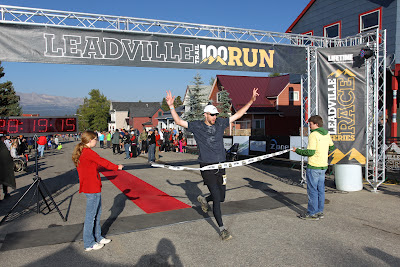
Finish #3!

The final score: 28:19-- a 64 minute improvement over last year's time (on a course that was 3 miles longer).

Pure maltodextrin + Clip2 + Gatorade for the win!

I am still baffled as to why I suffered IT band issues during the race. Why this race? Why now and not during all the races I ran this summer? Did I tighten up during my taper for the 100? I don't know, but I'm confident that it's a solvable problem. What I'm elated about is that after almost three years of trying, I finally solved my nutrition problem and it certainly appears that, yes, it was poor race nutrition that was the primary cause of my slowdown in past races. That was always the theory, but now I've got the evidence. After many failed attempts, I was beginning to doubt that I'd ever figure out how to make my stomach happy. Having at least one positive data point is very, very uplifting. Now, all I have to do is combine an ITBS-free race with solid nutrition and I am certain that I can shave another hour off of my finishing time! That is both inspiring and motivating.

This year's race had more drama than any of my previous LT100 races. I came closer to giving up and quitting than ever before and yet I ran my best race ever. While I still didn't hit my goal time of 27 hours, I persevered and proved to myself that I could run much stronger splits in the second half of the race. That's a huge confidence boost.

I'm sure I'll scribble down more notes in future posts about exactly what did and what did not work for me this year, and where I think I can make further improvements. But for now, I'm limping around my house, multiple ice packs taped to my left leg, basking in the glory of LT100 finish #3.

Thursday, August 2, 2012

Month in Review (July)

7/2010: 145.0 miles (0 babies)
7/2011: 235.5 miles (0 babies)
7/2012: 198.1 miles (1 baby)

Another solid month of training, but with a bit of an early taper...

I had tentatively planned to run my traditional double-crossing of Hope Pass on the last weekend of July, but life had other plans! Instead of 20.5 miles from Twin to Winfield and back, my wife and I must have logged at least a mile of power walking in the hospital lobby trying to speed up her contractions and induce labor! On the morning of 7/29 it finally worked and our new son, Ethan Stirling Reiff, was born!


Future ultra runner: Ethan.

Watching my amazing wife endure labor (without any painkillers!) and give birth to a perfect, healthy little baby certainly put things in perspective on many levels. The 100 seems very small in comparison. And whining about sore legs or an upset stomach during the race? Laughable.

I logged a total of 39,064 feet of elevation gain in July. A little low compared to last year, but almost all of that came during a seven day stretch from the Silver Rush 50 to the following Saturday: 21,000 feet of vertical in seven days. I set PRs on both Mt. Elbert and Mt. Massive-- I was not holding back on the downhills to save my legs.


Near the summit of Mt. Elbert

While my running training has been put on hold for a bit, my sleep deprivation training has just begun! Ethan is a very quiet baby, alternating between nursing, pooping, and sleeping every few hours. We're waiting for him to discover his vocal cords, but for now he is remarkably well behaved... a thoughtful, almost contemplative little guy. The only things that seem to annoy him are having his diaper changed and when his oxygen tubes fall into his mouth. Like most infants in Leadville, he's on oxygen for the first few months. It's annoying for parents to have to deal with the tangle of tubes and tanks, but a good precaution. And, of course, this means I'll have several oxygen tanks at my disposal during the 100... Hmm... I wonder if there are any rules against that? :)

I'm going to try to get in one or two more long runs (16-20 miles) this weekend, but after that everything will be 10 miles or less. Probably just one 10 miler next weekend, I think. I'm enjoying paternity leave and looking forward to the race-- though I'm obviously a bit distracted at the moment. That's probably a good thing. It's easy to starting obsessing about race day details once you start tapering... but I'm going to try to relax and enjoy these few weeks with my family.

Thursday, July 19, 2012

Silver Rush 50 Race Report

Last Sunday I ran the Silver Rush 50 for the third time. It is (and has always been) my final tune-up race before the Leadville 100-- my last chance to try out new gear and new strategies in a race situation before the real deal in August. Some folks worry that it's too close to the 100-- that there isn't enough time to fully recover from it-- but I disagree. I think the five weeks that separate the two is about perfect.

What did the race teach me this year? That running 50 miles is hard.

As sobering a lesson as that is, it's good to be reminded of that fact before the 100. It insures that I toe the starting line with a healthy dose of respect for the distance. I keep waiting to finish a 50 feeling as strong as I do when I finish a marathon, but that has yet to happen. Maybe it's not possible... I mean, yes, of course I expect to feel more fatigued after running almost twice the distance, but when I cross the finish line of a 50 I am utterly spent. It's a whole different order of magnitude.

I woke up at 3:45am on race day to make sure I had enough time to eat (and digest) breakfast before the race began at 6:00am. I've learned that trying to sleep in later just makes for a rushed, anxious morning. I'd much rather loose a little sleep and be able to take my time, arriving at the starting line calm, organized, and well fed.

Immediately I pushed the pace a little bit, trying to take advantage of some flatter/downhill sections in the first few miles. I usually run races very conservatively, but I consciously didn't hold back early on in the race-- unless it was so that I could take a moment to eat or drink. On the way into the Printer Boy aid station (at mile 13) I ran two sub-8:00 min/miles. That is basically my fastest vaguely sustainable speed at altitude if the conditions are perfect. It has taken me three years of racing to become bold enough to go out that fast in an ultra. It takes some self-confidence (or wishful thinking?) to do that, knowing that I'll still be running 8+ hours later.

I arrived at Printer Boy about 2-3 minutes ahead of schedule. It was great to see my crew and hear everyone's cheers. Of course, I was happy to be ahead of schedule, but I was also happy because I had been eating and drinking well. After 2.5 hours of running I had already drunk 50 oz of fluid and eaten 750 calories. If I had skimped on calories, I certainly would've arrived even sooner (since I generally walk while I'm eating), but I swore to myself that I was going to hit my nutrition goals for the day.

I managed to stay on top of my calories and my hydration up until the halfway point. It was pushed back this year by almost a mile. Instead of simply dead-ending, the course now curls around in a little loop which climbs up a steep section of hill on a rocky trail. Ugh. I had been warned about this ahead of time, so it wasn't a surprise, but that didn't make grunting past the old aid station's location any easier. I had slowed down a little bit during this 11 mile section from Printer Boy-- running it at about the same pace I did last year, though I arrived a few minutes later because of the extra mileage. No problem. My high level race plan was to finish the race strong and make almost all of my gains during the last 13 miles. I didn't really expect to reach the halfway mark any faster than I did last year. Of course, there's always the secret hope that miraculously I'll be in better shape than I have been in the past, but my training routine hasn't radically changed from year-to-year-- especially by mid-July-- and my fitness is pretty comparable. The main difference year-to-year is my growing experience, and to a lesser extent: new gear.

My crew (my sister-in-law Jennifer, her husband-- and super human mountain biker-- Jeremy, and my 3 year old daughter Sierra) met me at the aid station and took great care of me. It's so nice to have a dedicated crew at aid stations-- especially when they take care of the cumbersome chore of re-filling your hydration pack!

I asked my crew to bring my old pair of New Balance MT101's to Printer Boy. (The same pair shoes I ran the 100 in last year.) My Hokas were chafing my ankles again-- just like they did in the SJS50. It was annoying, but something I'd have to deal with for another 11 miles until I met my crew again. I thought the chafing was due to the extremely narrow single track that we ran on above treeline during the SJS50. However, it was happening again on the relatively wide jeep roads of the Silver Rush 50. I had even taped my ankles in the morning in anticipation, but I guess I had chosen the wrong spot. As I ran, I began to look for lines that would cause my feet to tilt outwards to reduce the friction. Annoying.

So far the weather was holding up great. The forecast was for a 50% chance of thunderstorms, which around Leadville means a 100% chance of thunderstorms. It's just a matter of when. Glancing up at the sky it looked as though I'd be able to make it around Ball Mountain before the skies opened up. Good. As I climbed up Ball I felt my first twinge of nausea. I'm not sure why. My hydration and nutrition were spot on at that point. But I took a slurp of gel that I could barely choke down. Hmmm... I tried to keep consuming calories at regular intervals, but in hindsight the amounts became smaller and smaller...

A small storm cloud passed overhead on the way back to Printer Boy, dumping some hail on me. It quickly moved on. I felt myself slowing down a bit-- nothing too dramatic, though. I was still running what I should be running and walking what I should be walking, but probably a bit slower than last year. I managed to choke down a few more calories before the aid station and I finished another 50 oz of fluid. Coming into Printer Boy, I was about 15 minutes behind my time from last year, but again the extra mileage accounted for most-- but not all-- of that.

I met my crew and plopped down in a chair they had set up for me. I switched my shoes and sipped some Coke. I had them fill up another bottle with 12 oz of Coke and ice to carry with me for the next leg. The next 6 mile stretch up and down Iowa Gulch is always the toughest one for me. It seems so easy during training, but in the heat of the afternoon, after 33 miles and ~6,000 ft of elevation gain, it's brutal. I had never made it to the next aid station without throwing up. And this is the stretch where I planned to set a PR! All I had to do was not completely blow up like I had in the past.

Now, since I started wearing Hoka Mafate 2's in April when I was battling through a case of ITBS, I've been pretty darn happy with them. Even ecstatic at times. I've set my biggest PRs this year while wearing them! That's a pretty strong endorsement. However, since they started chafing my ankles during the SJS50 I had cooled a little bit on them. And now with the chafing reoccurring during the first 33 miles of the Silver Rush I was starting to get a little pissed. I think even the biggest Hoka advocates need to do what I did on Sunday at least once: run in them for 7 hours, then take them off and replace them with shoes that weight 6 oz less per shoe! Holy crap! When I stepped out of my chair to begin up Iowa Gulch I was shocked at how light my newly shod feet felt. Shocked. It was like my shoes had disappeared. My feet felt so much lighter. 12 oz lighter, in fact. That's 3/4 of a pound that I was carrying on my feet: gone. Now, on the flip side, the first time you wear a pair of Hokas it's shocking as well. They feel so different than normal shoes. So comfortable and amazingly cushioned. But, believe me, that comes with a price. When I examined my Hokas more closely after the race I noticed they had developed a huge (1/2") depression in the foam right underneath my arches, on the inside edge of the shoe towards the back. Somehow the foam in that a particular spot had become severely compacted. I mean the whole sole looked distorted. This must've been causing my feet tilt inwards and rubbing the outside of my ankle against the lip of the shoe. That spot on each of my feet had been turned into hamburger. I've never heard of this happening before... why would such a severe compaction occur in this one area of the sole? It probably has something to do with my stride and the size of my feet. I don't know... but it has me suddenly very doubtful that I'll be using Hokas during the 100.

Anyway, back to the race. My condition was slowly deteriorating, but it was better than it had been in past years. I actually managed to slowly jog a few of the flatter sections of the road up Iowa Gulch. And I managed a few 9:00 min/miles on the way down. I fought a bit of side stitch on the downhill and had to drop to a walk for a bit and catch up on fluids. When I finally pulled into the next aid station, I wasn't feeling great, but I also had managed to survive the leg without puking my guts out by the side of the trail. How's that for victory? Trail running is so glamorous.

At the final aid station I sat down again and sipped some more Coke and ate a few bits of potato. I also grabbed another 12 oz bottle of ice-cold Coke for the next leg. Coke and potatoes: that was my nutrition plan for the final 13 miles! At each of the last three aid stations I had asked if they had soup. I desperately wanted some soup to eat. No luck. It's readily available at the SJS50 and the 100, but not during the Silver Rush. I should've prepared some in advance for my crew to bring. Next year.

At this point I was pretty sure a PR was in my grasp, but not by much. I had 7 more miles to go. I ate about 200 calories at the final aid station, told my crew I'd see them at the finish line, and took off. I ran pretty strong for about two miles or so-- even running some of the gentle uphills. I wasn't feeling great, but I was hanging in there. The thunder and rain arrived giving yet another reason to finish the race as quickly as possible. Unfortunately I started slowing down with about 4.5 miles left to go. Soon my 10:00 min/miles turned into 11:00 min/miles and then into 13:00 min/miles. Ugh. I probably should've sat at the aid station until I was able to force down 400 calories. The initial surge of energy kept me going for about 30 minutes or so, but then it was survival mode. The pack of runners I was running with all started to gap me. Soon runners were coming up from behind and passing me. I must've been passed by 20 runners during the final 5 miles. I just had no energy to keep up with them. I always underestimate these final miles, expecting the finish line to appear sooner than it does. I let my guard down because I think the finish line is so close, when it's really 45 minutes away. I only ate approximately 200 calories during this stretch-- all of it fluids-- and I ended up being about 16 oz of water short for the final 13 miles. (In other words, I finished the race with about 16 oz of water in my hydration pack when it should've been empty.)

Not content to just push the halfway point farther away, the race organizers had also altered the last 0.25 miles of the race. We stayed up high on Dutch Henri Hill, ran past the starting line (above it) and then looped down the sledding hill (?!) into the finish chute. This was exciting for the spectators because you could see your runner cross above you and hear their name announced before they dropped down to finish, but after 47.6 miles I just wanted to be done. I managed to sprint to the last 50 yards to the finish (to avoid being passed yet again) and collapsed with a time of 10:54.

I finally broke the 11 hour barrier. An 11 minute PR on a course that was 1 mile longer. So, not quite the epic PR I was dreaming of, but still a respectable improvement. I then proceeded to dry heave for about 5 minutes.

This year's Silver Rush seemed more shades of grey rather than black and white. In past years I'd made what now seem like obvious mistakes. This year seems a little murkier. Why did I fade so badly in the final miles? Would another 200 calories have made a difference? 16 oz of fluid? More of each? Should I be sitting at aid stations longer rather than trying to consume all my calories on the move? Am I still feeling some lingering effects from the SJS50 three weeks ago? I honestly don't know.

I guess it's time to let this latest experience sink in. I've got four long runs left before I start tapering for the 100. They should provide plenty of time to contemplate what I could've done differently.

If it's possible to be simultaneously feeling excited, confident, and humble, I guess that's what I'm feeling.

Monday, July 2, 2012

Month in Review (June)

6/2010: 215.4
6/2011: 210.2
6/2012: 221.7

I managed to run more miles this June than any previous June. Another PR, but one with as much to do with the calendar as with any special extra effort on my part (5 vs. 4 weekends for long runs).

Weekly mileage totals for June were:

76.5
50.2
43.7
65.8
36.6

My weekly mileage fluctuated a bit, but that was mostly due to all the races I ran: a 50K, a half, a 50 miler, and a marathon. I'd tried to keep my 3-week average hovering around 50 and took things a little easy leading up to a race and in the days following a race (which were generally also the days leading up to a race!).

Total elevation for the month: 45,458 ft. That's just a couple of hundred feet shy of my monthly record (set in July of last year).

All in all, a very solid month of training. Probably in the top 3 of all time, I think.

I'm actually looking forward to only having one race to plan for in July: Leadville's Silver Rush 50. This year will be the third time I've run it. I have to be honest and say that I really want to set a PR for it. I feel like I've got a ~10 hour run in me on that course and a positive 50-mile experience would be a great confidence boost heading into the 100 in August. Towards that end I may take it a little easier on my runs this week and next-- not in terms of mileage necessarily, but in terms of elevation gain. I really focused on my power hike leading up to the SJS50, but now I think it's time to return to long, steady miles. Of course, you can't really run 20 miles around Leadville without getting 4,000 ft of elevation gain, but I'll try to minimize what I can. My calves need a bit of a rest, I think.

Even though I'm focused on setting a PR on what should be just a training run for the 100, I truly believe that if I just concentrate on proper hydration/nutrition during the race everything else will take care of itself. I've never been able to run the Silver Rush without a serious blow up in the final miles. If I can survive Iowa Gulch in the heat of the afternoon, I'll easily set a substantial PR. (Unsurprisingly, I feel that this same, simple strategy will get me to the finish line faster in the 100-- my true focus race.)

After a few recovery runs last week, I decided I was in good enough shape to run the Leadville marathon on Saturday. This year, the marathon always had a question mark next to it since it was only one week after the SJS50. (Last year there were two weeks between the two races.) I think because I was moving so slowly at Lake City, my legs didn't get quite as battered as I expected. I was also frustrated with my performance-- specifically the fact that it seemed almost all due to stomach mismanagement on my part. I needed some redemption. So, on Friday afternoon I walked up to the Lifetime office and signed up.

And... the race was awesome! I'm so glad I ran it. It's just a great hometown event-- I saw folks I knew at almost every aid station (all locals). Everyone was friendly and chatty and full of energy. It was a really uplifting experience and reminded me why I enjoy racing so much.

I felt surprisingly good throughout the race. Most importantly my nutrition was totally solid. I don't think I've ever felt that consistently good during a 6 hour race before. After breaking down my SJS50 performance, I felt like the most likely explanation was simple dehydration. Get behind on fluids and everything becomes harder. So, my mission during the marathon had nothing to do with time: it was to eat a solid breakfast, pre-hydrate, drink 120+ oz of fluid during the race, and eat 1,800+ calories. (That's ~20 oz/hour of water and ~300 calories/hour of food.)

Success!

Early in the week I had replaced the nozzle on my hydration pack with a more easy-flowing one. It made a big difference. I was gulping down Clip2 throughout the race. That seemed to keep my stomach at a happy baseline and then it was just a matter of pausing every 30-40 minutes or so and slurping down a gel, or eating a Honey Stinger waffle, or even a PB&J sandwich. I was packing away the calories. I was in a minute or two of my PR splits for the first 16 or so miles of the race, but then I had the most ridiculous aid station resupply experience of my racing career at the bottom of Mosquito at the Resurrection aid station. It was comical. I was fighting to re-fill my hydration bladder and spilling water, with the other hand I was trying to dig the packets of Clip2 out of my pack, I forgot to add Nuun (extra electrolytes) to mixture, when I finally got it full and sealed, my tube was clogged with Clip2, as I shook the pack in frustration gels flew everywhere, etc. I was smirking and shaking my head in disbelief as I finally ran off. I must have lost 5 minutes and looked like a complete idiot.

During the grind up to the Venir aid station, I could feel my calves complaining. They were done. No more uphill legs for me. My downhill legs (i.e., my quads) felt great the entire race, but I had nothing left in my calves. It was honestly a strange feeling to be totally on top of nutrition so late in a race and to be completely limited by leg strength. I don't think that's ever happened to me before. In the past, my stomach has always been the major factor in any significant late race slowdown. But this time I just had nothing left for the final uphills. I bombed the last downhill section into town and finished in 5:53. The second fastest time I've ever run this race and just 5 minutes slower than my PR last year. I ran the 63rd fastest final split (which is all downhill) even though I finished in 195th place.

I was psyched. I ran great on Saturday and I really couldn't have asked for a better race. It was so refreshing and confidence-restoring to run a race where my nutrition wasn't an issue. Man, it's all about staying on top of hydration! Everything flows from that. I saw three other racers who I recognized from the SJS50 the week before. I gave each a hearty hello and chatted with all of them. What makes folks run a 50 miler one weekend and then a marathon the next? All of us were training for a bigger race later in the season (Leadville, Wasatch, and UTMB).

For the record here's what I ate:

  • A solid pre-race breakfast of coffee, a fruit smoothie (OJ, yogurt, a little protein powder, Udo's Oil, a banana, frozen strawberries, blueberries, raspberries, and mango), and a boiled potato (with some olive oil, Parmesan, and salt). Drank about 16 oz of water before the start.
  • 1 gel at the starting line (100)
  • 4 oz of gel during the race (360)
  • 2 Honey Stinger waffles (320)
  • 2 PB&J quarters (200)
  • 6 oz of Coke (70)
  • 6 packets of Clip2 (900)
  • 150 oz of water
  • 2 S!-Caps and 1 Nuun tablet
Total: 1950 calories

It was so great to be out there on the course, enjoying the race, and grinding out the miles on tired legs, a smile on my face.

On a final note, I should add that July will bring much more than just another 50-mile race. Our second child, a little boy, is due on July 25th! Now that's something to truly celebrate! July is going to be awesome. And I hope to make the little guy proud when I toe the line at the 100 come August.