Saturday, June 15, 2013

The New, New Route to Winfield?

Recently I decided to shift my training focus more towards vertical rather than distance. The general idea is to keep my mileage around 55 miles per week for the rest of the season, but steadily increase the amount of climbing I do. This week I started with my baseline recovery run of 6 miles and 680 ft of vertical on Monday. Then each subsequent day I raised the vertical. 1,000 ft on Tuesday (Elk Run), 1,400 ft on Wednesday (Highline-Rock Creek Loop), 1,550 ft on Thursday (Mayqueen to Sugarloaf), 2,000 ft on Friday (Mosquito Pass), and then ~7,000 ft on Saturday (a double crossing of Hope Pass). Raising my vertical each day was a fun micro-goal and kept me motivated. I felt great throughout the week, setting multiple PRs. I managed to shave 4 minutes off of a very stout PR for the Highline-Rock Creek Loop, which I was especially happy about. I set that PR about 4 weeks before the 100 in 2011, so I was in pretty good shape at the time. When I look at my splits, I'm noticing that I'm running both the uphills and the downhills faster than I have in the past. Maybe about ~30-60 seconds/mile faster. Somehow I've managed to increase my speed this year, though I'm not quite sure how. More consistent midweek running? More weekend long runs? Lower body weight? I don't know for sure, but I'm certainly enjoying it!

Hope Pass was gorgeous today. The entire 100 course is officially open for business, with no snow to worry about-- just a few patches on the north side of Hope Pass, right near the top. Honestly, Mosquito Pass had far more snow on it than Hope. The only tricky part of the course right now is the Lake Creek river crossing. I avoided it and started at the bridge west of Twin lakes. The water is really flowing strongly now, and I didn't want to fight my way across-- especially when running solo and without poles. I only ran into one other runner (Joe from Ouray) until I was nearing the top of Hope Pass for the second time. Then the runners starting coming fast and furious. With about three switchbacks to go, a group ~10 runners (!) passed me headed down the south side of the pass. Then I regularly ran into clusters of 1-4 runners on my way down the north side. It was a beautiful, beautiful day and everyone looked to be enjoying themselves.

The old route(s) to Winfield, for comparison.

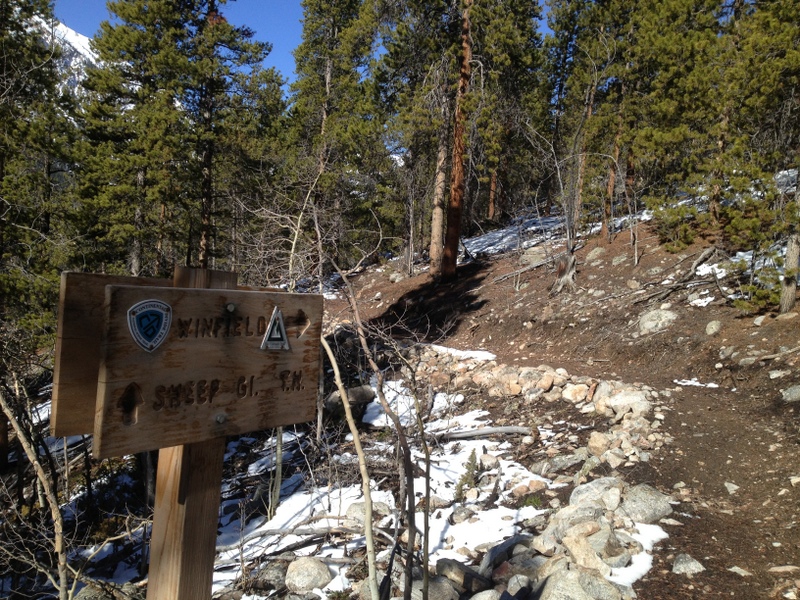
On my way to Winfield, I kept my eyes peeled for an old jeep road I had seen on one of my earlier runs this spring. It looked like it might descend directly into town rather than looping around like the course did last year. Leadville race officials announced that we'd be taking a more direct route down to Winfield this year, so I wanted to investigate a bit. I'm 99% sure this will be the route we'll take. (I mean, there are no other options that I can think of-- short of building a new trail, which seems highly unlikely.) The old road is actually in pretty good condition, passing a collapsed entrance to a small abandoned mine, and dumping you out on the road just before the town. There's still a bit of a climb on the new single track trail from last year before you divert down on the jeep road, but it will almost certainly save us ~10-15 minutes each way. I piled up some stones to form a cairn right at the intersection. The new route is easy to follow once you're on it, especially heading downhill to Winfield. Just be careful as you're heading back up it as it forks at one point. You want to keep to the left, on the higher road back to the single track. (For the curious, if you look carefully, I believe you can see the faint outline of the road on Google Earth.)

The new route to Winfield?
An overview of the entire route I took this Saturday. 19 miles.
The alternate start to avoid the Lake Creek river crossing.
The snow field at the top of Hope Pass.
It's not as bad as it looks, really.
One of the best views in Colorado.
The old jeep road descends to the left. Note the cairn.
A view of the jeep road, looking back north.
Another view of the jeep road, looking back north.
Here's where it pops out on Clear Creek Road. Note the small cairns.
Two small cairns mark the intersection with the road. Without them, it would be very easy to miss.
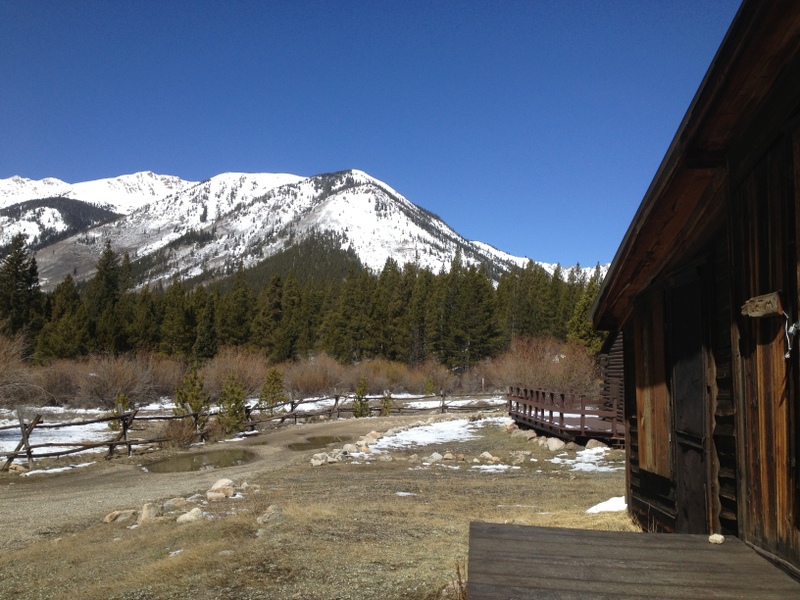
Winfield. Slightly less snowy than the last time I visited.
On top of Hope Pass again, looking north.

A few notes about my double crossing. I never managed to run Hope Pass in training last year-- my son, Ethan, had other plans. So, discounting race days, the last time I ran it in training was in early July, 2011. I ran it with fellow locals, Mike and Marvin-- who were both training for Leadman at the time. Having some company on a run (which is rare for me) pushed me a bit and I remember it being a solid workout. This year, as a challenge to myself, I actually ran every step of the way from my car to the snow field at the top of the pass. No hiking. I was certainly moving slowly, but maintaining a running cadence. While I was happy that I had the willpower and endurance to accomplish that feat, I only made it to the top a minute or two faster than when I aggressively power hiked it in 2011. (And I certainly have no illusions of being able to run up the north side of Hope during the 100!) An interesting data point.

I ran down the south side approximately three minutes slower than in 2011, which didn't surprise me at all because I have a very clear memory of recklessly bombing down the trail in 2011. I mean, I was flying, leaping off rocks (KJ style). This Saturday, I was much more conservative. I don't think technical downhill skill plays much of a role in the 100, in fact I think it can lure you into prematurely destroying your quads or even injuring yourself with a nasty fall. (And a three minute difference is definitely not worth it.) The biggest difference between 2011 and this year was how fast I ascended the south side: a full 5 min/mile faster than in 2011. I was really pushing it, panting like mad man, and swearing regularly. I feel like things become slightly more sane once you reach tree line, but-- damn-- the first part of the ascent is brutal. I found myself asking, "Do I really want to do this for 40+ hours at Hardrock?" (Assuming I ever get in.) 1,000+ ft of climbing in a mile is utterly exhausting. However, I am proud to say that I managed to make it to the top (from the junction with the new trail) in less than an hour. I even ran the last handful of switchbacks. That was a first.

While a bit mundane (but, hey, this is a training blog), I'd like to note that I really focused on staying hydrated during the entire run. After my debacle at Sage Burner, I've been paying extra attention to proper hydration during my long runs. I consumed ~150 oz of water (about seven and a half bottles worth or ~24 oz/hour ), stopping to purify water and refill at streams four separate times. I'm finding that I enjoy carrying two handheld bottles vs. a hydration pack. Yes, ideally I'd rather have my hands free-- you can't use poles or push off on your knees easily while carrying two handhelds-- but I find drinking to be much, much easier, and I think that may trump any other consideration. You can more easily tell how much you've drunk, you can dump water on your head to cool off, and you can quickly scoop up water from streams.

Fueling was pretty straight forward: maple almond butter x4, fig newtons x2, chews x2, gels x2.
 
All-in-all, a great workout in a fantastic setting. Hope Pass is always inspiring.

Wednesday, June 5, 2013

Month in Review (May)

5/2010: 238.4 miles
5/2011: 192.2 miles
5/2012: 216.5 miles
5/2013: 223.6 miles

Dare I say that summer has finally arrived in Lake County? The high this weekend is forecast to be 70F. The leaves are budding on the aspens, the snow is melting, and the increased traffic on Harrison has started to make left hand turns prohibitively frustrating. It's hard to believe that just last Wednesday I was caught in a snow storm at the top of Elk Run. I seriously considered transferring my running socks from my feet to my hands to use as makeshift mittens. Ah, Leadville. Mountain livin' at its finest.

Descending into Twin Lakes; Hope Pass in the distance.

May was a great month of training. I can't really think of much I'd do differently given the chance (except the obvious adjustments I should have made for Sage Burner). While May's mileage was right where I wanted it to be, the wintery spring weather kept me from getting as much vertical as I have in the past. Last year I had run Quad Rock and climbed a few 14ers/13ers by this point. Now that some of the higher elevation trails are starting to melt out, I hope to focus a bit more on elevation gain in June and July.

Yellow=bike, green=long, bold=race

I have a running/biking streak going that extends all the way back to early April, when I returned from my trip to the Grand Canyon. I'm kind of surprised about that. It was one of my goals this year to run more frequent, shorter runs, so I'm obviously succeeding at that. But I certainly didn't plan on running every single day. It just kind of happened. I guess that I've found that the streak helps motivate me to get out the door. The decision isn't whether or not to run, but which route to run and at what intensity. I still ask myself, "What is the purpose of this run? Why am I running today?" and two or three times a week the answer is usually "To recover", or "To keep my legs loose". My long runs are always at a conversational pace (though there's rarely any one to talk to besides myself). I probably only really push myself on one or two runs per week, usually on a hilly route, and sometimes only in one direction. All things considered, my weekly mileage isn't especially high so I'm not too worried.

My biggest fear, of course, is coming down with another case of ITBS. My best explanation for why I came down with it during the 100 last year is that I must have tightened up during my 3 week taper, when I started spacing out my runs more and drastically dropping my mileage. So I'm hoping all these extra 3-5 mile runs are helping to keep me loose. (Well, looser anyway.)

So, I've got about 8 weeks of training left before my taper begins. I think I've got the "50 mile week" thing pretty much figured out. Given my schedule, however, it's tricky for me to do much more. I'm not even sure what I would do if I had the time. A second long run, I guess? That's pretty much impossible unless I take a day off from work (which is not out of the question, but certainly not an every week occurrence). I could start tacking on 5 miles to my long runs, bringing them up to 25 or so. Alternatively, I could also increase the vertical. That will probably just happen naturally as the peaks start melting out. Maybe I could sneak in a 10 miler on Friday with a little bit more intensity thrown in? Or maybe a quick mid-week 14er? Or a mid-week speed work session? I feel like I've got to make a few adjustments or I might plateau around the end of June. Of course, there was a fair amount of weekly see-sawing in my mileage totals last year in June and July. So, even just sticking to my current, relatively consistent training schedule will probably be an improvement.

I'm sad that I won't be running the San Juan Solstice 50 this year. It's only a few weeks away. It's such a fun, grueling race, but I really felt like I should cut back a little bit on my racing this year. Damn, it'll be hard to replace that 13,000 ft of vertical! But... I'm planning on running some epic local routes in the months ahead, which will certainly give me something to look forward to. Also, skipping the race gives me the opportunity to run the Leadville Marathon on fresh legs for the first time since '10. It'll be fun to see if I can pull off another PR there...

Overall, I'm very, very happy with where my fitness is right now. I'm just looking for the best way to kick it up a notch as I enter my peak training period.

On the Colorado Trail this weekend.

Tuesday, June 4, 2013

Turquoise Lake Half Marathon Report

I definitely look forward to running the local half marathon each year. For at least the past two years, it's fallen on the Saturday after the Sage Burner 50K, making for a double race week with only four days to recover between the two. I have a hard time motivating for tempo runs, so the Turquoise Lake Half provides a great excuse to get out and run at a faster pace than normal. As someone who has yet to fully embrace speed work, I'm pretty sure I would benefit from running even more half marathons during my training. (Probably more than running yet another hilly marathon or 50 miler.)

With my disappointing 50K effort, I was really hoping for some redemption in the half. Not that the two races are much alike, but I felt I needed to run a solid race-- of any distance-- without any issues to restore some of my confidence.

  • Tuesday was a slow recovery run of 6 miles on Wheeler's Way, Gold Digger, Cold Feet, and Old Chub. As I mentioned in my previous post, I actually still felt that side stitch during this run. Crazy.
  • Wednesday was a 7 mile hill effort up Elk Run. 1,000 ft of vertical. I took the downhill super easy.
  • Thursday was an easy 5 mile effort on (Lower) Boulders. The beavers have been busy! The river crossing is now above my knees. Refreshing!
  • Friday was an easy, flat 3 mile loop on Giddy Up.

I love the fact that all the rest of my races this summer start at my door step! The half started late enough on Saturday morning (9am) that I didn't even have to set an alarm. I just rolled out of bed, fixed some coffee, drank my traditional smoothie, and gathered my gear. Nutrition plan: simple. Carry a 20 oz bottle full of maltodextrin mix. I deviated a bit from my normal recipe and omitted the protein given the short duration of the race, plus I added the contents of an Endurolyte capsule out of paranoia. I went a little lighter on the protein and fat in my breakfast, too. I didn't want to overdo anything. I figured the bottle would last me until around the first aid station and then I would just drink Gatorade the rest of the way.

When I reached the lake, I picked up my bib and t-shirt, and ran an easy warm up mile alongside the lake to loosen up the legs (and lungs). Lots of my local friends were present-- either running or just spectating. It was great to chat and soak up the relaxed atmosphere. Around 9am, we all gathered at the start for a quick briefing. The most interesting news: the race would now be a true half with an added 0.7 mile section on a nature trail to bring the total to 13.1. Awesome, but I'm somewhat embarrassed to admit that my initial reaction was that it would complicate my PR efforts. I guess I'm a little hung up on tracking my historical progress-- not that I've ever run the exact same 100 mile course twice! (Nor will I this year: they keep changing the damn thing.)

After a blast from the shotgun, we were off. The Turquoise Lake Half breaks down into roughly three sections: 6.5 miles of road (with most of the climbing), 4 miles of moderately technical single track with some rollers, and finishes with 2.5 miles of smooth, flat single track. The entire course has 1,250 ft of climbing, so it's pretty flat by Colorado standards. Those 4 miles of technical single track can be surprising slow, however. Anyone who has stumbled through them in the dark during the 100 knows what I'm talking about.

Anyway, I didn't really have a specific pacing plan in mind-- for example, a goal for a particular section or anything like that. I had looked at my mile splits from the previous year and I definitely saw room for improvement. I felt a PR was very doable, but after Sage Burner I was trying not to take anything for granted. So, I settled on the amazingly complicated plan of "just run everything faster, you're in better shape". Yup, genius.

The time to beat was 1:56. My modest goal was to try to average <9:00 minute miles over the entire course. I knew the road would be the fastest section, so I wanted to put in a solid effort early on. I managed to run two 8:45 min/miles while gaining 150 ft/mile. At 10,000 ft, that's not too shabby, at least for me. On the heart rate graph, you can definitely tell where those hills were. They represented my hardest effort. On the downhills I hoped to be somewhere in the mid 7:00's. I clocked two 7:40 min/miles on the way down to Mayqueen. Again, a relatively modest pace-- certainly not as strong as my uphill pace-- but solid for me.

The group of runners I happened to be running with all stayed pretty close to each other during the entire race. I passed a few folks on the uphill, and cruising into Mayqueen into the first aid station, but one or two runners also jumped ahead of me on the downhill and on the more technical sections that followed. However, I wasn't too worried. They never got out of sight and I was fairly confident that unless they were also training for a 100 mile race (which, in the end, I'm actually pretty sure some of them were!), my advantage increased the deeper into the race we got.

I'd guess that after mile 8 or so, I started reeling folks in who were ever-so-slightly fading. It was all very good natured and we'd always congratulate each other and say a few words of motivation. But I was certainly happy to see that I was maintaining a strong pace. And, honestly, my pace felt solid, but totally sustainable. I was certainly not in the hurt locker or anything like that. I am a wimp when it comes to speed work and really pushing myself aerobically while moving quickly. For whatever reason, I prefer to push going uphill where leg speed has less to do with it. But even then I try not to push so hard that it takes too long to recover once I reach the top. I think one of the most surprising differences for a flat lander coming up to altitude is how long it takes to recover from an uphill effort.

Anyway, I hadn't really been checking my watch during the race, but it was pretty obvious given how good I was feeling that I was going to go well under my PR. I was definitely excited and thoroughly enjoying the race. I grabbed some more Gatorade at the Tabor Boat Ramp and kept chasing the runner in front of me. The new section of trail turned out to be really nice-- a very soft and runnable trail through the pines and around two small ponds. The trail looped tightly so you got a glimpse of the runners a minute ahead and a minute behind you.

I passed one runner, joking that if it was last year we'd be done already, and then set my sights on the next. I had been running within sight of him for the entire race. As I approached the finish, I waved to my wife and kids who were playing in the sand on the beach. It's always great to see them at the finish line. Finally, I made my passing move on the wooden stairs leading up to the parking lot and sprinted to the finish. (I seem to pass someone every year right at this point. It's kind of stressful-- I generally try to avoid finish line drama if I can help it.)

1:50. A 6 minute PR on a course that was a half a mile longer!

Insert obligatory spreadsheet image here.

The atmosphere at the finish line was just as fun and relaxed as the starting line. It was great. I felt energized. I had no problem chowing down on the post race food immediately after I'd finished-- always a good sign that I've stayed on top of my hydration and nutrition during the race itself.

My race went about as well as I could have hoped. I recovered quickly from my 50K on Monday and managed to run a solid, well-paced half marathon on Saturday.

How do I feel? I believe Mr. LL Cool J said it best: Mamma Said Knock You Out.

Monday, June 3, 2013

Sage Burner 50K Race Report

I guess one advantage of waiting a week before writing up a post about my experience at this year's Sage Burner 50K is that I've calmed down a bit and perhaps I've gained a little perspective.

It did not go well. I suffered through one of my more spectacular blow-ups in a race.

I think the lesson here is this: When you live near here:

Cottonwood Pass on the drive down to Gunnison. Notice anything?

be extra careful racing here:

The course at Hartman Rocks. Notice the lack of anything?

Okay, okay. That's a slight exaggeration. I don't actually live on top of Cottonwood Pass, but you get my point. It was hot. Much hotter than this poor Leadville resident was prepared for. I mean, if I wasn't a complete idiot I certainly could've survived the race in much better condition than I did, so the outcome was far from pre-determined, but I made some stupid mistakes and basically walked it in from mile 20.

I was feeling very confident coming into the race, just off a big PR at Collegiate Peaks. In fact, I may have felt a little too confident. I thought a new PR at Sage Burner was all but guaranteed.  (I mean, I majored in Philosophy and Classics as an undergraduate. You would think I'd know a thing or two about hubris.) I didn't read my race report from last year carefully enough. I spoke about how dehydrated I felt after the race (surprise!) and how I really needed to consume more fluids-- especially when I wasn't heat acclimated. I guess that fact was overshadowed by the euphoria of setting a 34 minute PR last year. Ah, the irony.

I've run the Sage Burner 50K four times. You'd think I'd learn, right? Here are my times over the years, with the temperature on race day in parentheses.

2013: 6:21 (71F)
2012: 6:20 (64F)
2011: 7:05 (73F)
2010: 6:54 (71F)

So, this year wasn't especially hot. The historical average for Gunnison, CO on 5/27 is 67F. So, it was a little hotter than average, but certainly not anything noteworthy. However, as usual, this race is the first time I run in ~70F weather each year. That presents a bit of a challenge. For comparison, the high in Buena Vista for Collegiate Peaks was ~50F. And that race starts earlier and (since the 25 is shorter) finishes earlier.

Here are my splits.


Do you, perhaps, notice a trend in my average pace after say... mile 20? Yeah... that's me suffering from dehydration.

Up until mile 16.5, everything was going great. Of course, I had already sown the seeds of my own destruction by that point, but I was feeling good and I was right where I expected to be. I was already 25 minutes (!!!) up on my splits from last year (though the course alternates direction each year, so they aren't quite comparable). I wouldn't say that I went out too aggressive, just that I didn't go out conservative (if that makes any sense).

First problem: I was only carrying one 20 oz hand held water bottle. Stupid, stupid, stupid. I should've carried two.

Second problem: I was more concerned with my calorie intake than water intake. Wrong priority.

Third problem: My calorie source (maltodextrin powder) displaces my water! My 20 oz water bottle probably only had 17 oz of actual water in it given the huge amount of powder I dump into it to get 300+ calories per bottle.

I knew things were taking a turn for the worse around mile 20, but I adjusted incorrectly. I was a little behind on calories at that point and in my myopia I assumed that that was my problem. So, what did I do? I put 150% of my normal powder into my water bottle, displacing even more liquid! I wanted to carry more water as well, but I had no means to do so. I tried to compensate by stopping at the aid stations and drinking coke, but it was far too little, too late. Around mile 28 or so I started feeling dizzy and even started walking some of the downhills. It was that bad.

But wait! It gets worse!

I was at mile 30.3, at the top of a hill with the finish line in sight below. My watch read something like 6:12. I had ~8 minutes to run about a half a mile downhill to set a PR. And I couldn't do it! As I started staggering downhill, I immediately got a massive side stitch on my right side. No amount of massage, deep breathing, or swearing could break it. I remember thinking to myself, "Damn it, this is just perfect. I executed this race so poorly, I don't deserve a PR."

Perhaps a little melodramatic, but that's what I was thinking. I was very frustrated with myself. Not because of my time per se, but because of how poorly I had executed my race. I had the fitness to run a ~5:40 race-- I'm sure of it.  But I made far too many mistakes-- and mistakes that I had already made in the past and should have been smart enough to address. I am more proud of my ridiculously slow time of 7:05 in 2011-- where I ran the race suffering from a terrible head cold.

In fact, in 2011, I ran faster from mile 20 on than I did this year! That is really eye-opening.

Proof that dehydration is worse than a head cold.

When I finally arrived back home in Leadville, I hopped on the scale. I weighed in at 166, down from 172. And that's after drinking a coke, some chocolate milk, and a fruit smoothie on the two hour drive back home. Not good. Not good at all. I finally peed sometime after dinner, about 5 hours after the race had ended.

If I was forced to try to take something positive away from the race is would be this: it was the most focused experiment in dehydration that I've ever run. In the past, when I've finished a race poorly-- especially a race in which I thought heat was a factor-- I've debated whether or not it was a lack of calories or a lack of water that did me in. (Most often, I think it was a combination of both.) But I feel like things were more clear cut during this race. Sage Burner 2013 was a shining example of what dehydration does to performance. I consumed 1,800 calories during the race. Calories were definitely not the issue. Fitness was also definitely not the issue. I was more than prepared to run the distance. I was well rested. I had no injuries. There is nothing to blame except heat and dehydration (and stupidity, of course).

Interestingly, I've experienced that exact side stitch in two other races before (both during the Silver Rush 50 around mile 36, at the top of Iowa Gulch), where I was slightly mystified as to its cause. It always seems to happen late in a hot race, when I'm transitioning from struggling uphill (slowly hiking) to trying to run downhill. Now, I can be fairly confident that it was due to a lack of water. To my surprise, the side stitch actually re-surfaced during my next two recovery runs in Leadville (both of which were very easy efforts of ~6 miles). I guess my diaphragm was still recovering? Pretty amazing.

So, how much water should I be drinking? Not a ton. I think maybe 24 to 28 oz an hour, max. The problem was that I was only getting ~17 oz an hour during the 50K. Drink to thirst. Believe me, I wanted to drink to thirst, but I simply couldn't due to a lack of capacity.

From here on out, I plan to train carrying two full water bottles-- even on my short, midweek runs. I think that will be my most common hydration setup for my next few races, so I might as well practice.

Self flagellation aside for a moment, I did have a fun time travelling to and racing in Gunnison. Sage Burner is a small, but fun race. It's a tradition of mine and it's always been a good challenge. I just wish I could've run it better.

Ah, well... Live and learn. (Come on, Andy... learn!)

Monday, May 20, 2013

Current Leadville Conditions

Just a quick update on the current conditions around Leadville for those curious about such things.

Spring has been slow-coming this year and I've had to be fairly creative trying to find routes for my long runs. I've been forced to stay on dirt roads, south-facing slopes, or exposed, sage brush-lined trails.

On Saturday I parked at the South Elbert Trailhead and was able to run the Colorado Trail all the way up to Lily Ponds-- and a little bit past it-- before the drifts got too frequent. That was a pleasant surprise. I wasn't sure if I'd have to run the 4WD road up or not. From there, it was all clear heading south on the Colorado Trail around Twin Lakes all the way to Interlaken. I've heard it's clear at least all the way to the intersection with the trail over Hope Pass. By next weekend I'm fairly confident you could run all the way around Twin Lakes without encountering significant snow.

The week prior, I ran from the Colorado Trail intersection all the way up Clear Creek Road to Winfield, taking the new section of the CDT for the final few miles. All runnable-- except for a few huge drifts in the trees just before Winfield. I'm sure it's melted out even more since then.

Closer to Leadville, the single track around town is still pretty muddy/messy and there are frequent drifts to post-hole through. I've heard Turquoise Lake is still pretty well snowed in, though I haven't tried running there yet. I've heard folks are running up Halfmoon Road, which is clear. I haven't bothered trying the trails above the Fish Hatchery yet or up the Powerlines. It's all still pretty snowy. The Mineral Belt has been plowed, so if you want some fast on-pavement running, there's that for a 12.5 mile option.

I've got the Sage Burner 50K this weekend, which I'm very excited about. The weather looks to be in the 70s and sunny in Gunnison. Sweet! Hopefully by the following weekend there will be more options to explore around town... I'd guess that trails are about 6-8 weeks "behind schedule" when compared to last year.

I have a feeling that Lifetime will probably be looking for volunteers to help shovel out sections of the Marathon and Silver Rush courses this year! The snow will stick around for a long time near 12,000 ft-- especially in the willows near Ball Mtn and the top of Iowa Gulch.

21 miles from the South Elbert Trailhead. All clear.


21 miles to Winfield and back. Should be all clear by now.


Clear Creek Road on 5/11


Climbing up the south side of Hope Pass.

The intersection with the new CDT section to Winfield.


Most of the trail is probably all melted by now.

The biggest drifts were within the last 0.3 miles before Winfield.

The jeep road down into Winfield.

Ah, Winfield. My first time back since the 100.


Back on Clear Creek Road with Hope Pass in the distance.

Big horn sheep!


Thursday, May 9, 2013

Collegiate Peaks Race Report

The Story

The days leading up the CPTR 25 were a bit hectic, but such is life with two working parents and two little kids. I managed to squeeze in a short, 3-mile jog on Thursday morning. We then packed up the kids and drove down to Denver to buy a new car to replace our old Honda (which was struck outside our house while we were on vacation at the Grand Canyon). Christina continued on to Ft. Collins for a conference she had on Friday, while I loaded up the kids into the new car and turned around and drove back to Leadville. Friday morning I drove Sierra down to Frisco for her dance class (usually Mom's duty) and then hurried back to Leadville to at least get in a few hours of work while our nanny was still around. During my lunch break, I snuck out for a final 2-mile jog and packed up my racing gear for the next morning. I took over child care at 4pm. Christina returned from her conference at 8pm. I was in bed by 9pm.

A textbook taper, really.

My alarm went off at 4am and I went about my pre-race routine. A big cup of coffee (with plenty of half-and-half) and a fruit smoothie (soy milk, 1+ cup of rice, yogurt, banana, maple syrup, oj, whatever frozen berries are on hand, etc.). Five bags of maltodextrin stuffed in my running vest, sunblock applied, nipples taped, toenails clipped. The usual.

My friend, Lisa, swung by to pick me up around 5am. (Sadly, a terrible case of blisters caused her to DNF at Leadville last year, but she's back at it; training again!) We chatted merrily away as we drove through the pre-dawn light, passing multiple herds of elk, on our way to BV. The land of warmth! The land of spring!

There was a huge contingent of folks from Leadville running the race this year. It was fun to say hi to many of them (and more!) before the start of the race. Everything felt very casual, relaxed, and unhurried. I made sure to stretch my hips. Then I lined up near the front of the pack at the starting line. I go out faster in this race more than any other I run because the course quickly drops to single track alongside the river before emerging out onto a paved road. The first year I ran it I ended up starting closer to the back, but that forced me to walk as traffic backed up entering the single track bottleneck.

Before the race, I felt my fitness was good. Surprisingly good, really. Probably better than any other year at this point in my training. I wasn't exactly sure why I was in such good shape, but I was fairly confident that a new PR was within my grasp if I could just execute. As far as my pacing strategy went, well... I knew that there were at least a few miles that I had battled nausea last year (roughly from miles 11-14) where I knew I could make up 5+ minutes. I also knew that in '12 I had intentionally taken the first 18 miles fairly easy (focusing on nutrition) so that I would have plenty of energy left to crank out the last 7 (where I had faded badly in '11). So, that meant that if I wasn't quite as conservative this year I'd probably gain a few more minutes in those first 18 miles. After that, I'd just try to run the last 3 miles as fast as I ran the first 3 miles and finish strong. After crunching the numbers and checking my gut, I told my wife to expect me to cross the finish line around the 4:20 mark. That would be almost a 15 minute improvement over my time from last year-- something I'd definitely be happy with. This would be my fourth running of the race, so I had a lot of historical data to work with when coming up with my estimate.

I had my splits from last year written on my forearm. My first goal: 27 minutes to the turn off before the tunnels. This stretch is mostly pavement, with two small hills. I pushed pretty hard during the first mile and then, glancing at my GPS, backed off a bit, saying to myself "Slow down, slow down... Take it easy...I'm in better shape this year, I shouldn't have to push at a higher perceived effort to achieve a PR. Just let it come to you." I made the turn at 24:48. Nice.

The next section of the trail to the first aid station went smoothly. Cursing, I had to stop and tie my shoe at one point, but no big deal. There is not much flat terrain in these miles and there are plenty of rollers-- some steep enough to cause most folks around me to drop to a hike. This is where course familiarity comes in handy. You can plan ahead for what's around the next bend, out of sight. I run all these hills in training, so that was my strategy during the race. I would just shorten up my stride and tip-toe up to the top. My goal for the hitting the first aid station was 1:00:00. I made it there in 56:23. My fingers were almost too cold to open my bag of maltodextrin, but I managed and within a few seconds I was off again. 310 calories down. Another 310 calories reloaded in my handheld.

The weather was beautiful and it started to warm up during the next stretch. I was feeling great. I hadn't run most of this next section in training as I typically cut it off and run a 20-mile version of the course. It's almost all uphill from mile 6 to mile 11.5 with some short, incredibly steep rollers at the end. I was debating whether or not to run them and hadn't really made up my mind beforehand. My ego got the best of me and I charged up all three. Now, I probably wasn't moving much faster than a strong power hike, but it was a psychological boost. I knew if I could run these, I would run the entire course. My goal from the second aid station: 2:02. I clocked in a 1:54. Now I was really starting to gain confidence. I hadn't really expected to make up this much time this early in the race. Awesome, awesome. 620 calories down.


The next 3-mile section is leg is almost all downhill, with some more rollers thrown in for good measure. This is the leg which went especially badly for me last year as I had gagged on a gel and then felt nauseated for a few miles. This year everything went smoothly and I cruised along enjoying the scenery and feeling incredibly excited about how my race was unfolding. I arrived at the next aid station at 2:21. I was now almost 20 minutes ahead of where I had been in '12! Even better, I had managed to consume another 310 calories during that short stretch, bringing my total up to 930. That represented the total number of calories I ate during the entire race last year! I was only at mile 14.5.

If you're not careful, miles 14.5-18 of the race can do some damage. It's all uphill, gaining about 300+ ft/mile for two of those miles. Very runnable if you're fresh, but it can be challenging if you haven't been fueling properly or if your legs are beginning to tire from all the rollers. I took it conservatively and let a group of runners I had been running with slip ahead a couple of hundred yards, but I still felt good. A solid effort, yet relaxed enough that I was able to continue to take gulps from my handheld, determined to empty it by the top of the climb. When I reached the top, I glanced at my watch: 3:01. I immediately choked up and swore under my breath. Seriously, I almost cried with joy. I had never expected to reach this point in the race this quickly. I had extended my lead on my former self by another 5 minutes. And from my recent training runs, I knew I could finish the course in approximately an hour-- if I didn't blow up. There were 7 miles to go and they were all downhill or flat. My calorie count now stood at 1240. I quickly emptied my last bag of maltodextrin and set off down the hill, telling myself "Relax, relax... Don't seize up. You've got this. Stay loose."

I had already run the final 7 miles of the course three times in training this year, so I was well prepared for what was to come. I tried not to do too much damage to my quads as I plunged downhill, running in the middle of the double track in hopes it would provide more cushioning. After a mile or so I passed a few of the runners that had gapped me on the climb. I hit the railroad grade single track and kept chugging along, trying to keep my pace steady. Around mile 22 I blew through the final aid station without stopping. I had about half a handheld left of my energy drink, which would be plenty for the final three miles. I could see another small group of runners ahead that had also started the climb with me at mile 14.5. I tried to use them as motivation as I maintained a 8:30 min/mile pace (which I knew was faster than I ran this section last year). The miles clicked by and slowly-- very slowly-- I reeled them in. Mile 24 is the most technical section of the entire course, as the trail switchbacks sharply down to the Arkansas River. I bombed down this section and quickly caught up with one of the runners, who I just barely managed to squeeze by at the top of a small roller. We were now crossing paths with the lead 50 mile racers headed in the other direction. (Hi Woody!) Then came the bridge across the river, the cheering spectators, and the final push to the finish. I ran the last quarter mile of the race at a 5:30 min/mile pace, gritting my teeth, and crossed the finish line in 4:02:22. Ecstatic and out of breath.

I finished so early, my family hadn't arrived yet! Eventually, with a big smile plastered on my face, I found them. I hung my finisher's medal around Sierra's neck and we sat down and enjoyed the beautiful sunshine and the comradery at the finish line, cheering as racers finished. Sierra played in the dirt. Ethan tried to eat rocks. Everyone was having fun. I was feeling fantastic and ate my entire lunch within a half an hour of finishing. No stomach issues at all-- not during the race, nor after it.

And my Leadville neighbors? Well, despite having the race of my life and setting a 32 minute PR, I still came in 15 minutes behind my dentist, Lance. (Yes, my dentist kicked my ass!) His wife, Michelle, crossed the finish line only 15 minutes after me, setting her own PR. We've trained and raced together frequently, and I think this is the first time I've ever managed to finish ahead of her in a race. She crushed the Leadville 100 in '10, finishing under 27 hours. And, of course, I came in 45 minutes later than my friend and regular pacer for the Leadville 100, Matt, a local history teacher who works with my wife at HMI. He had a ho-hum race and only came in 4th, 10 minutes slower than his 2nd place finish in '10. He is an incredible runner. Many more familiar faces crossed the finish line as we shouted encouragement. They all seemed to have smiles on their faces. So, after a leisurely second lunch at the Eddyline Brewery, we all piled back into our car and headed back home.

It was a fantastic-- dare I say perfect?-- day on many different levels. 

The Analysis

So, what the hell happened? I've been asking myself that question for a while now. I think what's so puzzling is that I've run this race four times now. If I had only run it once before, I could shrug it off saying, "Well, I guess I just had a bad day last year." But, it's not so simple. Here's are my mile splits from the race compared to last year:

That's a lot of green.

I ran every single mile faster than I did in '12. That is pretty awesome, but wait... Here's a table of my results over the years, next to how many miles I had trained from 1/1 to 4/30 for each year.


So, take the mileage numbers with a grain of salt, since the race occurred a week earlier in '12, but they should give a rough idea of how much I had been training each year. There's a big jump from '11 to '12, both in terms of results and training miles. Going into the race in '12, I knew I had trained more, so I was really expecting a PR. This year, well... I really hadn't trained that much more than last year. So why an even bigger improvement? That's what I've been puzzling about this week. I think it comes down to a combination of factors:


  1. 1 extra 20 mile run was simply due to the fact that the race took place a week later this year. I got that one for free. The second extra 20 miler was due to avoiding ITBS and staying injury-free. The third 20 miler, well... I think I was extra motivated to get in another long run in March because I knew I had my R2R2R attempt ahead of me in early April.
  2. It's only a 25 mile race. I'm sure you can run it just fine consuming "only" 900 calories. You've got 90 minutes of glycogen reserves and then 900 calories gives you another 3 hours to complete the race. 1500 calories was overkill, but I was purposefully trying to maintain an eating schedule that was appropriate for a 100-miler. The big difference between to two years was how I got the calories. This year it was effortless: just take a swig from my handheld. Absolutely no issues. Last year during the race I was juggling a gel flask, honey stinger waffles, homemade rice/egg/nut bars, and chews. I was trying to eat more solid food and, in retrospect, all the fiddling around was really slowing me down. Yes, I eventually managed to get 900 calories down, but I was constantly taking small bites, letting them dissolve in my cheek, trying not to gag (and failing). Liquid nutrition is so much easier.
  3. I think my lower body weight this year was the most surprising factor-- the one that I didn't fully appreciate the impact of ahead of time. Now, I'm usually around 175 by the time the 100 rolls around in August, but I think this is the first time I've had a body weight this low this early in the season. I guess eating a salad instead of potato chips, and eating only half a sub (instead of a full one) each day for lunch is having an effect. I also wonder if my more frequent, shorter runs are kicking my metabolism into a higher gear. I'm not precisely sure why I lost the weight, but I think it helped. A lot.
  4. Paying attention to shoe weight (and gear weight in general) is just an extension of paying attention to your body weight. Though I confess that I do come from a thru-hiking background, which inevitably causes you to obsess about gear weight. Ever since late March I've been running exclusively in a pair Montrail FluidFlexes. I really like 'em. They're as light as my minimalist NB MT110s, but they actually *gasp* have a comfortable, cushioned sole. They also share the same 4mm heel-to-toe drop, I believe. Oh, and they're about a half a pound lighter (per shoe!) than the Hokas I wore in '12.
  5. Finally, though it's not on the chart above, I do think my shorter, more frequent running schedule, combined with Leadville's snowy weather has encouraged me to run at least a few more faster miles than I usually would. The snow has pushed me off the trails and onto the roads around town. It's not uncommon for three miles of my usual six mile run to be right around an 8:00 min/mile pace. I think this hidden speed work (remember, I live at 10,000 ft) made it easier for me to cruise on the flats and gentle downhill sections of the CPTR course.
So, there ya have it. That's my best guess as to why I was able to make such an improvement this year. I'm sure there are some intangibles that I haven't accounted for, but I think those five points are the major factors.

I'm excited to see how this all plays out. I think it's easier to make bigger leaps in improvement earlier in the season and that your fitness tends to converge as your training continues, but who knows? My 4:02 represents an 11% improvement over my time from last year. Naturally, I couldn't resist seeing what an 11% improvement on 28:18 comes to... 25:11. You can dream, right?

It's 100 days until the Leadville 100.

Wednesday, May 8, 2013

2013 Nutrition Plan

[NOTE: I dredged up this post from the depths of my drafts folder-- where it's lain unpublished for months-- because I thought it might provide some context for my upcoming CPTR 25 Race Report. I'm still mulling over what the hell happened that allowed me to run a 4:02 race-- an 11% improvement over my PR from last year!]

Some perspective.

Even though I wrote up most of this blog entry in December, I hesitated to post it for a couple of reasons. First, I'm certainly not a nutrition expert. I'm making most of this sh*t up. Second, in my opinion, I think that (generally speaking) most runners overestimate their diet's impact on their running performance. So why bother dedicating a blog entry to it? You can eat like crap and run at a very high level. I confess that I tend to roll my eyes a bit when I read yet another article gushing about the virtues of the paleo diet. While I agree with some aspects of the diet (minimizing the consumption of simple carbohydrates, eating plenty of fruits and vegetables), I think it goes too far in completely excluding certain kinds of food (e.g., bread, beer, pasta, rice, dairy, etc.). I try to take a less dogmatic approach. I also roll my eyes when I flip through a Hammer Nutrition catalog and see page after page of supplement options. I mean, really? If I took every supplement they recommend I'd probably be taking over a dozen pills per day. Now, I can definitely understand the draw of supplements and special diets. And I'm certainly guilty of succumbing to my insecurities and taking a few vitamins or "superfoods"-- just in case! You work so hard in training, dedicating so much personal time, that you don't want to jeopardize that in any way. You certainly don't want to miss out on some untapped performance boost-- however small-- just because you neglected your iron levels or your ability to metabolize fat or what-have-you. Yes, I have been known to eat chia seeds and goji berries from time to time. We're all looking for that magic silver bullet.

Mmm... bacon.

Even though I'm skeptical that extreme diets, superfoods, and supplements will actually affect your race performance, I am constantly preaching the importance of in-race nutrition (as opposed to daily nutrition). In fact, I attribute almost all of my PRs over my three years of running ultras primarily to better nutrition while racing (i.e., consuming more calories per hour). If I had to rank the importance of various aspects of training nutrition I'd rank them like so:

  1. Proper in-race nutrition/hydration. The longer the race, the more important this becomes. In fact, in a 100-mile race, I'd say that it dwarfs all other "controllable" factors. I don't care how many miles/week you ran in training. If you don't consume enough calories, you're in for a very long second half.
  2. Proper post-workout recovery nutrition. Consume plenty of carbs and protein in liquid form immediately after hard/long workouts. This is important to maximize the quality of your workouts.
  3. Proper daily nutrition. Try to find your ideal body weight. Weighing less on race day will help. Just eat real, whole foods. (Avoid highly processed foods.)
  4. Proper pre-race nutrition. Be sure to eat enough (simple to digest) calories for breakfast a few hours before a race. This is mostly for insurance, giving you a buffer in case you don't nail your in-race nutrition.
  5. Experiment with bonk/depletion runs only after you've mastered #1-4. And, honestly, if you're nailing #1 does it really matter all that much if you're better at metabolizing your body fat?
  6. Vitamins, supplements, salt tablets, and everything else. If you must take them, treat them like insurance-- not magical performance improvers. If they help, it's probably the placebo effect-- which is fine, of course, to use to your advantage!

It's all about balance. As Charlie Papazian said, "Relax. Don't worry. Have a homebrew." Personally, I find that his oft-repeated advice is applicable not only to learning how to brew beer, but also very relevant to ultra running.

So, to sum up my humble advice for aspiring ultra runners: First, focus on staying healthy and injury free. Second, focus on the quality of your workouts. Third, focus on developing an in-race nutrition strategy that works for you. A distant fourth, focus on everything else related to nutrition. I mean, hey, we all have to eat. So you might as well spend some time considering what to eat. But don't obsess over it. And don't expect miracles.

My (mostly vague and high-level) nutrition goals for the year.

  • Try to hit a 175 lb race weight rather than hovering around 180 lbs. 
    • Conventional wisdom: pace improves 2 seconds/mile/pound lost.
  • Eat more fruit (1 per day at breakfast)
  • Eat more veggies (1 salad per day at lunch or dinner).
  • Eat more nuts (in oatmeal, as snacks, on salads, etc.).
  • Eat more eggs (for breakfast, in recovery smoothies).
  • Eat more beets (in salads, as juice).
  • Eat more sweet potatoes.
  • Experiment with almond butter/honey during long runs.
  • Take a daily multivitamin and an iron supplement as insurance.
  • Avoid highly processed foods (except soda immediately after long runs).
  • I'm not giving up high GI foods like pasta, potatoes, or rice. Nor am I giving up dairy. (Nor am I giving up beer! Are you crazy?) This is not a paleo diet. It's an "eat real food; don't worry about fat; and make sure to consume plenty of fruit, vegetables, and protein" diet. (The best resource I've found that agrees with my general nutrition philosophy is The Feed Zone.)
  • What does this mean for my normal daily eating routine? Not much.
    • Eat heartier breakfasts (oatmeal with fruit and nuts, omelets, granola and yogurt, etc.)
    • Limit empty lunch calories (e.g., chips, soda).
    • Limit myself to half of a High Mountain Pies sub per day. :(
    • Eat healthy snacks in the afternoon.
    • Dinner remains unchanged.
  • Don't bother drinking water or ingesting calories on runs <90 minutes.
  • Midweek, try to run before breakfast (on an empty stomach) when possible.
  • Always consume a protein-rich recovery drink immediately after hard workouts.
  • Eat ~700 calories for breakfast ~2 hours before a race (e.g., fruit smoothie w/ rice).
  • Don't bother pre-hydrating before a race.
  • Continue to refine my homemade, maltodextrin-based energy drink formula.
  • While racing or on a long run:
    • 2 calories/lb/hour (~350 calories/hour).
    • ~20 oz of fluid/hour.
    • A little bit of protein (and/or amino acids).
    • Don't worry about electrolytes (i.e., salt tablets).