Monday, July 1, 2013

Leadville Marathon Race Report

Goals

If you've been following my blog then you know that I've been pretty happy with how my training has been going so far this year. So, admittedly, I approached the marathon with a certain degree of confidence. I tried to downplay it and not to get too excited about the race, but I'm not so sure I was successful. I didn't get much work done on Friday, as I was fairly distracted. I found myself pouring over my past splits, revising my race strategy, and fiddling with my gear.

If I had one over-arching goal for the marathon I guess you could say it was to not fade at the end of the race. Finish strong. The goal was not the top of Mosquito Pass (the halfway point and the highest point of the course), but getting back to the top of Ball Mountain in good shape. What would prevent me from doing that? First: poor hydration, secondly: poor nutrition, and a distant third: pushing too hard too early in the race.

I also had a few micro-goals that I had set for myself:

  • Don't go out too fast. (Don't make the central governor panic.)
  • Get to the first aid station in 46-50 minutes.
  • Stay below 20:00 min/miles climbing up Mosquito Pass.
  • Run the last 0.5 mile to the top of Mosquito Pass (which is flattish despite being at 13,000 ft).
  • Get to the top of Mosquito Pass by the 3 hour mark.
  • Run all the way from the base of Mosquito Pass back up to the Venir aid station. No hiking.
  • Stay cool: make good use of the snow and water crossings on the course.
  • Stay hydrated: don't get a side-stitch while running the big downhills.
  • Run the last 2 miles at a <8:00 min/mile pace.

The Leadville Marathon is interesting because my times over the years are tightly clustered together-- all within a few minutes of 5:50, with my PR being 5:48 in 2011. Unlike the 50 and the 100, my marathon times haven't steadily decreased each year-- there's been some fluctuation, with my '11 time being better than my '12 time. Why? Probably due to running the San Juan Solstice 50 miler the Saturday before the marathon last year! 13,000 ft of elevation gain will tend to do that.

Even though I live and train in Leadville, I actually don't run that much of the marathon course during training. Sure, maybe I make the climb up Mosquito Pass or Ball Mountain once or twice a season, but that's about it. I prefer other options around town, and I do almost all my long runs on the west side of the valley, in the Sawatch. So, it's not like I have a ton of historical data from training runs to precisely judge split times with-- I just have the GPS data from my two previous races. (I didn't own a GPS in '10. Hard to believe.) This is in contrast to, say, the Collegiate Peaks course which I run almost in its entirety two to three times each spring prior to that race. Consequently, I didn't really have precise goals for each split other than the hand-wavingly vague: run it faster than I did before. Considering residual fatigue from the SJS50 in past years, my surprisingly improved fitness this year, plus my more foolproof nutrition plan, I thought that a time of 5:20 would be a realistic goal. Approximately a 30 minute PR. Sure, I thought maybe I could better, but planning on a bigger improvement seemed a bit... cocky? I could finish in 5:20 and be happy. And that's ultimately what I wanted: a performance that I could be happy with. I didn't want to set an unrealistically ambitious goal, miss it by a few minutes, and then be disappointed. (It's all just mind games.)

The Taper

I promised myself I would maintain at least 50 miles/week (and 10,000 ft of vertical/week) this summer-- even leading up to a race. I didn't want my weekly mileage to fluctuate as much as it did last year as I took days off to taper for non-focus races. So, I carefully calculated my daily runs to come in just over those minimum marks. However, I found myself driving down to Salida on Wednesday to pick up 50 lbs of organic, grass-fed beef from a local rancher (mmm... protein), so I stopped off in Buena Vista and ran up Midland Hill. I had never been to the top; it was a sweet, very scenic trail, but also 1,700 ft of vertical in 2.3 miles! I ran the whole way up in the mid-day heat. Maybe not smart, but a lot of fun!

The splits to beat.

The Race

I walked the four blocks from my house to the starting line and chatted with all my friends and neighbors that I spotted in the crowd. The energy level was high, but I tried to stay relaxed. I started way in the back of the pack; it took me a full minute to reach the starting line after the gun went off. I did this intentionally to slow myself down during the first mile, which I spent weaving in and out between runners as I slowly worked my way up. As I was looking at my GPS data prior to the race, I was somewhat surprised to find that the climb to the first aid station (at ~4 miles) has almost exactly the same elevation gain as the climb to the top of the Powerlines (~1,600 ft)! No wonder that section of the marathon always seems painfully slow-- especially considering the higher starting elevation and the generally crappier trail conditions.

I tried to keep my perceived effort at a relatively constant level-- aiming to stay just a bit harder than "conversational". Except for one woman just in front of me, who I ran the whole way up with (and finished right next to many hours later!), everyone else around me was alternating between bursts of running and hiking. They'd run maybe 10 ft ahead of me, then start hiking, then I'd pass them, then they'd run 10 ft ahead of me, etc. Even though the net result was often about the same, I personally prefer to stay in one mode or another for longer stretches of time, cutting down on the number of transitions between running and hiking. It feels more fluid and I think you can adapt to micro-changes in the terrain more easily. I think the slight bounce of a running cadence also helps me breathe better. But, I'm probably over thinking it.

Climbing slow and steady...
At the top, I glanced at my watch and saw 48 minutes. Perfect! I was already 4 minutes up on my PR. Since I was carrying two handhelds I could easily blow right through the aid station without stopping. I emptied the first bottle just a few minutes later and shoved it in the back of my shorts. 310 calories down. A rogue cloud had actually sprinkled on us a little bit at the start, and there was now some solid cloud cover-- a rarity in Leadville this early in the morning. The clouds kept things relatively cool throughout much of the day, which really helped with heat management, I think.

I continued running all the way around Ball Mountain to the second aid station-- only stopping very briefly to scoop up a handful of snow to plop on top of my hat. So refreshing! At the second aid station, I paused briefly to refill both my bottles with maltodextrin powder and water and continued on. I was ~10 minutes ahead of my PR pace now.

I kept things casual running down to the third aid station, not pushing it too much, chatting with fellow runners. I wet my hat in streams both before and after the aid station, and stopped at the aid station itself to top off one bottle with more water (which was about 1/4 full at that point). Now it was time to tackle Mosquito Pass. The biggest climb of the race.

Beginning the climb up Mosquito Pass.
Around 11,800 ft I switched to hiking mode. I wanted to hike this section really strongly. No one passed me, but neither did I pass many other folks on the way up-- that is, until I started running near the top. At the beginning of each switchback, I asked myself if I should switch back to running or not. I always found myself deciding to keep hiking rather than pushing it with a run/shuffle. I told myself that a hiking pace allowed me to keep ingesting more calories more easily, which is true-- and I did-- but I think that was somewhat of a cop out. But, though I just barely missed my <20:00 min/mile goal for one mile, I hiked it faster than I ever have in the marathon before. And I've only run it a few minutes faster during training, so I can't be that disappointed. I made a point of stopping at each snow drift to shove more snow on my hat and down the back of my shirt. After jogging the last half mile, I finally made it to the top at 2:49-- 20 minutes ahead of my PR! Excellent.

If you look closely, you can see the snowball on my head. Heat management!
I had emptied another bottle full of maltodextrin on the way up, but I still had another bottle full of water left (plus maybe ~100 calories), so I skipped the aid station at the top and started bombing down the mountain, trying not to kill myself. I logged a low 8:00 min/mile on some pretty gnarly terrain; any faster would have been near suicidal. In previous years I had come down with a sidestitch or some other bad cramp on this descent, forcing me to walk a bit and recover. This year I felt great, which I took to mean that was staying on top of my hydration: my #1 goal for the race. (Of course, the clouds also helped.)

At the next aid station I was now ~24 minutes up on my PR pace. I stopped to dump my last two bags of maltodextrin powder into my bottles and topped everything up. I had finished all my water on the way down. Things were going great. I was excited to be this far ahead of my splits this early in the race as I knew that if I could hold things together I could continue to make up big chunks of time in the next six miles. I managed to run the entire way uphill to the next aid station. I wasn't moving particularly fast, but I was steadily trotting along. I have never been able to do that in the past; instead forced to drop to a hike for most of this grueling uphill. My only regret is that I didn't completely finish off a bottle on the way up to Venir. I drank maybe half of it-- not quite enough. I think I slipped a little behind on calories in this section, causing a small bonk just after I left the second-to-last aid station to circle around Ball Mountain one final time. There was a pack of six or so runners right in front of me as I crested the high point around Ball. By this time I had slowed down just a tad to catch back up on calories.

If you can believe it, this was my low point of the race.
I had polished off that bottle and started working on my final one. I started picking up the pace as my blood sugar increased (or the placebo effect kicked in... whatever, I'll take it) and started passing the folks in front of me one by one. My energy restored, I actually ran the final uphill into the last aid station, quickly filled my final bottle back up to about half full (with maybe 150 calories left in it), and set off for the final rocky descent down into town. Glancing at my watch, it read 4:33. Holy f---! I choked up just like I did at the 3:00 hour mark during the CPTR when I knew I could come close to finishing in 4 hours. Likewise, I knew I could run the final section of the marathon in very close to 30 minutes. 5:00 was probably just out of reach, but I was sure as hell going to come as close as I could! I turned my ipod back on. (I had been running with it off for hours now, trying not to get too excited.) The Chemical Brothers (Don't Think) and Daft Punk (Alive 2007) would carry me to finish line in record time! (You gotta love songs which have lyrics like "Don't think, just let it flow..." and "Work it, work it, work it, harder, harder, harder...".)

What can I say? My legs felt great during the descent. I was bouncing down the hill at a low 7:00 min/mile pace, passing another handful of runners along the way. I have always run this final section relatively well, but this year I was even faster. No tripping, no stubbed toes, no tumbles, alert and focused. My brain had plenty of glucose to work with. I ran up the annoying final grunter just past Adelade Road and continued truckin' along. It felt heroic. After some very emotional, triumphant miles, I crossed the finish line in 5:03:33. That put me in 63rd place out of 517 runners (chip time-- I actually gained two places over gun time since I started so far back in the pack). A 45 frickin' minute PR! That comes out to a 13% performance improvement. (Which is itself a record!) Ridiculous!

The second race of the year where I beat my family to the finish line!
As fantastic as my race was, I'd like to give a shout out to the 5 (!) Leadville residents and running friends who finished in front of me! Damn, this is a tough town to be competitive in! I think I was the second to last male finisher from Leadville... It was so great to have so many locals cheering me on at the aid stations! There is always great crowd enthusiasm during the marathon.

A Very Quick Analysis

The Leadville Marathon was the third race this year where I ran every single mile faster than my previous PR for the course. That's pretty solid.

Hell, yeah: another "all green" race!

You can see that I didn't quite reach my goal of keeping it under 20:00 min/miles climbing up Mosquito Pass, but I came pretty close. Other than that, I think I could have maybe run miles 19 and 20 a bit faster if I had consumed just a bit more calories leaving the aid station at mile 17. So, there's a little room for improvement, but honestly, not much.

I consumed 1,900 calories in 5 hours of racing. That's 380 calories/hour! And never mind the 300 calories I ate in the hour before the start (a Justin's Maple Almond Nut Butter packet and a GU Roctane gel). Plus, maybe ~600 additional calories of smoothie/coffee consumed for breakfast! Damn. I am an eating machine. Why do I need to eat so much? I have no idea, but I swear that I was feeling a slight hunger pang on the climb up to Venir. My stomach felt totally solid-- never sloshy. I never felt nauseated-- not even the slightest bit. This is the first time I've run this race without vomiting. As silly as it sounds, I think the best measurement of how well you fueled during a race is how quickly you can eat normal food after finishing. I was nursing a beer and wolfing down a burrito 20 minutes after the marathon. And to think that in previous years I'd shoot for Hammer Nutrition's suggested upper limit of ~280 calories/hour. Apparently that is not my upper limit. Fat adapted, I'm not.

So, the obvious question: why the massive improvement this year? Well, here's some interesting data:

Evidence that there's more to training than total miles.

The chart above lists training data from all four times that I've run the Leadville Marathon. YTD Miles counts miles from 1/1 to 6/30. Long runs counts all the ~20 mile runs I've run prior to (but not including) the marathon. Then I've also listed if/when I ran the San Juan Solstice 50 that year.

So, you can see that I haven't run that many more miles this year than last, but I've been consistently getting in my long runs. That, coupled with skipping the SJS50, really helped, I think. If I had to break it down, I'd say I gained ~10 minutes from being rested, ~15 minutes from better nutrition, and ~20 minutes from being in better shape. Just a guess.

Boring Gear Details

Despite the plethora of loose, softball-sized rocks on the course-- especially on the steep, downhill sections-- I decided to run in a pair of Montrail FluidFlexes rather than my Hoka Bondis or Stinsons. (I ran the marathon in Hoka Mafates last year.) I have been doing most of my training in my Montrails and they have held up admirably. They're much lighter yet well-cushioned. Okay, I'll shut up now about shoes.

As has become my custom, I wore my Salomon vest but with the entire hydration bladder/tube removed. I use its many pockets to hold my bags of maltodextrin powder, plus whatever else I may need, and carry two 20 oz handheld water bottles. It's a very comfortable arrangement; and I can easily carry enough fuel for 6+ hours of running (~1,800+ calories) without ever having to take off the vest at aid stations to refill (everything can be stored in the front pockets). Depending on the heat, 40 oz of fluid is good for about 90-120 minutes of running, I find. That's generally plenty of time to get to the next aid station (or water source).

Friday, June 28, 2013

The Highline Trail Loop

The Highline Trail Loop (aka the Native Lake Loop) has got to be one of my favorite running routes in Leadville. I ran it last Sunday as my final long run before the marathon. It's a relatively easy loop, all things considered, but still provides a solid workout with plenty of opportunities to enjoy some breathtaking scenery. The Highline Trail feels much more remote than its more heavily traveled neighbor, the Colorado Trail. There are no thru-hikers, no crowds of weekenders out to climb a 14er, and I rarely run into anyone who's training for the 100 until I hit Sugarloaf. Course familiarity is certainly a plus, but I would strongly encourage folks to get off the 100 course and explore some of the other alternatives around Leadville. They will not disappoint.

The 17.75 mile (3,500 ft vertical) version of the loop. It's easy to tack on more miles if you want.
I like to park on Hagerman Road and begin with run there, running the loop counterclockwise. The road provides a nice warm up before you hit the trail itself. Last weekend I ran into a young bull moose-- a rarity in Lake County-- and chased it up the road for two miles or so. I can confirm that a moose can easily maintain a sub-8:00 min/mile pace uphill!

The backdrop for the first climb.

The first climb is one of my favorite climbs of all time. It gently switchbacks up a very steep slope, crisscrossing a stream until it reaches the top of the ridge. It's all runnable, and very dramatic, which makes you feel like a rock star. Snow can be an issue here because it's a north-facing slope and the whole north Mt. Massive area pretty much acts as a giant refrigerator. However, the drifts can usually be avoided with short detours into the trees. They generally last until July.

This constitutes a "flat" Leadville run. The little bump at mile 8 is probably the toughest uphill.

The top of the ridge is what makes this route so special. You get a very unique view of Mt. Massive with the surrounding peaks stretching all along the horizon. My wife and I joke that if we ever decide to leave Leadville we have to make the decision while standing on top of this ridge and experiencing the spectacular view. It would make the decision very difficult! It's amazing to think this is just a short drive/run from my house. Inspiring.


The descent down to Native Lake is beautiful, with Mt. Massive making an imposing backdrop. I generally stop here for a snack break and enjoy the view.


The trail peters out at a small beaver dam near the lake. Just wade across the stream and pick up the trail again in the adjacent meadow. Several stream crossings and a short climb later you reach another lake. If you'd like to try the Nolans 14 traverse, just proceed up the ridge to the top of Mt. Massive and continue bagging 14ers for another 100 miles or so. If you're slightly less ambitious, enjoy the rolling downhill-- past the remains of an old logging camp-- back to the Colorado Trail above the Fish Hatchery. Bomb down the single track to Rock Creek (stopping to refill water along the way at one of the many stream crossings) and continue following the Colorado Trail up to the jeep road at the top of Sugarloaf, where you'll intersect the LT100 course. Consider it an alternate-- far more scenic-- version of the Powerlines climb. From here you can take the course back to the beginning (dodging mountain bikers along the way) or take the slightly shorter/steeper Colorado Trail down to Hagerman Road.

A longer version of the route (~22 miles) with about 1,000 ft more vertical would be to start/finish at the Fish Hatchery.

This run always rejuvenates me. This year I set a healthy 17 minute PR on it. But more importantly, it feeds the soul. Run it, if you get the chance.

Enjoy!

Saturday, June 15, 2013

The New, New Route to Winfield?

Recently I decided to shift my training focus more towards vertical rather than distance. The general idea is to keep my mileage around 55 miles per week for the rest of the season, but steadily increase the amount of climbing I do. This week I started with my baseline recovery run of 6 miles and 680 ft of vertical on Monday. Then each subsequent day I raised the vertical. 1,000 ft on Tuesday (Elk Run), 1,400 ft on Wednesday (Highline-Rock Creek Loop), 1,550 ft on Thursday (Mayqueen to Sugarloaf), 2,000 ft on Friday (Mosquito Pass), and then ~7,000 ft on Saturday (a double crossing of Hope Pass). Raising my vertical each day was a fun micro-goal and kept me motivated. I felt great throughout the week, setting multiple PRs. I managed to shave 4 minutes off of a very stout PR for the Highline-Rock Creek Loop, which I was especially happy about. I set that PR about 4 weeks before the 100 in 2011, so I was in pretty good shape at the time. When I look at my splits, I'm noticing that I'm running both the uphills and the downhills faster than I have in the past. Maybe about ~30-60 seconds/mile faster. Somehow I've managed to increase my speed this year, though I'm not quite sure how. More consistent midweek running? More weekend long runs? Lower body weight? I don't know for sure, but I'm certainly enjoying it!

Hope Pass was gorgeous today. The entire 100 course is officially open for business, with no snow to worry about-- just a few patches on the north side of Hope Pass, right near the top. Honestly, Mosquito Pass had far more snow on it than Hope. The only tricky part of the course right now is the Lake Creek river crossing. I avoided it and started at the bridge west of Twin lakes. The water is really flowing strongly now, and I didn't want to fight my way across-- especially when running solo and without poles. I only ran into one other runner (Joe from Ouray) until I was nearing the top of Hope Pass for the second time. Then the runners starting coming fast and furious. With about three switchbacks to go, a group ~10 runners (!) passed me headed down the south side of the pass. Then I regularly ran into clusters of 1-4 runners on my way down the north side. It was a beautiful, beautiful day and everyone looked to be enjoying themselves.

The old route(s) to Winfield, for comparison.

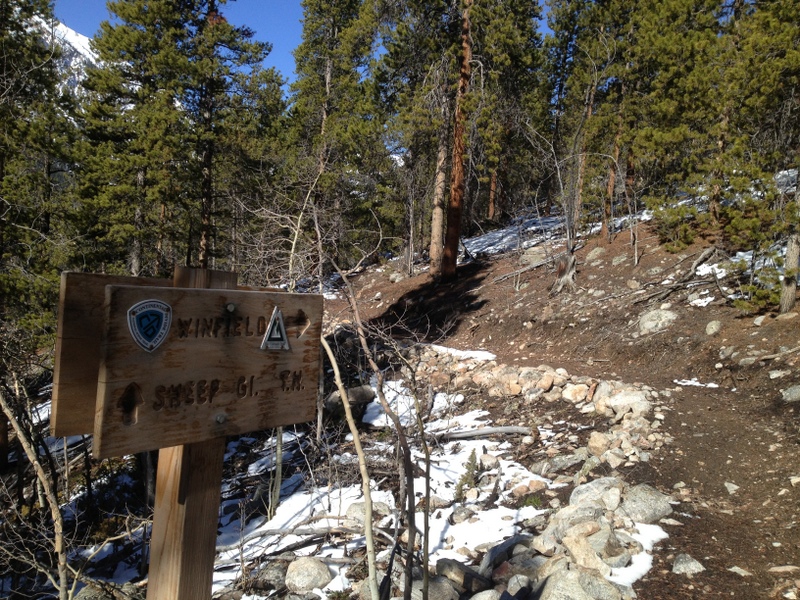
On my way to Winfield, I kept my eyes peeled for an old jeep road I had seen on one of my earlier runs this spring. It looked like it might descend directly into town rather than looping around like the course did last year. Leadville race officials announced that we'd be taking a more direct route down to Winfield this year, so I wanted to investigate a bit. I'm 99% sure this will be the route we'll take. (I mean, there are no other options that I can think of-- short of building a new trail, which seems highly unlikely.) The old road is actually in pretty good condition, passing a collapsed entrance to a small abandoned mine, and dumping you out on the road just before the town. There's still a bit of a climb on the new single track trail from last year before you divert down on the jeep road, but it will almost certainly save us ~10-15 minutes each way. I piled up some stones to form a cairn right at the intersection. The new route is easy to follow once you're on it, especially heading downhill to Winfield. Just be careful as you're heading back up it as it forks at one point. You want to keep to the left, on the higher road back to the single track. (For the curious, if you look carefully, I believe you can see the faint outline of the road on Google Earth.)

The new route to Winfield?
An overview of the entire route I took this Saturday. 19 miles.
The alternate start to avoid the Lake Creek river crossing.
The snow field at the top of Hope Pass.
It's not as bad as it looks, really.
One of the best views in Colorado.
The old jeep road descends to the left. Note the cairn.
A view of the jeep road, looking back north.
Another view of the jeep road, looking back north.
Here's where it pops out on Clear Creek Road. Note the small cairns.
Two small cairns mark the intersection with the road. Without them, it would be very easy to miss.
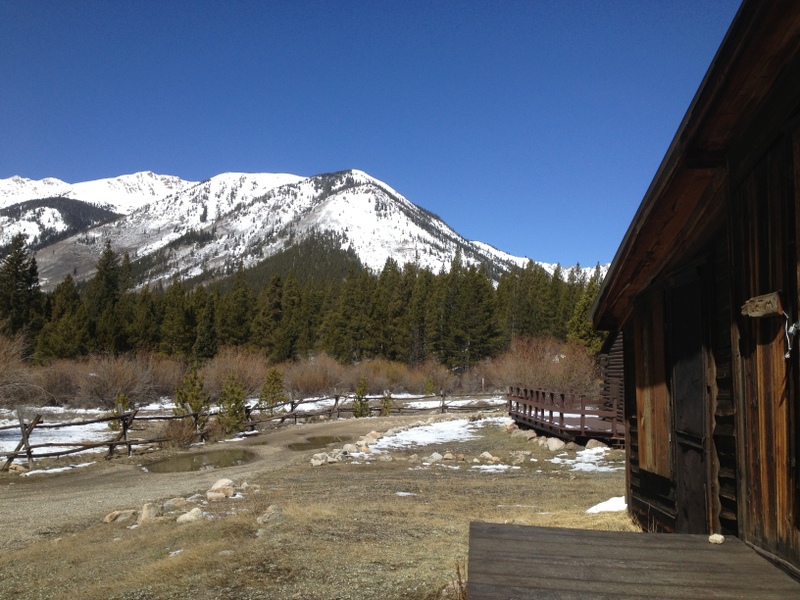
Winfield. Slightly less snowy than the last time I visited.
On top of Hope Pass again, looking north.

A few notes about my double crossing. I never managed to run Hope Pass in training last year-- my son, Ethan, had other plans. So, discounting race days, the last time I ran it in training was in early July, 2011. I ran it with fellow locals, Mike and Marvin-- who were both training for Leadman at the time. Having some company on a run (which is rare for me) pushed me a bit and I remember it being a solid workout. This year, as a challenge to myself, I actually ran every step of the way from my car to the snow field at the top of the pass. No hiking. I was certainly moving slowly, but maintaining a running cadence. While I was happy that I had the willpower and endurance to accomplish that feat, I only made it to the top a minute or two faster than when I aggressively power hiked it in 2011. (And I certainly have no illusions of being able to run up the north side of Hope during the 100!) An interesting data point.

I ran down the south side approximately three minutes slower than in 2011, which didn't surprise me at all because I have a very clear memory of recklessly bombing down the trail in 2011. I mean, I was flying, leaping off rocks (KJ style). This Saturday, I was much more conservative. I don't think technical downhill skill plays much of a role in the 100, in fact I think it can lure you into prematurely destroying your quads or even injuring yourself with a nasty fall. (And a three minute difference is definitely not worth it.) The biggest difference between 2011 and this year was how fast I ascended the south side: a full 5 min/mile faster than in 2011. I was really pushing it, panting like mad man, and swearing regularly. I feel like things become slightly more sane once you reach tree line, but-- damn-- the first part of the ascent is brutal. I found myself asking, "Do I really want to do this for 40+ hours at Hardrock?" (Assuming I ever get in.) 1,000+ ft of climbing in a mile is utterly exhausting. However, I am proud to say that I managed to make it to the top (from the junction with the new trail) in less than an hour. I even ran the last handful of switchbacks. That was a first.

While a bit mundane (but, hey, this is a training blog), I'd like to note that I really focused on staying hydrated during the entire run. After my debacle at Sage Burner, I've been paying extra attention to proper hydration during my long runs. I consumed ~150 oz of water (about seven and a half bottles worth or ~24 oz/hour ), stopping to purify water and refill at streams four separate times. I'm finding that I enjoy carrying two handheld bottles vs. a hydration pack. Yes, ideally I'd rather have my hands free-- you can't use poles or push off on your knees easily while carrying two handhelds-- but I find drinking to be much, much easier, and I think that may trump any other consideration. You can more easily tell how much you've drunk, you can dump water on your head to cool off, and you can quickly scoop up water from streams.

Fueling was pretty straight forward: maple almond butter x4, fig newtons x2, chews x2, gels x2.
 
All-in-all, a great workout in a fantastic setting. Hope Pass is always inspiring.

Wednesday, June 5, 2013

Month in Review (May)

5/2010: 238.4 miles
5/2011: 192.2 miles
5/2012: 216.5 miles
5/2013: 223.6 miles

Dare I say that summer has finally arrived in Lake County? The high this weekend is forecast to be 70F. The leaves are budding on the aspens, the snow is melting, and the increased traffic on Harrison has started to make left hand turns prohibitively frustrating. It's hard to believe that just last Wednesday I was caught in a snow storm at the top of Elk Run. I seriously considered transferring my running socks from my feet to my hands to use as makeshift mittens. Ah, Leadville. Mountain livin' at its finest.

Descending into Twin Lakes; Hope Pass in the distance.

May was a great month of training. I can't really think of much I'd do differently given the chance (except the obvious adjustments I should have made for Sage Burner). While May's mileage was right where I wanted it to be, the wintery spring weather kept me from getting as much vertical as I have in the past. Last year I had run Quad Rock and climbed a few 14ers/13ers by this point. Now that some of the higher elevation trails are starting to melt out, I hope to focus a bit more on elevation gain in June and July.

Yellow=bike, green=long, bold=race

I have a running/biking streak going that extends all the way back to early April, when I returned from my trip to the Grand Canyon. I'm kind of surprised about that. It was one of my goals this year to run more frequent, shorter runs, so I'm obviously succeeding at that. But I certainly didn't plan on running every single day. It just kind of happened. I guess that I've found that the streak helps motivate me to get out the door. The decision isn't whether or not to run, but which route to run and at what intensity. I still ask myself, "What is the purpose of this run? Why am I running today?" and two or three times a week the answer is usually "To recover", or "To keep my legs loose". My long runs are always at a conversational pace (though there's rarely any one to talk to besides myself). I probably only really push myself on one or two runs per week, usually on a hilly route, and sometimes only in one direction. All things considered, my weekly mileage isn't especially high so I'm not too worried.

My biggest fear, of course, is coming down with another case of ITBS. My best explanation for why I came down with it during the 100 last year is that I must have tightened up during my 3 week taper, when I started spacing out my runs more and drastically dropping my mileage. So I'm hoping all these extra 3-5 mile runs are helping to keep me loose. (Well, looser anyway.)

So, I've got about 8 weeks of training left before my taper begins. I think I've got the "50 mile week" thing pretty much figured out. Given my schedule, however, it's tricky for me to do much more. I'm not even sure what I would do if I had the time. A second long run, I guess? That's pretty much impossible unless I take a day off from work (which is not out of the question, but certainly not an every week occurrence). I could start tacking on 5 miles to my long runs, bringing them up to 25 or so. Alternatively, I could also increase the vertical. That will probably just happen naturally as the peaks start melting out. Maybe I could sneak in a 10 miler on Friday with a little bit more intensity thrown in? Or maybe a quick mid-week 14er? Or a mid-week speed work session? I feel like I've got to make a few adjustments or I might plateau around the end of June. Of course, there was a fair amount of weekly see-sawing in my mileage totals last year in June and July. So, even just sticking to my current, relatively consistent training schedule will probably be an improvement.

I'm sad that I won't be running the San Juan Solstice 50 this year. It's only a few weeks away. It's such a fun, grueling race, but I really felt like I should cut back a little bit on my racing this year. Damn, it'll be hard to replace that 13,000 ft of vertical! But... I'm planning on running some epic local routes in the months ahead, which will certainly give me something to look forward to. Also, skipping the race gives me the opportunity to run the Leadville Marathon on fresh legs for the first time since '10. It'll be fun to see if I can pull off another PR there...

Overall, I'm very, very happy with where my fitness is right now. I'm just looking for the best way to kick it up a notch as I enter my peak training period.

On the Colorado Trail this weekend.

Tuesday, June 4, 2013

Turquoise Lake Half Marathon Report

I definitely look forward to running the local half marathon each year. For at least the past two years, it's fallen on the Saturday after the Sage Burner 50K, making for a double race week with only four days to recover between the two. I have a hard time motivating for tempo runs, so the Turquoise Lake Half provides a great excuse to get out and run at a faster pace than normal. As someone who has yet to fully embrace speed work, I'm pretty sure I would benefit from running even more half marathons during my training. (Probably more than running yet another hilly marathon or 50 miler.)

With my disappointing 50K effort, I was really hoping for some redemption in the half. Not that the two races are much alike, but I felt I needed to run a solid race-- of any distance-- without any issues to restore some of my confidence.

  • Tuesday was a slow recovery run of 6 miles on Wheeler's Way, Gold Digger, Cold Feet, and Old Chub. As I mentioned in my previous post, I actually still felt that side stitch during this run. Crazy.
  • Wednesday was a 7 mile hill effort up Elk Run. 1,000 ft of vertical. I took the downhill super easy.
  • Thursday was an easy 5 mile effort on (Lower) Boulders. The beavers have been busy! The river crossing is now above my knees. Refreshing!
  • Friday was an easy, flat 3 mile loop on Giddy Up.

I love the fact that all the rest of my races this summer start at my door step! The half started late enough on Saturday morning (9am) that I didn't even have to set an alarm. I just rolled out of bed, fixed some coffee, drank my traditional smoothie, and gathered my gear. Nutrition plan: simple. Carry a 20 oz bottle full of maltodextrin mix. I deviated a bit from my normal recipe and omitted the protein given the short duration of the race, plus I added the contents of an Endurolyte capsule out of paranoia. I went a little lighter on the protein and fat in my breakfast, too. I didn't want to overdo anything. I figured the bottle would last me until around the first aid station and then I would just drink Gatorade the rest of the way.

When I reached the lake, I picked up my bib and t-shirt, and ran an easy warm up mile alongside the lake to loosen up the legs (and lungs). Lots of my local friends were present-- either running or just spectating. It was great to chat and soak up the relaxed atmosphere. Around 9am, we all gathered at the start for a quick briefing. The most interesting news: the race would now be a true half with an added 0.7 mile section on a nature trail to bring the total to 13.1. Awesome, but I'm somewhat embarrassed to admit that my initial reaction was that it would complicate my PR efforts. I guess I'm a little hung up on tracking my historical progress-- not that I've ever run the exact same 100 mile course twice! (Nor will I this year: they keep changing the damn thing.)

After a blast from the shotgun, we were off. The Turquoise Lake Half breaks down into roughly three sections: 6.5 miles of road (with most of the climbing), 4 miles of moderately technical single track with some rollers, and finishes with 2.5 miles of smooth, flat single track. The entire course has 1,250 ft of climbing, so it's pretty flat by Colorado standards. Those 4 miles of technical single track can be surprising slow, however. Anyone who has stumbled through them in the dark during the 100 knows what I'm talking about.

Anyway, I didn't really have a specific pacing plan in mind-- for example, a goal for a particular section or anything like that. I had looked at my mile splits from the previous year and I definitely saw room for improvement. I felt a PR was very doable, but after Sage Burner I was trying not to take anything for granted. So, I settled on the amazingly complicated plan of "just run everything faster, you're in better shape". Yup, genius.

The time to beat was 1:56. My modest goal was to try to average <9:00 minute miles over the entire course. I knew the road would be the fastest section, so I wanted to put in a solid effort early on. I managed to run two 8:45 min/miles while gaining 150 ft/mile. At 10,000 ft, that's not too shabby, at least for me. On the heart rate graph, you can definitely tell where those hills were. They represented my hardest effort. On the downhills I hoped to be somewhere in the mid 7:00's. I clocked two 7:40 min/miles on the way down to Mayqueen. Again, a relatively modest pace-- certainly not as strong as my uphill pace-- but solid for me.

The group of runners I happened to be running with all stayed pretty close to each other during the entire race. I passed a few folks on the uphill, and cruising into Mayqueen into the first aid station, but one or two runners also jumped ahead of me on the downhill and on the more technical sections that followed. However, I wasn't too worried. They never got out of sight and I was fairly confident that unless they were also training for a 100 mile race (which, in the end, I'm actually pretty sure some of them were!), my advantage increased the deeper into the race we got.

I'd guess that after mile 8 or so, I started reeling folks in who were ever-so-slightly fading. It was all very good natured and we'd always congratulate each other and say a few words of motivation. But I was certainly happy to see that I was maintaining a strong pace. And, honestly, my pace felt solid, but totally sustainable. I was certainly not in the hurt locker or anything like that. I am a wimp when it comes to speed work and really pushing myself aerobically while moving quickly. For whatever reason, I prefer to push going uphill where leg speed has less to do with it. But even then I try not to push so hard that it takes too long to recover once I reach the top. I think one of the most surprising differences for a flat lander coming up to altitude is how long it takes to recover from an uphill effort.

Anyway, I hadn't really been checking my watch during the race, but it was pretty obvious given how good I was feeling that I was going to go well under my PR. I was definitely excited and thoroughly enjoying the race. I grabbed some more Gatorade at the Tabor Boat Ramp and kept chasing the runner in front of me. The new section of trail turned out to be really nice-- a very soft and runnable trail through the pines and around two small ponds. The trail looped tightly so you got a glimpse of the runners a minute ahead and a minute behind you.

I passed one runner, joking that if it was last year we'd be done already, and then set my sights on the next. I had been running within sight of him for the entire race. As I approached the finish, I waved to my wife and kids who were playing in the sand on the beach. It's always great to see them at the finish line. Finally, I made my passing move on the wooden stairs leading up to the parking lot and sprinted to the finish. (I seem to pass someone every year right at this point. It's kind of stressful-- I generally try to avoid finish line drama if I can help it.)

1:50. A 6 minute PR on a course that was a half a mile longer!

Insert obligatory spreadsheet image here.

The atmosphere at the finish line was just as fun and relaxed as the starting line. It was great. I felt energized. I had no problem chowing down on the post race food immediately after I'd finished-- always a good sign that I've stayed on top of my hydration and nutrition during the race itself.

My race went about as well as I could have hoped. I recovered quickly from my 50K on Monday and managed to run a solid, well-paced half marathon on Saturday.

How do I feel? I believe Mr. LL Cool J said it best: Mamma Said Knock You Out.

Monday, June 3, 2013

Sage Burner 50K Race Report

I guess one advantage of waiting a week before writing up a post about my experience at this year's Sage Burner 50K is that I've calmed down a bit and perhaps I've gained a little perspective.

It did not go well. I suffered through one of my more spectacular blow-ups in a race.

I think the lesson here is this: When you live near here:

Cottonwood Pass on the drive down to Gunnison. Notice anything?

be extra careful racing here:

The course at Hartman Rocks. Notice the lack of anything?

Okay, okay. That's a slight exaggeration. I don't actually live on top of Cottonwood Pass, but you get my point. It was hot. Much hotter than this poor Leadville resident was prepared for. I mean, if I wasn't a complete idiot I certainly could've survived the race in much better condition than I did, so the outcome was far from pre-determined, but I made some stupid mistakes and basically walked it in from mile 20.

I was feeling very confident coming into the race, just off a big PR at Collegiate Peaks. In fact, I may have felt a little too confident. I thought a new PR at Sage Burner was all but guaranteed.  (I mean, I majored in Philosophy and Classics as an undergraduate. You would think I'd know a thing or two about hubris.) I didn't read my race report from last year carefully enough. I spoke about how dehydrated I felt after the race (surprise!) and how I really needed to consume more fluids-- especially when I wasn't heat acclimated. I guess that fact was overshadowed by the euphoria of setting a 34 minute PR last year. Ah, the irony.

I've run the Sage Burner 50K four times. You'd think I'd learn, right? Here are my times over the years, with the temperature on race day in parentheses.

2013: 6:21 (71F)
2012: 6:20 (64F)
2011: 7:05 (73F)
2010: 6:54 (71F)

So, this year wasn't especially hot. The historical average for Gunnison, CO on 5/27 is 67F. So, it was a little hotter than average, but certainly not anything noteworthy. However, as usual, this race is the first time I run in ~70F weather each year. That presents a bit of a challenge. For comparison, the high in Buena Vista for Collegiate Peaks was ~50F. And that race starts earlier and (since the 25 is shorter) finishes earlier.

Here are my splits.


Do you, perhaps, notice a trend in my average pace after say... mile 20? Yeah... that's me suffering from dehydration.

Up until mile 16.5, everything was going great. Of course, I had already sown the seeds of my own destruction by that point, but I was feeling good and I was right where I expected to be. I was already 25 minutes (!!!) up on my splits from last year (though the course alternates direction each year, so they aren't quite comparable). I wouldn't say that I went out too aggressive, just that I didn't go out conservative (if that makes any sense).
First problem: I was only carrying one 20 oz hand held water bottle. Stupid, stupid, stupid. I should've carried two.

Second problem: I was more concerned with my calorie intake than water intake. Wrong priority.

Third problem: My calorie source (maltodextrin powder) displaces my water! My 20 oz water bottle probably only had 17 oz of actual water in it given the huge amount of powder I dump into it to get 300+ calories per bottle.

I knew things were taking a turn for the worse around mile 20, but I adjusted incorrectly. I was a little behind on calories at that point and in my myopia I assumed that that was my problem. So, what did I do? I put 150% of my normal powder into my water bottle, displacing even more liquid! I wanted to carry more water as well, but I had no means to do so. I tried to compensate by stopping at the aid stations and drinking coke, but it was far too little, too late. Around mile 28 or so I started feeling dizzy and even started walking some of the downhills. It was that bad.

But wait! It gets worse!

I was at mile 30.3, at the top of a hill with the finish line in sight below. My watch read something like 6:12. I had ~8 minutes to run about a half a mile downhill to set a PR. And I couldn't do it! As I started staggering downhill, I immediately got a massive side stitch on my right side. No amount of massage, deep breathing, or swearing could break it. I remember thinking to myself, "Damn it, this is just perfect. I executed this race so poorly, I don't deserve a PR."

Perhaps a little melodramatic, but that's what I was thinking. I was very frustrated with myself. Not because of my time per se, but because of how poorly I had executed my race. I had the fitness to run a ~5:40 race-- I'm sure of it.  But I made far too many mistakes-- and mistakes that I had already made in the past and should have been smart enough to address. I am more proud of my ridiculously slow time of 7:05 in 2011-- where I ran the race suffering from a terrible head cold.

In fact, in 2011, I ran faster from mile 20 on than I did this year! That is really eye-opening.

Proof that dehydration is worse than a head cold.

When I finally arrived back home in Leadville, I hopped on the scale. I weighed in at 166, down from 172. And that's after drinking a coke, some chocolate milk, and a fruit smoothie on the two hour drive back home. Not good. Not good at all. I finally peed sometime after dinner, about 5 hours after the race had ended.

If I was forced to try to take something positive away from the race is would be this: it was the most focused experiment in dehydration that I've ever run. In the past, when I've finished a race poorly-- especially a race in which I thought heat was a factor-- I've debated whether or not it was a lack of calories or a lack of water that did me in. (Most often, I think it was a combination of both.) But I feel like things were more clear cut during this race. Sage Burner 2013 was a shining example of what dehydration does to performance. I consumed 1,800 calories during the race. Calories were definitely not the issue. Fitness was also definitely not the issue. I was more than prepared to run the distance. I was well rested. I had no injuries. There is nothing to blame except heat and dehydration (and stupidity, of course).

Interestingly, I've experienced that exact side stitch in two other races before (both during the Silver Rush 50 around mile 36, at the top of Iowa Gulch), where I was slightly mystified as to its cause. It always seems to happen late in a hot race, when I'm transitioning from struggling uphill (slowly hiking) to trying to run downhill. Now, I can be fairly confident that it was due to a lack of water. To my surprise, the side stitch actually re-surfaced during my next two recovery runs in Leadville (both of which were very easy efforts of ~6 miles). I guess my diaphragm was still recovering? Pretty amazing.

So, how much water should I be drinking? Not a ton. I think maybe 24 to 28 oz an hour, max. The problem was that I was only getting ~17 oz an hour during the 50K. Drink to thirst. Believe me, I wanted to drink to thirst, but I simply couldn't due to a lack of capacity.

From here on out, I plan to train carrying two full water bottles-- even on my short, midweek runs. I think that will be my most common hydration setup for my next few races, so I might as well practice.

Self flagellation aside for a moment, I did have a fun time travelling to and racing in Gunnison. Sage Burner is a small, but fun race. It's a tradition of mine and it's always been a good challenge. I just wish I could've run it better.

Ah, well... Live and learn. (Come on, Andy... learn!)

Monday, May 20, 2013

Current Leadville Conditions

Just a quick update on the current conditions around Leadville for those curious about such things.

Spring has been slow-coming this year and I've had to be fairly creative trying to find routes for my long runs. I've been forced to stay on dirt roads, south-facing slopes, or exposed, sage brush-lined trails.

On Saturday I parked at the South Elbert Trailhead and was able to run the Colorado Trail all the way up to Lily Ponds-- and a little bit past it-- before the drifts got too frequent. That was a pleasant surprise. I wasn't sure if I'd have to run the 4WD road up or not. From there, it was all clear heading south on the Colorado Trail around Twin Lakes all the way to Interlaken. I've heard it's clear at least all the way to the intersection with the trail over Hope Pass. By next weekend I'm fairly confident you could run all the way around Twin Lakes without encountering significant snow.

The week prior, I ran from the Colorado Trail intersection all the way up Clear Creek Road to Winfield, taking the new section of the CDT for the final few miles. All runnable-- except for a few huge drifts in the trees just before Winfield. I'm sure it's melted out even more since then.

Closer to Leadville, the single track around town is still pretty muddy/messy and there are frequent drifts to post-hole through. I've heard Turquoise Lake is still pretty well snowed in, though I haven't tried running there yet. I've heard folks are running up Halfmoon Road, which is clear. I haven't bothered trying the trails above the Fish Hatchery yet or up the Powerlines. It's all still pretty snowy. The Mineral Belt has been plowed, so if you want some fast on-pavement running, there's that for a 12.5 mile option.

I've got the Sage Burner 50K this weekend, which I'm very excited about. The weather looks to be in the 70s and sunny in Gunnison. Sweet! Hopefully by the following weekend there will be more options to explore around town... I'd guess that trails are about 6-8 weeks "behind schedule" when compared to last year.

I have a feeling that Lifetime will probably be looking for volunteers to help shovel out sections of the Marathon and Silver Rush courses this year! The snow will stick around for a long time near 12,000 ft-- especially in the willows near Ball Mtn and the top of Iowa Gulch.

21 miles from the South Elbert Trailhead. All clear.


21 miles to Winfield and back. Should be all clear by now.


Clear Creek Road on 5/11


Climbing up the south side of Hope Pass.

The intersection with the new CDT section to Winfield.


Most of the trail is probably all melted by now.

The biggest drifts were within the last 0.3 miles before Winfield.

The jeep road down into Winfield.

Ah, Winfield. My first time back since the 100.


Back on Clear Creek Road with Hope Pass in the distance.

Big horn sheep!