Tuesday, August 20, 2013

LT100 Race Report

Prelude

If I had to describe the week leading up to the Leadville Trail 100 with one word it would probably be "paranoia".

My taper was working insofar as my leg muscles felt absolutely great. In the final weeks before the race, with rested legs, I had a spring in my step that I hadn't felt in a long while. PRs on local routes around town came easily without much effort. I'd glance at my GPS and find that I was "accidentally" running 7-minute miles. However, I was now only running every other day and it seemed that a new mysterious tweak or minor joint ache would manifest itself on each of the off days. Kneecap soreness. Tight shins. A painful sore spot on the outside of my right foot. WTF?! Where was all this coming from? It felt like my body realized that daily running had stopped so now it was okay to finally breakdown. I kept up with stretching my hips before, during, and after every run. I also iced my left knee after every run-- the knee which has given me the most trouble in the past. And I'd also foam roll my legs every night for about 5 minutes or so. I thought I was doing enough to keep any potential case of ITBS at bay.

For my final long run I ran the 11 miles from Pipeline to the Colorado Trail and back. It's become a tradition. I ran it very strongly, but I distinctly felt a dreaded tightness on the outside of my left knee. Dammit! Wasn't I icing and stretching enough to prevent ITBS? With only 7 days left until the race I went into full-on panic mode. I visited the local pool to jump in the hot tub to loosen everything up and then stretched and stretched until I couldn't feel any tightness in my hips at all. I iced both legs 3 times a day. I foam rolled like a mad man over the weekend and took big doses (800 mg) of ibuprofen to try to "break" any lingering inflammation. After debating full rest vs. sticking with my plan for my taper, I decided to go out for my remaining 5, 4, and 3 mile runs. Short, flat, easy runs on the LT100 course just to keep everything moving. I was hyper-alert during the runs-- completely focused on my knee-- but the tightness didn't re-surface. I continued stretching and icing during the week leading up to the 100, but I stopped foam rolling. I didn't think deep massage was a good idea so close to the race. If nothing else, the short runs helped calm me down. I knew that they didn't prove much (since they were so short), but they restored a bit of my confidence.

Why the paranoia? Well, I've come down with ITBS in 2 out of my 3 LT100 races. The first time, it was a pre-existing condition that I knew about ahead of time and could anticipate dealing with during the race itself. The second time, I ran the race without any knee problems whatsoever. I thought ITBS was a thing of the past. However, last year, during my third LT100, it came out of nowhere at mile 30 and derailed the rest of my race.

This year there was more on the line. I was aiming for a big buckle: 24:45. A finishing time that would require a whopping 3.5 hour PR. I was confident that I had the required fitness. I was confident that I had a nutrition plan that would work.

All I needed was for my knee to cooperate.

The Plan

Before I had even declared my intention of going for a sub-25 hour finish, I had sat down and gone over my splits from last year (along with my notes) and tried to find places to save time. How could I actually shave off over 3 hours from my previous PR?
  1. Well, the course would be 2 miles shorter; returning to its normal length. That's 30 minutes right there.
  2. Historically, I've spent way too much time at aid stations. Especially from Twin Lakes to Winfield and back. I estimated that I could save about 60 minutes if I just didn't stop.
  3. Don't get ITBS. I hoped that staying injury-free would save me ~90 minutes on the downhills. This had more to do with proper training (and recovery) than anything that I did in the race itself.
  4. Only the remaining 30 minutes would come from improved fitness. Mostly during the first 40 miles.
Simple, right?

Seriously though, I liked the fact that the plan didn't require me to push any harder than I had in the past. Hopefully, my perceived effort would be about the same as it always has been. Mostly, I would just run smarter and uninjured.

Start to May Queen

I hesitate to say that preparing for the 100 the morning of the race has become routine, but it's become pretty close. I know exactly what I'll eat, what I'll wear, how long it will take me to get dressed, how long I'll stretch, etc. Pre-race jitters are no longer an issue. The only three things I did differently this year were to 1) use a heat wrap to warm up my leg muscles (prior to stretching), 2) wear compression shorts in an effort to keep my hips warmer, and 3) wear an IT band strap from the start. Mostly for the placebo effect, I guess, as I'm dubious they actually do much, if anything. At 3:30am, after my last sip of coffee, my wife, Christina, and I walked the three blocks from our house to the starting line.

I felt relaxed. What would happen with my knee, would happen. I had done everything I could think of to prepare it for this day. I was confident in my training. I knew the course like the back of my hand. I had an experienced crew and a totally solid group of veteran pacers ready to help.

I just had to execute.

With a blast from the shotgun, we were off. Time to get in to position for the trip around the lake. I chatted with some friends I spotted in the pack and tried to maintain an easy 8:20 min/mile pace down the Boulevard, cracking jokes about how sustainable it was. As we hit the flats at the bottom of the valley I shifted down to 9's. I actually jogged up the mini-powerline climb and then shifted down again to 10's around the lake until Tabor. Once past Tabor, when the trail becomes a little more technical and rolling, I shifted down yet again to 11's. It was a very comfortable pace. I'd get backed up when folks in front of me starting power-hiking the small uphills, but I'd usually be able to dodge around them.

I did feel the tightness in my left knee return as I jogged around the lake in the darkness. It was intermittent and only someone as paranoid as myself would have even noticed it. All I could do was quietly sigh and tell myself to stay positive. Maybe it was nothing.

Nutrition-wise, I kicked ass during this section. 820 calories down the hatch. I drank two bottles of my homemade energy drink and slurped down two gels. I also quickly refilled one of my bottles with tap water as we passed through the Matchless parking lot (the first boat ramp). I highly recommend that strategy to top off your fluids during this leg.

I hit the May Queen aid station in 2:08. 2 minutes faster than my goal and a 9-minute PR. In retrospect, I think this is a pretty darn good goal time for this leg. Anywhere from 2:05 to 2:10. I think it strikes a nice balance between speed and sustainability.

May Queen to Outward Bound

I quickly spotted my crew, took off all my warm layers and my headlamp, grabbed two new bottles of energy drink, my hat, and sunglasses, and jogged off up the road to the Timberline Lake TH.

This is the leg where I knew my improved fitness would have the most obvious impact. I planned on slowly jogging all the way to the top of Sugarloaf. Previously, I'd only attempt to jog Hagerman Road and hike the rest. But, if I've mastered anything this summer, I've mastered the slow 12-14 min/mile uphill jog at altitude. Whether you're jogging or hiking actually doesn't matter, in my opinion. What really matters, I think, is just a steady, sustainable, consistent effort. I prefer to slowly jog-- rather than quickly hiking-- and adjust my cadence to match the grade. There were two racers next to me who were constantly power-hiking past me, huffing and puffing with their poles clicking madly away, only to drop back again and repeat the process as I trotted steadily along. Personally, I don't think those spikes in energy are optimal.

Jogging up Sugarloaf.

I broke my promise to myself to not run faster than 8:30 min/miles down Powerlines. I just got carried away, as I always seem to do. I was prancing down the mountain with an exaggerated forefoot strike, trying desperately not to damage my knees. I think I overdid it a bit as a few miles later I felt a slight pull/tear on top of my right foot. Stupid! I hoped it wouldn't come back to bite me in the next 80 miles. My knee felt fine, though. Perhaps some intermittent tightness, but nothing consistent and certainly not getting any worse.

I hit the Outward Bound aid station in 1:54. 6 minutes faster than my goal and a 14-minute PR. And this section was about 0.3 miles longer given the new aid station location. (Rumor has it that Lifetime pissed off the manager of the Fish Hatchery, who kicked them out. Just local gossip, but sad to hear.)

Outward Bound to Halfpipe

I met my crew near the aid station and quickly swapped my two empty bottles for one new full one. (Another 720 calories down! I was rockin' it-- though I still felt strangely hungry.) I headed off down the road, cruising along, listening to my ipod. If you're ever going to listen to music during this race, this is the section to listen to it! Flat, paved road and lots of it. I hovered around high 9's and low 10's during this section, with an 11 min/mile on the dirt road up to Pipeline. A very comfortable pace. At Pipeline I met my crew again and traded my empty bottle (another 310 calories in 40 minutes!) for two full ones, plus an extra bag of energy drink powder to mix up during the next section. They also dumped some ice water on my head. So refreshing! (My 4 year old daughter, who was there cheering me on, apparently thought this was hilarious and later emulated it at home with her own water bottle.) I continued on to Halfpipe, jogging everything. That was a change from last year, for sure, when I had begun to hike some of the uphills.

I hit the Halfpipe aid station in 1:11. 9 minutes faster than my goal and another 14-minute PR. Most of that PR was probably made on the gently uphill dirt roads, rather than on the pavement. Again, my improved fitness played a big role in this section. I could jog everything without much difficulty.

Halfpipe to Twin Lakes

Rather than stopping for 5-10 minutes like I normally have in past races, I blew right through the aid station. It felt good, but in hindsight I think it was a mistake. While I was doing great as far as calories went, I don't think I was actually drinking enough water. I was probably only getting ~17-18 oz of water per bottle given the density of my energy drink. And, in the mounting heat of the afternoon, I think that ultimately hurt me.

I realized I couldn't make it all the way to the Mt. Elbert aid station before refueling, so I waited until we crossed the major stream in this section and filled up there, dumping water on my head to cool off as well. The clouds were mostly obscuring the sun, but the heat was rising. If only I had chugged 8-12 oz of additional water here, I think it would've been a game changer. Ah, well. Hindsight and all that.

Psychologically, I had passed a huge milestone, though. Both times I had come down with ITBS during this race, it was always during this section. Right before the course hits the Colorado Trail. The intermittent tightness in my left knee had completely disappeared. I hadn't felt anything for miles. Could this really finally be happening? The magical race where neither nutrition nor my knee held me back? I definitely had to choke back some tears at the thought.

Dehydrated, but no ITBS!

I topped off one water bottle at the Mt. Elbert aid station and began the descent down into Twin Lakes. 9 min/miles felt amazing compared to the 11-12's I could only muster limping downhill last year.

I hit the Twin Lakes aid station in 1:45. Exactly my goal for this section and a 5-minute PR (over my time from '11-- I actually ran it 29 minutes faster than last year). In retrospect, I think 1:50 might have been a wiser goal. You need to hit Hope Pass in really good shape, so you need to absolutely nail both your nutrition and your hydration during this leg. I nailed the former, but I think I was falling behind on the latter. It would come back to haunt me shortly.

I made it to Twin Lakes in almost exactly 7 hours-- 15 minutes ahead of my goal pace and more than an hour faster than I had ever made it to Twin Lakes before. So far, so good!

Twin Lakes to Winfield

I took a quick sip of soup at the aid station, met my crew, put on my pack, grabbed two new bottles, dumped more ice water on my head, and immediately set off for Hope Pass. Having basically run straight through Twin Lakes without stopping for more than a minute I knew that I was already 10 minutes ahead of my time for this split from last year, when I had to stop much longer to try to deal with my emerging case of ITBS. That's a nice feeling, believe me. It's almost like cheating.

My energy levels didn't feel quite right, though. As I approached the river I felt a bit... foggy. Splashing through the puddles that preceded the crossing filled one of my shoes with grit. Sighing, I knew that I'd have to stop to clean it out. Luckily I knew of a great rock by the trail to sit on so I could do just that. (Yes, I guess you could say I'm rather familiar with the course!) As I sat down I realized that I had actually run every step of the course for the first ~42 miles. Wow.

A low point in multiple ways.

At this moment I was probably as far up as I would ever be in the race. Later number crunching put me at 98th place at Twin Lakes and I'm sure I passed a few more folks as I blew through the aid station itself. I was about to lose some places, though, as I struggled with the climb. Soon runners were hiking by me like I was standing still. I said hi to many of my friends as they passed by: Marvin, Mike, and Andy in particular. I just couldn't summon up the energy to maintain a solid pace and keep up with them. I never stopped, but progress was slow. I became dizzy and light-headed, then finally a bit nauseous. I tried to get more calories down, but I couldn't take more than a few sips of energy drink at a time without feeling bloated and vaguely sick. In hindsight, I think it was dehydration rather than a deficiency in calories. My blood was probably thickening. Ugh. I splashed water all over myself as the trail neared the stream. It felt great, but I really should have taken the time to drink more.

Still, I reached the Hopeless aid station in about the time I predicted: 1:50 from Twin Lakes. That was faster than last year, but mostly due to not stopping at Twin Lakes. When I was moving, I wasn't moving much faster than I had in previous races. But, hey, whatever works! After quickly refilling my bottles at Hopeless I took off for the summit. Again, efficient aid station management immediately put another ~8 minutes in the bank as I normally collapse on a log at Hopeless and try to choke down some soup. Not this time. I think I felt a bit better as I climbed the last section of trail from the aid station to the top. I was two or three switchbacks from the top when the leaders came bombing down past me. I looked at my watch and took note of Mike's time so that I could update Ian and Nick as they passed by later.

Feeling better on the downhill.

Things definitely felt better on the way down. I just cruised down, occasionally darting aside to avoid the leaders who were climbing up. I wasn't really pushing it-- it just felt nice to not feel so nauseated as I had on the climb. My knee felt fine. It wasn't even on my radar anymore. I guess I felt confident that if I had developed a case of ITBS during training it would've surfaced by now. I just had to try to recover from whatever caused that bought of dizziness and nausea on the way up (it still really hadn't sunk in that it was probably due to dehydration... I don't know why). It was really starting to heat up on the south side of Hope Pass. Again, I took a moment to stop at a stream crossing and dose myself with ice cold water. So, so good. Luckily I had previously taken note of various landmarks on this section of trail so I knew exactly when then downhill into Winfield was approaching and didn't get my hopes up too soon. It was becoming harder to jog the uphills and I definitely resorted to hiking some of the way.

Almost half way. 20 minutes ahead of schedule.

As I emerged out onto the dirt road my wife and I almost immediately caught sight of each other and she jumped up and down cheering for me. It was a happy moment. Even though I had struggled on the uphill, I had given myself a generous amount of time for this split and was I still ahead of schedule.

I hit the Winfield aid station in 3:34 from Twin Lakes, approximately 6 minutes ahead of my modest goal for the split. I arrived in 10 hours and 35 minutes, a total of 20 minutes ahead of my goal. More than that, this was the first time I had ever met or exceeded my goal for the first half of the race-- no matter the goal!

Winfield to Twin Lakes

I was somewhere between 3-4 lbs down at Winfield. Not too bad, I think. (I guess I couldn't have been that dehydrated.) I quickly dropped my pack, and picked up my poles and my first pacer, Terra! I was in and out in maybe 2 minutes.

Terra's paced me in every 100 I've run, so she's a pro. She works for Clif Bar and had taken time out of her busy schedule to help me complete this crazy race yet again. (Clif had a big presence in Aspen that weekend due to the Pro Cycling Challenge.) Sadly, as we proceeded uphill to the single track, my nausea returned. I just couldn't drink much without feeling bloated. Finally, I gave up and puked on the side of the trail. Almost nothing came up, but I felt slightly better afterwards. I had hoped to make it the entire race without puking, but at least I set a new PR for farthest distance run without ejecting the contents of my stomach: 51 miles. (My previous PR was maybe 43 miles for this course. 47 miles, all time. That's ultra!) I was able to trot a bit to the intersection with the Sheep Gulch Trail, then I grabbed my poles and went to work. Just like the north side, I made it all the way to the top without stopping, but I was moving very slowly. Folks were passing me again and I was loosing more spots. I wasn't very talkative and just tried to grind my way to the top without bonking too hard. Things got a bit easier as we approached the final switchbacks and the trail leveled out some. I saw many folks sprawled out on the side of the trail at various points-- not a strategy I recommend. But, I was feeling so poorly that I wasn't in any kind of position to be giving advice. Finally we reached the top, but about 15 minutes behind schedule. Again, I had set a generous goal time for the split to Twin Lakes, so all was not lost. There was still the possibility that I could make up some time on the downhill.

Grinding up Hope Pass.

Terra ran ahead to fill up my bottles and I jogged along behind. I made much faster progress down to the aid station than last year when my ITBS really flared up during this section. It felt so good to just be dealing with tired legs and not the feeling of being repeatedly stabbed in the outside of my knee. At Hopeless I actually grabbed one of the few remaining cups of mashed potatoes and noodles. I ran with it in my hands while Terra took my poles and managed to polish it off in a few minutes. On the way down we stopped again as the trail neared the stream and I used the empty cup to pour ice-cold water all over myself. It was a religious experience. I hooted with delight and took off down the trail, sopping wet. We made good progress down the mountain, passing a few folks along the way. (I'm sure we passed plenty more at the aid station itself.) I was running maybe 9-10 min/miles, I'd say. Much faster than I'd ever been able to do during this section in the past. We kept on jogging all the way to the river and to Twin Lakes itself.

This was the first time I'd ever made it to Twin Lakes (inbound) before the sun had set. It was really uplifting. I saw a lot of locals that I knew in the crowd and waved. Their cheers were much appreciated and I joking flexed and smiled as I ran by looking for my crew. I had survived Hope Pass... barely.

It had taken me 3:50 to get from Winfield back to Twin Lakes. My goal was 3:40, so I was 10 minutes late. But, considering the 6 minutes I had gained on the way to Winfield, I was only down 4 minutes for the entire grueling 21 mile section. Secretly, I had thought that maybe I could have exceeded my conservative goals for Hope Pass by a fair amount, but I'll take it. (If there's any place to put a cushion in your goal times, it's Hope Pass.) I was still 10 minutes up overall on my goal pace through mile 60. I still had a lot of ground to cover, but a big buckle was starting to feel like a real possibility.

Twin Lakes to Halfpipe

When I met my crew, I quickly sat down to change into dry socks and shoes. That wasn't my original plan, but when I had crossed the river they'd filled with sand and grit again. (Actually, it wasn't due to the river, but to the muddy puddles after it.) It didn't take long until I said thanks to Terra and picked up my new pacer, Alex-- an old friend from college and fellow ultra runner. As we set off up the hill to the Mt. Elbert aid station together I was still amazed that it was light out.

On the way up, we were quickly joined by fellow Leadville locals and friends, Smokey and his pacer Craig. Also, another Alex I had met earlier in town (brother of Drew, a friendly ultra runner who used to live up here) showed up with his pacer. Everyone seemed to be in good spirits and we joked and laughed on the way up to the top. My pacer, Alex, shook his head in disbelief at how happy we all were this late in the race.

While I felt pretty good on the climb up, I was still having trouble getting down enough calories. I had switched to Coke for a change, and was able to polish off a bottle by the top of the climb, but my energy drink wasn't sitting very well. It seemed warm and unpalatable. I'd take a sip, feel strangely full/bloated, jog a bit until I burped, take another sip, etc. It wasn't very efficient. Alex and I managed to jog most of what I'd hoped to jog heading in to Halfpipe, but not as fast as I'd hoped. I also took a few walking breaks on some uncharacteristically easy terrain. I just couldn't quite pull it together to nail this section. My legs felt fine, I just had low energy. A handful of runners passed me and I leapfrogged a few for a while. It got dark just as we reached the aid station and we finally put on our headlamps. Glancing at my watch, I knew we were slightly behind my goal time for this split, but we had still barely managed to set a PR. I took some small comfort in that fact even though I felt pretty low at this point in the race.

We hit Halfpipe aid station in 2:20, 5 minutes behind my goal time for this split. I now only had a 5 minute cushion remaining on my overall goal pace.

Halfpipe to Outward Bound

We jogged past Halfpipe without stopping. Alex ran in to see if they had some ice for my energy drink, but they did not. It was a long shot. Shortly afterwards, I think, (or maybe it was after we were leaving Twin Lakes?) we were passed by a runner who exclaimed something to the effect of, "This must be the fifth time I've passed you during this race! How much time do you spend at aid stations?" I smiled and replied, "I don't." I took some small pride in the fact that someone had actually noticed my strategy and commented on it.

I managed to pick up the pace a bit during this leg and I finally stopped hemorrhaging positions. Alex called ahead to Christina at Pipeline to warn her I was approaching so they could expect us and have everything ready ahead of time. I asked for more Coke and more ice. And some Redbull. I plowed on through the line of cars while Alex ran ahead to get everything. It was still incredibly warm out (for this time of night), so I remained in my t-shirt and shorts. I proceeded down the dirt road in the darkness, headed for the pavement. Alex caught up with me about halfway there. I tried some Redbull. It tasted disgusting. I switched back to Coke and jogged along. By not having to stop to change shoes or into tights at Pipeline (like I did last year), I knew I was already 5 minutes ahead for this split. I just had to keep jogging. I knew I had averaged around 13 min/miles during this section last year, so I tried to keep under that. I could-- just barely. My legs were definitely getting a bit sore, but it was nothing compared to the knee pain/stiffness I had to deal with last year.

We watched the lights from the aid station grow slowly closer and closer. We seemed to be in a pretty big gap of runners without too many folks nearby. As we finally closed in on Outward Bound, Alex took stock of everything I needed and shot off to track down our crew and sync up with my next pacer: Justin.

I had a few moments alone out there under the stars, jogging along the pavement. It was quiet. I was holding on and getting closer to that big buckle with every weary step.

I hit Outward Bound in 1:26, 14 minutes ahead of my goal time. It really didn't feel like I was moving that much faster during this section, but I think-- again-- not stopping really helped. My legs were never getting an opportunity to stiffen and lock up.

Outward Bound to May Queen

I was back up to a 20-minute cushion on my goal pace-- which itself had a built in 15-minute cushion to the 25 hour deadline. (I was aiming for a 24:45 finish-- just to be safe.) I started doing the math in my fatigued head. I really didn't want the march from May Queen to the finish line to be a desperate race against the clock only to finish in, say, 25:05 or something. That would be soul crushing. Having walked pretty much every step of the last 12.5 miles in each of my previous races, I knew it would only take me 3:40 to hike it in its entirety. My goal pace called for a slightly more aggressive 3:15 to the finish. Well, 3:15 plus a built in 15-minute cushion, plus my current 20-minute cushion on top of that, put me at... 3:50. Solid, but not quite guaranteed. If I could just nail this 10-mile leg over Powerlines to May Queen then maybe I could rest easy.

Justin was just the man for the job. This would be the third time he'd pace me to the finish (and the fourth time, total). I know these final 23 miles are not exactly his favorite section to pace, but he's usually been my closer-- and for good reason. He's such a relaxed, optimistic guy; perfectly willing to talk about anything and everything to pass the time (even when I'm not being very responsive), and he knows the course and is very good at gently reminding me to pick up the pace or eat more or do whatever I need to do to survive. Last year, his encouragement at the river crossing near Twin Lakes, when I was suffering from ITBS (and took two frickin' hours to descend from the top of the pass), was probably the only reason I didn't DNF.

I tried to get down as much Coke as I could on the pavement before the climb, where I knew I'd need some energy. I had run from Twin Lakes to Outward Bound without poles, but now it was time to power hike again. I wouldn't exactly say we crushed the uphill, but again I made it to the top without stopping. No breaks. It was a solid pace for this late in the race and we actually started passing a few folks on the way up. I don't think I had passed anyone on an uphill for about 40 miles. Up until this point I hadn't taken a single painkiller during the race. Sure, I was a bit sore, but I don't like to take pills if I don't have to. But, I knew I really wanted to hammer the downhill into May Queen. I told Justin that if I couldn't run at least 13 min/miles going down Sugarloaf, I wanted to stop and choke down some Tylenol. I did not relish the thought. As we crested, I started jogging a bit and slowly tried to stretch out my tired legs. 14 min/mile, 13 min/mile, 12 min/mile... Justin jogged ahead to scout out the smooth singletrack carved by all the mountain bike riders the previous Saturday (which dodged all the rocks)... 11 min/mile, 10 min/mile pace! I shouted with joy. The pace seemed blisteringly fast for mile 85! I think I even saw a 9 min/mile pace on my GPS at one point. That big belt buckle was going to be mine! We must have passed well over a dozen runners on the descent. I silently thanked my quads as we turned off Hagerman Road and on to the Colorado Trail.

The two-ish miles from Hagerman Road to May Queen always scare me. They seem impossibly technical this late in a 100 mile race. I grabbed my poles again and tried not to do anything too stupid. We had caught up to Smokey and Craig again and they fell in behind us. We chatted away as we gingerly negotiated all the rocks, jogging when we could and taking it easy when it got too rocky or steep. One bridge down, two bridges; finally the third bridge...

There's minimal cell service at May Queen so as we emerged onto the pavement Justin ran ahead to track down my crew, Christina and Jeremy.

Again, a quiet moment alone. I took a breath and looked at my watch. It was 1am. I had obliterated the section, running it in 2:44, 16 minutes faster than my goal and over a half an hour faster than my previous PR! I now had a comfortable 4 hours to make it to the finish line.

I ran the 41st fastest split from Outward Bound to May Queen. Damn.

May Queen to Finish

Regrettably I kind of shutdown after May Queen. The knowledge that a big belt buckle was pretty much in the bag, caused me to loose my focus and intensity. I managed to get a few calories in me going over Powerlines, but not enough to sustain a surge all the way to the finish. I was still battling some nausea and I wasn't really interested in any of the drinks I was carrying.

Sticking with my plan, I jogged straight through May Queen while Justin dealt with logistics. We swapped headlamps and got some more bottles of Coke and energy drink. I had put on a long sleeved shirt going over Powerlines, but I was getting warm and I took it off again. May Queen is usually an ice box-- it was amazing how warm it was.

I tried jogging every so often, but I just couldn't muster the energy. I puked. I staggered on. The Tabor Boat Ramp seemed to take forever. Runners were passing me at regular intervals. I wasn't worried, but I was vaguely disappointed that it seemed a strong finish would elude me yet again. Still, my disappointment was tempered by the fact that I was actually going to big buckle. Impossible! Luckily we picked up my poles again at the boat ramp because they saved me from a tumble or two going down the mini-power lines. I was getting sleepy and I noticed that it was becoming difficult to walk a straight line. Once we hit the bottom of the valley the temperature felt like it dropped 20 degrees. I immediately put on a warm layer, a hat, gloves, and a rain jacket. I saw my parents drive by on their way to meet me at the finish line. My cheering section was assembling! I just had to survive the Boulevard. I desperately wanted to be done. Last year I had the energy/willpower to jog some of the Boulevard, but not this year. I just clicked along with my poles, chatting about whatever I could think of to pass the time. A nearby racer exclaimed with a humorous mixture of joy and disgust, "My last gel!" I knew exactly how he felt.

My first "one sunrise" 100 miler!

Finally, the pavement. 6th St. The top of the hill. I somehow summoned the energy for a victory jog to the finish, waving to all my friends and family who had woken up at 4:30am to see me. It felt good to finally cross the finish line. Very, very good.

24:28:55. 112th out of 944 starters (494 finishers).

What an amazing finish to another amazing summer of running in the mountains. My fourth consecutive Leadville finish. My fourth consecutive PR. A 3:50 PR! A big buckle. Incredible. A huge thank you to my crew and pacers for helping me get 'er done.

I accomplished something that I assumed was so far beyond the realm of possibility at the beginning of the year that it never even crossed my mind to have it as some sort of nebulous, far off stretch goal. I honestly thought I'd end up taking it easy this year; I had no plans to radically change my training. My main focus was simply to not get injured during training. Even now, as I write this a week after the finish, it's difficult for me to believe. I've always been a mid-pack runner. And yet somehow I pulled it off. If this blog inspires just one person to keep at it; to keep training for another year, to be patient, to be smart, to be consistent, and to break through and achieve an entirely unexpected result then it'll all be worth it.

My daughter Sierra holding the prize.

Analysis

Some obligatory tables. My race was far from flawless. The first 40 miles felt great; 7 hours to Twin Lakes feels about right, but yet again Hope Pass proved to be more challenging than I thought. In training, I can do a double crossing in 5 hours. Yes, of course I expect to be slower during the race, but 2.5 hours slower seems a bit excessive. I'm convinced that my slowdown this year was due to mild dehydration and a subsequent lack of calories. I need to take better care of myself from Halfpipe to Twin Lakes and stay on top of nutrition while slogging over the pass itself. Psychologically I was done at mile 87.5. I lost my motivation. I really want to finish the race strong one day. There is huge room for improvement from May Queen to the finish. So, as crazy as it sounds, I think overall I could've run at least about an hour faster. Well, maybe next time...

A comparison of my '13 splits and my '12 splits. I ran every split faster!

A comparison of my '13 splits vs. the median splits for '13. (Hope Pass #2 should be red.)

A comparison of my '13 splits vs. my PR splits. My old PRs were from '12, '11, and '10.

A comparison of my '13 splits vs. my goals for '13. Not too shabby.

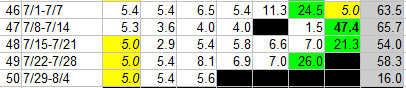
My place at each split, how much it changed, and how my split ranked. I crushed Powerlines inbound!

Sunday, August 18, 2013

24:28:55!

I couldn't have done it without my amazingly dedicated crew and pacers! More details to come, but now I'm off to limp my way to the awards ceremony and pick up my big belt buckle! Yeehaw!

Wednesday, July 31, 2013

Month in Review (July)

7/2010: 145.0 miles
7/2011: 235.5 miles (46,134 ft vertical)
7/2012: 198.1 miles (39,064 ft vertical)
7/2013: 257.5 miles (53,809 ft vertical)


Well, another month for the record books. I broke both my monthly mileage and my monthly elevation gain PRs that I just set in June. My July numbers aren't that much bigger than June's, but what's impressive to me is that I managed to pull it off with only 4 weekends in July vs. 5 weekends in June. I was a little worried that maybe my training had peaked too early, and that I wouldn't be able to maintain my momentum in July, but luckily I was able to keep pushing for another month. My monthly totals are relatively modest in the grand scheme of things, but I'm confident that the quality of my runs has been high. All on trails, all at 10,000+ ft; with 1-3 very solid efforts each week. I chuckled when I realized that the easiest-- yes, the easiest!-- long run I've run in the last five weeks (!) was a 21-mile, 7,000 ft vertical double crossing of Hope Pass. When that's your "easy" long run, I think you're doing okay...


July '13. Not too shabby.
I think I'm most insecure about my training in July, when I should be reaching my peak. What should I be doing to improve upon an already solid June? I'm always second guessing myself. I think whatever you do, variety is the key. Your body has already adapted to whatever it was you were doing before, so something has to change. I felt yet another ~20 miler with ~4,000 ft of vertical wasn't going to do much. I've been running those since March. I basically had a few choices: 1) go faster, 2) go longer, or 3) go more vertical (verticaler?). The first option would've been smart, but I'm still a wimp when it comes to speed work. It hurts. I couldn't take the second option very far because I had pretty much already exhausted all my free time. Still, by waking up extremely early on the weekends, I was able to tack on a few extra miles to my long runs and push a couple of them into the mid-20's. And, of course, running the Silver Rush 50 certainly helped on the extra-long long run front. But, I put most of my emphasis on the third option: more vertical. I didn't feel super confident in my power hike, so power hiking was the plan, culminating with an Elbert-Massive double last weekend. Additionally, I made sure to put in a solid uphill effort on the day before my long run (excluding races). Those 7-milers are up and down the Powerlines at PR pace. That meant I started the long run the next day with just a touch of fatigue in my legs to better simulate conditions in the 100. So... not exactly back-to-back 20 milers, but I'm pretty happy with the strategy given my available options. I think it may be one of the key components to my training this year that's led to such a surprising improvement.

To cap off the month of July, today I ran one of those dreaded speed workouts I generally try to avoid. 5.6 miles down the Boulevard and back. According to my training log, this was the 75th time I've run that route. I spend a lot of time on it during the winter and in the early spring when all the other options are snowed in. The last time I ran it was late April. The PR I set in August '11 has stood for a long, long time. I couldn't break it last year. Today I shattered it by 4 minutes. I guess all that vertical is paying off!

I'm thoroughly enjoying my taper-- tapering hard, as I like to joke. The little niggles that come with peak training were beginning to accumulate. I was starting to feel sleepy and somewhat lethargic on some of my runs early last week. Luckily, I was able to rally and was really inspired on my last long run-- I never quite burnt out, but I could feel myself getting close. In other words, I'm definitely glad to be tapering. I'm looking forward to recovering and recharging these next couple of weeks. I'll be chomping at the bit on race day, I'm sure. I wouldn't want it any other way. But for now... it's time to relax, don't worry, and have a beer.

Cheers!


The next time I'm on top of Hope Pass it'll be race day! Yeehaw!

Sunday, July 28, 2013

Stick a fork in me...

...I'm done!

Yesterday was my last big training run. Left the N. Elbert TH at 4am and ran a 26 mile (10,000 ft vertical) figure-8 loop over Elbert and Massive. An awesome, awesome run. Had Elbert all to myself. Jogged everything to treeline. Set a PR to the top. The sunrise at the summit was beautiful. Definitely worth the trip. Finished the loop just as the thunder started. Soaked my legs in Halfmoon Creek and basked in the glow of another season of training: complete. Next week: 70% mileage, one easy 3 hour run. The following week: 50% mileage, one 2 hour run. The week of the 100: a few short jogs.

Let the taper begin! Woo hoo!

Twin Lakes from the shoulder of Mt. Elbert. I made it to the summit just as the sun slipped above the horizon.

Wednesday, July 17, 2013

Silver Rush 50 Race Report

TL;DNR: 9:02. 1:52 PR. 17% improvement. 52nd place out of 449 runners. WTF?!

The Plan

Even though things have been going extremely well racing-wise for me this year, I approached the 50 with a certain amount of trepidation. I've run six 50 mile races over the years (Silver Rush '10, '11, '12, San Juan Solstice '11, '12, and Devil Mountain '11) and they have all utterly destroyed me. I have battled stomach issues in all of them, always faded badly, and reached the finish line completely spent. A 50 miler is not a marathon. (And I'm certainly not fast enough to fake my way through one.)

Respect the distance.

My results this year have shown excellent improvement in races that last 5 hours or less, but the only time I've raced longer than that (in the Sage Burner 50K), I blew up big time and staggered to the finish, defeated. So, yeah... me: 0, ultra marathons: 1.

Still, I had just managed to set my biggest PR ever (percentage-wise) in the Leadville Marathon two weeks ago. That was definitely a good sign. Applying my improvement in the marathon to the 50 yielded a time of 9:29. That sounded really, really fast to me. That would be a 1 hour and 25 minute improvement over my Silver Rush PR of 10:54 which I set last year.

So, what I finally ended up doing was taking a look at everyone who finished from 9:15 to 10:15 in last year's Silver Rush and averaging all their split times. When I added up the averaged splits I ended up with a time of 9:51. That sounded like a reasonable goal to me. It would require me to run every split faster than I did last year and it would still be over an hour improvement on my previous PR. Plausible. And a respectable result that I could be proud of.


As I expected, the difference between my new goal splits (i.e., the averaged splits) and my previous splits grew wider as the race progressed. I'd only have to run the first split 4 minutes faster, but then the next would require a 17-minute improvement. The third: 16 minutes. And the fourth: a whopping 26 minutes. Strong evidence that I had faded badly-- falling way off the average pace-- when I had run this race previously.

When I took a closer look at the historical splits, I noticed that out of all those finishers (in the 9:15-10:15 range), only 5 (out of 80) had managed to negative split the first (and last) 14 miles of the course. (That's only about 6%.) Since the first split involves 2,000 ft of elevation gain and the last split only involves 1,000 ft, that seemed like it should be possible if you ran a smart race and paced yourself correctly. (Yes, you have 33 miles under your belt when you begin the last split, but come on! That's 10 miles of very runnable downhill.) Of course, any race plan derived from historical averages almost always skews towards running the first half of the race faster than the second half of the race because, well, that's what most people do. I'm a big believer in trying to run even splits (assuming the terrain is comparable-- which it often isn't in trail races), so I kept this sub-goal in the back of my mind. It seemed theoretically possible given the nature of the course, but it would also require me to run the last 14 miles of the course almost an hour faster than I ever have before!

With my specific split times set, my high-level goals for the race remained pretty much unchanged:

  1. Stay hydrated! Drink 20-25 oz of water per hour (depending on the temperature).
  2. Eat! Consume 300 calories per hour, minimum. Generally more earlier on in the race.
  3. Stay cool! Dip my hat in all streams. Run in the shade. Stuff any snow on my head and down the back of my shirt. Pray for cloud cover.

Basically, take care of myself. The rest will follow.

The Taper

This year I've basically come to the conclusion that I cannot sacrifice my long run on the weekend prior to a race. Sure, I might not chose the hardest possible route to run a week out from a race, but it should still be an honest effort. My recovery run/bike on Sunday remains unchanged. Then my taper consists of running lower mileage/easier runs during the week. My weekly mileage should never drop below 50 miles/week and I want to maintain 10,000 ft of vertical minimum per week. These guidelines have served me well so far, keeping my training from fluctuating too much when I'm running non-focus races.

The week between the marathon and the 50 was notable in that it was my second highest mileage week (63.5) and my second highest vertical week (14.2k) for the year. On Friday and Saturday alone I ran ~36 miles and over 10,000 ft of vertical. I did not let my foot off the gas until the following week.

Two old high school friends, Andy and Danielle, and their two girls (ages 7 and 11), arrived on Wednesday evening for a long-awaited visit. I was flattered that they would make the long trek out to Leadville from Michigan to see me. It was so great to hang out with them-- it had been far too long-- and fun to play host while they were in town. On Thursday we went on a short hike up to Opal Lake. On Friday we rafted Brown's Canyon down in Buena Vista. Rafting was a ton of fun-- especially for the girls-- and a great activity for a taper week. I ended up breaking my running streak on Friday-- that is, unless you count walking a half a mile up to the new Two Guns Distillery to have a few shots of locally made whiskey and moonshine as exercise! There just wasn't a logical time for me to run. I briefly contemplated going for a short run after the kids were asleep and my wife had returned from work, but I thought better of it. What the hell good would that do? There would've been no purpose to the run other than to artificially extend the streak. So, yeah... time to start a new streak. On Saturday, my final shake down run was the 1.5 miles from my house to the start line (and back) to pick up my race packet. Andy, Danielle, and the girls went for an enjoyable, meandering horseback ride near Tennessee Pass. One of the side benefits of having such good friends visit is that it completely took my mind off of the race. When they finally returned to their campsite on Saturday evening I only had a few hours to get all my gear together. Oh, yeah, right... I'm running 50 miles tomorrow!

The Race

I woke up at o' dark thirty and instinctively went about my pre-race routine. Having run ~20 miles every weekend since mid-March, I think my body is now programmed to expect a long run every Saturday. When Sunday rolls around and I haven't run yet, it's confused. So, I definitely felt ready. Maybe a little flat simply because I hadn't exercised much during the week, but that's to be expected. You get so used to the "hum" of tired legs that when they're rested they feel strange.

From my yard I could hear the blare of the loudspeakers at Dutch Henry Hill. As I walked on down to the starting line carrying my drop bag, a generous fellow racer offered me a ride. I politely declined, joking that the race wasn't really 50 miles so I was making up some of the distance.

Start to Printer Boy

After chatting with friends and exchanging words of encouragement, we all lined up and the gun went off. I think I power hiked up the hill a bit too hard as I immediately felt a little queasy at the top. I pulled off into the trees to pee and let my heart rate settle a bit. A hundred runners must have passed by. I jogged along slowly, burping, and waiting for my stomach to settle. Around mile 3 or so I finally felt good and settled into a smooth, sustainable uphill pace. Not exactly an auspicious start!

The good news was that my legs felt fine. There was no residual soreness that I could detect-- which is rare during a peak training period. I began passing folks who were hiking the slightly steeper hills. I felt very comfortable around a 10:30 min/mi pace. Miles 4-7 hold a special significance for me as the course intersects a bunch of the local trails I run every week. Boulders, Elk Run, Old Chub. They're like old friends. Visions of trudging along those trails in the winter snow brought to mind just how long I've been training. Months and months of running. It was time to see what these legs could do.

I pulled into the first aid station and refilled my handhelds. 1+ bottle down. Shortly afterwards, I ducked into the aspens for a quick bio break. That cost me ~2-3 minutes, but it was definitely worth it, believe me! Onward and upward. The wild flowers in Iowa Gulch are truly spectacular this year. We ran through fields of purple Columbines. The sky was cloudy and kept things cool. Along the way I waved hello to my neighbors, Greg and Leaf, who are photographing all the races this year. Jokingly, I shouted out, "West 3rd Street! Represent!" and gave an exaggerated fist pump. There are at least three of us W 3rd St'ers running/biking this year. If I remember correctly, I reached the top of the climb just under the 2-hour mark. I took note of the lingering snow drift at the base of Dyer, knowing it would offer much-needed refreshment many hours later on the return trip. (Did anyone else notice the explosion of Columbines on the slope above the drift? Amazing!) I took it a little easier on the downhill than I did last year, staying in the low-8:00 min/mi range. No rush. I had climbed more strongly than before and I was pretty sure I would arrive at Printer Boy under my goal time for this split. And sure enough I did: 2:33. 1 minute ahead of my goal and 5 minutes ahead of my PR pace. Better yet: I had emptied another 2 bottles of maltodextrin. A total of 900+ calories down the hatch. (Can anyone top that? I doubt it!)

I had a huge crowd of friends and family waiting for me at Printer Boy. Andy, Danielle, and their two girls were there to cheer me on. They were all packed up and ready to drive to Kansas. We shouted some final good byes to each other as I passed by. My sister-in-law, Jennifer, was there with her husband, Jeremy, and my two kids: Ethan and Sierra. (My wife was at work, of course. It's the summer.) Jeremy would be crewing me today. He's awesome. He'll be riding the 100 bike again this year, in pursuit of the elusive big buckle. We quickly exchanged bottles without breaking stride, and I jogged off into the woods to begin the descent down into Cal Gulch.

Printer Boy to Stumptown

I had some stomach issues during this section the previous year, but the drop into Cal Gulch went quickly. I insisted on running all the way up Adelade Road, as it's a frequent training run of mine and I stubbornly refused to power hike it. (I spend a lot of time on the 5th St-Adelade Road-Cal Gulch loop in the spring when the trails are still snowed in. It's a solid 6 mile loop from my house with plenty of vertical.) I mixed hiking and jogging up to the next aid station where I refilled another bottle with my maltodextrin concoction. Along the way, I exchanged a few friendly words with my fellow runners, always a sign that I'm feeling good-- I get chatty. The view from the shoulder of Ball Mountain across Iowa Gulch was beautiful; even as a jaded local it can take your breath away. As I approached the pass, I was playing leap frog with a pair of runners who were alternating between running/hiking while I was just slowly jogging everything. Just as I made a comment that this is where the lead runner usually crosses my path, he crested the pass not 50 yards in front of us-- dammit! I took the steep downhill after the pass pretty cautiously, cheering for Marco (currently in second place) as we passed, dipped my hat in the stream at the bottom, and jogged up the other side. On the way up I passed through a large clump of runners who were all hiking. It reminded me of one of my favorite tongue-in-cheek running observations that anyone who is running faster than you is being hopelessly reckless and will surely blow up, and anyone who is running slower than you is obviously undertrained and won't survive the race. That always makes me chuckle.

In retrospect, I don't think I pushed the downhills into Stumptown quite as hard as I should have, but I was enjoying myself and saying hi to everyone I knew. I grunted up the rock-strewn hill at the turn around, cursing its existence, and soon spotted Jeremy with my next two bottles of energy drink. I also grabbed an extra water-soaked bandanna to help keep me cool. Up until this point it had been mostly cloudy, but the sun was beginning to break through. I made it to the halfway point in 4:29-- running the second split 6 minutes faster than my goal and 23 minutes faster than the previous year. So far, so good.

Stumptown to Printer Boy

Except for one small stretch, I jogged everything up until the stream at the base of Ball Mountain. It was definitely getting tougher to resist the urge to drop to a power hike, though. I stopped at the unmanned, mini-aid station to top off my bottles in effort to keep hydrated. I remembered starting to feel nauseous here last year, which signaled the beginning of a battle with my stomach that lasted for the rest of the race. I was very thankful to be feeling so good. I dipped my hat in the stream again and huffed and puffed up to the top of pass. I never feel particularly strong when I'm power hiking-- which is kind of ironic given the absurd number of hiking miles I've logged in my lifetime-- but I managed to keep my pace under 20:00 min/mi while climbing up to the pass. That's pretty good, I think, though I feel there's still some room for improvement. You'd think that after hiking from Georgia to Maine and from Mexico to Canada there'd be nothing left to learn.

Juggling... so... much... maltodextrin!

The trip back around Ball Mountain went smoothly. I was still passing runners at fairly regular intervals. Dark clouds were beginning to form above Iowa Gulch, but it looked like I had plenty of time to get off the shoulder of Ball Mountain before any potential electrical activity. That's the only part of the course that really feels exposed to me. Another aid station, more maltodextrin. I was maintaining my 1 bottle/hour rate of consumption without any trouble. And, given the mostly cloudy weather, I felt pretty confident that I was getting enough fluid. After my legs loosened up a bit, the descent back down into Cal Gulch went quickly. Adelade Road served as another benchmark of my endurance. I was able to run up to the crest and then run smoothly down the other side. I kept waiting for a side stitch to strike or my IT band to flare up or my stomach to rebel or... something, anything to go wrong. At the 31-mile mark I set a 50K PR of 6:07. (Yeah, that's 14 minutes faster than my Sage Burner PR, with about 1,500 ft more vertical.... at 10,000+ ft.)

I crossed the pavement and started the climb back up to Printer Boy. It was then that I started thinking that if I could hold my shit together I might just be able to do something special today. I managed to jog the entire 400 ft climb back up to the aid station, arriving at the 6:32 mark. I beat my goal time for the section by 11 minutes and beat my time from last year by 27 minutes.

Printer Boy to Finish

Jeremy and I quickly exchanged bottles and I set off up the dreaded road to the top of Iowa Gulch. I told myself that I just had to survive 3 more miles of uphill and then I was home free. The weather couldn't have been better. It was cloudy and began to slowly drizzle. Thankfully, heat would not be an issue on this final, never-ending climb. This is where my race has always fallen apart in the past. This was the split where I needed to beat my PR by 26 minutes just to meet my goal time. I seemed to be in a large gap between runners. There was someone in a green shirt that occasionally appeared in the distance that I kept my eye on. I seemed to be closing... slowly. He was alternating between running and hiking. But his run was much faster than my jog. I kept glancing at my GPS trying to figure out what the best strategy was. I seemed to be able to jog around a ~14:00 min/mi pace and hike around a ~16:00 min/mi pace. I alternated a few times between the two, but I'd estimate that I ended up slowly jogging about 75% of  the climb. Soon a group of four or so other runners appeared in the distance. Green shirt started to slowly pull away from them, soon I managed to pass them too. Everything was happening in slow motion. One of the group, wearing a blue shirt, kept hiking strong and stayed a few feet in front of me up to the top. I was working hard enough that I didn't really have time to strike up any conversations. I stopped at the snow drift that I had spotted so many miles earlier and shoved snow on my hat and down my back. God, that felt good.

Now the downhill. 10 miles of downhill. Did I have any downhill legs left? The terrain at the start of the descent is pretty rough-- steep, rutted, muddy, and rocky-- so it's hard to get into any rhythm. Eventually though I found my stride. Fumbling, I skipped through the songs on my ipod searching for the most skull-pounding, motivational beats I could find-- trying not to trip and kill myself on the many rocks that littered the trail. I was cruising. Soon I passed the blue shirt. As I bombed past my neighbors, Greg and Leaf, a look of surprise crossed their faces and they cheered me on and snapped pictures. I had split this 3:00 hour section up into two 1:30 chunks-- an hour and half to the last aid station and then another hour and a half to the finish. It was just a guess, but it seemed plausible. As I approached the final aid station, I started doing some math in my head. I was about to finish this split in 1:19. I could still run 8:40 minute miles. There were 7.4 miles left. I took off my hydration pack on the run and waved at Jeremy to get his attention. He wasn't expecting me yet; I was 11 minutes early. I quickly handed him my pack and my bottles and grabbed my last two bottles of energy drink. I shouted out something like, "It's conceivable that I might be able to run this last leg in 1:15!" and charged off down the trail. My watch read 7 hours and 52 minutes.

There'd been a change a plans.

It's all downhill from here!
Running the final section was a transcendent experience. In the past, I have anticipated the finish line much too early and then became demoralized at how long it actually took to reach it. This time I tried to stay focused on the present moment and not think too far ahead. I had somehow fallen into another large gap between runners. For the first mile or two I was just running by myself. It was as if I was simply out on a training run. It was my home turf. I passed by the beaver ponds, enjoying the cooling shade of the aspens. Soon a few runners appeared in front of me. At this point I was in the zone, feeling great, and running everything-- including all the uphills. I quickly passed by them without a word, completely focused on running as strongly and smoothly as I could. I continued to nurse my energy drink, determined not to slack off on calories even this late in the race. Another bottle down. I made the turn away from Iowa Gulch and cut over to the power lines. About 3 miles to go. I'm not a huge fan of this section of the course, so I just focused on maintaining a steady pace. My friend and neighbor, Mike, came into view. (West 3rd St!) A super human Leadman athlete (doing it for the third year in a row!), I had never been able to catch Mike in a race before. Of course, he had rode the 50 bike the day before, so he wasn't exactly fresh, but he was also putting on a monster PR performance and was on pace to finish almost an hour faster than last year. We ran together for a mile or so, but then I broke away on the grassy descent to the Mineral Belt Trail. Mike waved me on and shouted words of encouragement. I staggered past another runner on the final painful uphill back up to Dutch Henry and kept on jogging as best I could. Soon afterward, a runner I recognized from the marathon jogged past me with authority (Barefoot Alex). He was the only runner to pass me in probably the last 20 miles. I was too happy to care at this point. My GPS beeped as 9:00 passed by. I could hear the cheers from the finish line. Down the chute. An all-out sprint. And done. 9:02:35!

Unpossible!

A Very Superficial Analysis

I ran the final 7.4 miles in 1:10 (maintaining a 9:22 pace after 40 miles of running). I ran the final 14 miles in 2:29 and negative split them by 4 minutes! I set a 1 hour and 52 minute PR! That represents a 17% performance improvement over my PR from last year. Seventeen percent?! What?! Are you kidding me? I was ecstatic. This was beyond anything I had considered possible. I finished in 52nd place out of 449 runners-- almost in the top 10%.

What an amazing, amazing day. A big thanks to my crew-- especially Jeremy, who helped me blow through every aid station without stopping. (That alone must have saved me ~10 minutes.) I couldn't have done it without them. And mad props to every runner who finished after ~10:45 or so who had to run through the most apocalyptic rain storm I've seen in Leadville in a long, long time. I'd have needed a boat to cross my street, there was so much water running down it!

This is the first time I have ever (ever!) finished a 50 mile race feeling more confident in my fitness and racing strategy than when I started. What does this all mean for the 100? Well, I get butterflies in my stomach just thinking about it, but I'd be a fool if I didn't at least try to somehow run a sub-25 hour race. That still seems border-line impossible to me, but you only live once, right? Big buckle, here I come!

I'll let the numbers speak for themselves.

Saturday, July 6, 2013

Month in Review (June)

6/2010: 215.4 miles
6/2011: 210.2 miles (37,998 ft vertical)
6/2012: 221.7 miles (45,458 ft vertical)
6/2013: 247.8 miles (53,140 ft vertical)

I'm happy to say that this June was probably my best month of training ever. I set a personal record for both most miles run and most vertical climbed in a month (beating May of '10 and July of '11, respectively). With the exception of one run in Buena Vista, all my runs were at 10,000 ft. Quality. My running/biking streak, which stretches back to April 8th, is still going strong. During June, I set nine separate PRs on various routes I commonly run around town: including the Turquoise Lake Half Marathon, the Leadville Marathon, and shaving ~10 minutes off of my PR to the top of Mt. Elbert (with hurricane force winds knocking me over above treeline). My weight is hovering around 170 lbs these days (and has hopefully stabilized-- I'm almost down to my Appalachian Trail weight from '02). No significant injuries to speak of. Everything is going very well and I feel amazing. When I set my modest training goals for this year back in January (which could be basically summarized as "Just don't get injured!"), I never would've guessed my training would go this well. I'm still about a month out from my taper for the 100, but I can't imagine being in a better place.


My training from June of last year. Green = long run. Yellow = bike. Blue = sea level.


Compared to June of this year. Consistency ftw.
I feel like with just a bit more work I can squeeze a little more fitness out of this body in July. I think the key is to add just a few more miles to my long runs and maybe 1,000 ft more vertical. Towards that end I just got finished running 11.5 miles with 3,000 ft of vertical yesterday and 24.5 miles and 7,400 ft of vertical today. I am beat. But in a good way. I've got seven days to recover before the Silver Rush 50 next Sunday. I'm thinking: 5, 5, 4, 4, 3, 3, 2. Something like that. Lots of protein, plenty of ice, and as much sleep as I can handle.

I have never exactly been happy with my performance at the Silver Rush 50. Every year I say to myself, "10 hours is totally doable. I know I can run this race in 10 hours!" Not so much. I somehow manage to set a PR each year, but I'm still a long ways away from the 10 hour mark. I honestly think that dehydration has been my main problem over the years, leading to nausea, leading to not taking in enough calories, leading to a massive drop in speed in the last 13 miles of the race. Iowa Gulch is always depressingly brutal. It takes its toll. 20 people must have passed me in the last 5 miles of the race last year. It was not pretty.

This year I vow to stay on top of my hydration, to keep as cool as possible, to drink copious amount of calories, and to finally (finally!) finish strong.

And if I miraculously manage to finish under 10 hours... Well, I may allow myself to write up some very tentative splits for a 24:59 finish at the 100 this year!

Let's do this!

Monday, July 1, 2013

Leadville Marathon Race Report

Goals

If you've been following my blog then you know that I've been pretty happy with how my training has been going so far this year. So, admittedly, I approached the marathon with a certain degree of confidence. I tried to downplay it and not to get too excited about the race, but I'm not so sure I was successful. I didn't get much work done on Friday, as I was fairly distracted. I found myself pouring over my past splits, revising my race strategy, and fiddling with my gear.

If I had one over-arching goal for the marathon I guess you could say it was to not fade at the end of the race. Finish strong. The goal was not the top of Mosquito Pass (the halfway point and the highest point of the course), but getting back to the top of Ball Mountain in good shape. What would prevent me from doing that? First: poor hydration, secondly: poor nutrition, and a distant third: pushing too hard too early in the race.

I also had a few micro-goals that I had set for myself:

  • Don't go out too fast. (Don't make the central governor panic.)
  • Get to the first aid station in 46-50 minutes.
  • Stay below 20:00 min/miles climbing up Mosquito Pass.
  • Run the last 0.5 mile to the top of Mosquito Pass (which is flattish despite being at 13,000 ft).
  • Get to the top of Mosquito Pass by the 3 hour mark.
  • Run all the way from the base of Mosquito Pass back up to the Venir aid station. No hiking.
  • Stay cool: make good use of the snow and water crossings on the course.
  • Stay hydrated: don't get a side-stitch while running the big downhills.
  • Run the last 2 miles at a <8:00 min/mile pace.

The Leadville Marathon is interesting because my times over the years are tightly clustered together-- all within a few minutes of 5:50, with my PR being 5:48 in 2011. Unlike the 50 and the 100, my marathon times haven't steadily decreased each year-- there's been some fluctuation, with my '11 time being better than my '12 time. Why? Probably due to running the San Juan Solstice 50 miler the Saturday before the marathon last year! 13,000 ft of elevation gain will tend to do that.

Even though I live and train in Leadville, I actually don't run that much of the marathon course during training. Sure, maybe I make the climb up Mosquito Pass or Ball Mountain once or twice a season, but that's about it. I prefer other options around town, and I do almost all my long runs on the west side of the valley, in the Sawatch. So, it's not like I have a ton of historical data from training runs to precisely judge split times with-- I just have the GPS data from my two previous races. (I didn't own a GPS in '10. Hard to believe.) This is in contrast to, say, the Collegiate Peaks course which I run almost in its entirety two to three times each spring prior to that race. Consequently, I didn't really have precise goals for each split other than the hand-wavingly vague: run it faster than I did before. Considering residual fatigue from the SJS50 in past years, my surprisingly improved fitness this year, plus my more foolproof nutrition plan, I thought that a time of 5:20 would be a realistic goal. Approximately a 30 minute PR. Sure, I thought maybe I could better, but planning on a bigger improvement seemed a bit... cocky? I could finish in 5:20 and be happy. And that's ultimately what I wanted: a performance that I could be happy with. I didn't want to set an unrealistically ambitious goal, miss it by a few minutes, and then be disappointed. (It's all just mind games.)

The Taper

I promised myself I would maintain at least 50 miles/week (and 10,000 ft of vertical/week) this summer-- even leading up to a race. I didn't want my weekly mileage to fluctuate as much as it did last year as I took days off to taper for non-focus races. So, I carefully calculated my daily runs to come in just over those minimum marks. However, I found myself driving down to Salida on Wednesday to pick up 50 lbs of organic, grass-fed beef from a local rancher (mmm... protein), so I stopped off in Buena Vista and ran up Midland Hill. I had never been to the top; it was a sweet, very scenic trail, but also 1,700 ft of vertical in 2.3 miles! I ran the whole way up in the mid-day heat. Maybe not smart, but a lot of fun!

The splits to beat.

The Race

I walked the four blocks from my house to the starting line and chatted with all my friends and neighbors that I spotted in the crowd. The energy level was high, but I tried to stay relaxed. I started way in the back of the pack; it took me a full minute to reach the starting line after the gun went off. I did this intentionally to slow myself down during the first mile, which I spent weaving in and out between runners as I slowly worked my way up. As I was looking at my GPS data prior to the race, I was somewhat surprised to find that the climb to the first aid station (at ~4 miles) has almost exactly the same elevation gain as the climb to the top of the Powerlines (~1,600 ft)! No wonder that section of the marathon always seems painfully slow-- especially considering the higher starting elevation and the generally crappier trail conditions.

I tried to keep my perceived effort at a relatively constant level-- aiming to stay just a bit harder than "conversational". Except for one woman just in front of me, who I ran the whole way up with (and finished right next to many hours later!), everyone else around me was alternating between bursts of running and hiking. They'd run maybe 10 ft ahead of me, then start hiking, then I'd pass them, then they'd run 10 ft ahead of me, etc. Even though the net result was often about the same, I personally prefer to stay in one mode or another for longer stretches of time, cutting down on the number of transitions between running and hiking. It feels more fluid and I think you can adapt to micro-changes in the terrain more easily. I think the slight bounce of a running cadence also helps me breathe better. But, I'm probably over thinking it.

Climbing slow and steady...
At the top, I glanced at my watch and saw 48 minutes. Perfect! I was already 4 minutes up on my PR. Since I was carrying two handhelds I could easily blow right through the aid station without stopping. I emptied the first bottle just a few minutes later and shoved it in the back of my shorts. 310 calories down. A rogue cloud had actually sprinkled on us a little bit at the start, and there was now some solid cloud cover-- a rarity in Leadville this early in the morning. The clouds kept things relatively cool throughout much of the day, which really helped with heat management, I think.

I continued running all the way around Ball Mountain to the second aid station-- only stopping very briefly to scoop up a handful of snow to plop on top of my hat. So refreshing! At the second aid station, I paused briefly to refill both my bottles with maltodextrin powder and water and continued on. I was ~10 minutes ahead of my PR pace now.

I kept things casual running down to the third aid station, not pushing it too much, chatting with fellow runners. I wet my hat in streams both before and after the aid station, and stopped at the aid station itself to top off one bottle with more water (which was about 1/4 full at that point). Now it was time to tackle Mosquito Pass. The biggest climb of the race.

Beginning the climb up Mosquito Pass.
Around 11,800 ft I switched to hiking mode. I wanted to hike this section really strongly. No one passed me, but neither did I pass many other folks on the way up-- that is, until I started running near the top. At the beginning of each switchback, I asked myself if I should switch back to running or not. I always found myself deciding to keep hiking rather than pushing it with a run/shuffle. I told myself that a hiking pace allowed me to keep ingesting more calories more easily, which is true-- and I did-- but I think that was somewhat of a cop out. But, though I just barely missed my <20:00 min/mile goal for one mile, I hiked it faster than I ever have in the marathon before. And I've only run it a few minutes faster during training, so I can't be that disappointed. I made a point of stopping at each snow drift to shove more snow on my hat and down the back of my shirt. After jogging the last half mile, I finally made it to the top at 2:49-- 20 minutes ahead of my PR! Excellent.

If you look closely, you can see the snowball on my head. Heat management!
I had emptied another bottle full of maltodextrin on the way up, but I still had another bottle full of water left (plus maybe ~100 calories), so I skipped the aid station at the top and started bombing down the mountain, trying not to kill myself. I logged a low 8:00 min/mile on some pretty gnarly terrain; any faster would have been near suicidal. In previous years I had come down with a sidestitch or some other bad cramp on this descent, forcing me to walk a bit and recover. This year I felt great, which I took to mean that was staying on top of my hydration: my #1 goal for the race. (Of course, the clouds also helped.)

At the next aid station I was now ~24 minutes up on my PR pace. I stopped to dump my last two bags of maltodextrin powder into my bottles and topped everything up. I had finished all my water on the way down. Things were going great. I was excited to be this far ahead of my splits this early in the race as I knew that if I could hold things together I could continue to make up big chunks of time in the next six miles. I managed to run the entire way uphill to the next aid station. I wasn't moving particularly fast, but I was steadily trotting along. I have never been able to do that in the past; instead forced to drop to a hike for most of this grueling uphill. My only regret is that I didn't completely finish off a bottle on the way up to Venir. I drank maybe half of it-- not quite enough. I think I slipped a little behind on calories in this section, causing a small bonk just after I left the second-to-last aid station to circle around Ball Mountain one final time. There was a pack of six or so runners right in front of me as I crested the high point around Ball. By this time I had slowed down just a tad to catch back up on calories.

If you can believe it, this was my low point of the race.
I had polished off that bottle and started working on my final one. I started picking up the pace as my blood sugar increased (or the placebo effect kicked in... whatever, I'll take it) and started passing the folks in front of me one by one. My energy restored, I actually ran the final uphill into the last aid station, quickly filled my final bottle back up to about half full (with maybe 150 calories left in it), and set off for the final rocky descent down into town. Glancing at my watch, it read 4:33. Holy f---! I choked up just like I did at the 3:00 hour mark during the CPTR when I knew I could come close to finishing in 4 hours. Likewise, I knew I could run the final section of the marathon in very close to 30 minutes. 5:00 was probably just out of reach, but I was sure as hell going to come as close as I could! I turned my ipod back on. (I had been running with it off for hours now, trying not to get too excited.) The Chemical Brothers (Don't Think) and Daft Punk (Alive 2007) would carry me to finish line in record time! (You gotta love songs which have lyrics like "Don't think, just let it flow..." and "Work it, work it, work it, harder, harder, harder...".)

What can I say? My legs felt great during the descent. I was bouncing down the hill at a low 7:00 min/mile pace, passing another handful of runners along the way. I have always run this final section relatively well, but this year I was even faster. No tripping, no stubbed toes, no tumbles, alert and focused. My brain had plenty of glucose to work with. I ran up the annoying final grunter just past Adelade Road and continued truckin' along. It felt heroic. After some very emotional, triumphant miles, I crossed the finish line in 5:03:33. That put me in 63rd place out of 517 runners (chip time-- I actually gained two places over gun time since I started so far back in the pack). A 45 frickin' minute PR! That comes out to a 13% performance improvement. (Which is itself a record!) Ridiculous!

The second race of the year where I beat my family to the finish line!
As fantastic as my race was, I'd like to give a shout out to the 5 (!) Leadville residents and running friends who finished in front of me! Damn, this is a tough town to be competitive in! I think I was the second to last male finisher from Leadville... It was so great to have so many locals cheering me on at the aid stations! There is always great crowd enthusiasm during the marathon.

A Very Quick Analysis

The Leadville Marathon was the third race this year where I ran every single mile faster than my previous PR for the course. That's pretty solid.

Hell, yeah: another "all green" race!

You can see that I didn't quite reach my goal of keeping it under 20:00 min/miles climbing up Mosquito Pass, but I came pretty close. Other than that, I think I could have maybe run miles 19 and 20 a bit faster if I had consumed just a bit more calories leaving the aid station at mile 17. So, there's a little room for improvement, but honestly, not much.

I consumed 1,900 calories in 5 hours of racing. That's 380 calories/hour! And never mind the 300 calories I ate in the hour before the start (a Justin's Maple Almond Nut Butter packet and a GU Roctane gel). Plus, maybe ~600 additional calories of smoothie/coffee consumed for breakfast! Damn. I am an eating machine. Why do I need to eat so much? I have no idea, but I swear that I was feeling a slight hunger pang on the climb up to Venir. My stomach felt totally solid-- never sloshy. I never felt nauseated-- not even the slightest bit. This is the first time I've run this race without vomiting. As silly as it sounds, I think the best measurement of how well you fueled during a race is how quickly you can eat normal food after finishing. I was nursing a beer and wolfing down a burrito 20 minutes after the marathon. And to think that in previous years I'd shoot for Hammer Nutrition's suggested upper limit of ~280 calories/hour. Apparently that is not my upper limit. Fat adapted, I'm not.

So, the obvious question: why the massive improvement this year? Well, here's some interesting data:

Evidence that there's more to training than total miles.

The chart above lists training data from all four times that I've run the Leadville Marathon. YTD Miles counts miles from 1/1 to 6/30. Long runs counts all the ~20 mile runs I've run prior to (but not including) the marathon. Then I've also listed if/when I ran the San Juan Solstice 50 that year.

So, you can see that I haven't run that many more miles this year than last, but I've been consistently getting in my long runs. That, coupled with skipping the SJS50, really helped, I think. If I had to break it down, I'd say I gained ~10 minutes from being rested, ~15 minutes from better nutrition, and ~20 minutes from being in better shape. Just a guess.

Boring Gear Details

Despite the plethora of loose, softball-sized rocks on the course-- especially on the steep, downhill sections-- I decided to run in a pair of Montrail FluidFlexes rather than my Hoka Bondis or Stinsons. (I ran the marathon in Hoka Mafates last year.) I have been doing most of my training in my Montrails and they have held up admirably. They're much lighter yet well-cushioned. Okay, I'll shut up now about shoes.

As has become my custom, I wore my Salomon vest but with the entire hydration bladder/tube removed. I use its many pockets to hold my bags of maltodextrin powder, plus whatever else I may need, and carry two 20 oz handheld water bottles. It's a very comfortable arrangement; and I can easily carry enough fuel for 6+ hours of running (~1,800+ calories) without ever having to take off the vest at aid stations to refill (everything can be stored in the front pockets). Depending on the heat, 40 oz of fluid is good for about 90-120 minutes of running, I find. That's generally plenty of time to get to the next aid station (or water source).