Thursday, May 9, 2013

Collegiate Peaks Race Report

The Story

The days leading up the CPTR 25 were a bit hectic, but such is life with two working parents and two little kids. I managed to squeeze in a short, 3-mile jog on Thursday morning. We then packed up the kids and drove down to Denver to buy a new car to replace our old Honda (which was struck outside our house while we were on vacation at the Grand Canyon). Christina continued on to Ft. Collins for a conference she had on Friday, while I loaded up the kids into the new car and turned around and drove back to Leadville. Friday morning I drove Sierra down to Frisco for her dance class (usually Mom's duty) and then hurried back to Leadville to at least get in a few hours of work while our nanny was still around. During my lunch break, I snuck out for a final 2-mile jog and packed up my racing gear for the next morning. I took over child care at 4pm. Christina returned from her conference at 8pm. I was in bed by 9pm.

A textbook taper, really.

My alarm went off at 4am and I went about my pre-race routine. A big cup of coffee (with plenty of half-and-half) and a fruit smoothie (soy milk, 1+ cup of rice, yogurt, banana, maple syrup, oj, whatever frozen berries are on hand, etc.). Five bags of maltodextrin stuffed in my running vest, sunblock applied, nipples taped, toenails clipped. The usual.

My friend, Lisa, swung by to pick me up around 5am. (Sadly, a terrible case of blisters caused her to DNF at Leadville last year, but she's back at it; training again!) We chatted merrily away as we drove through the pre-dawn light, passing multiple herds of elk, on our way to BV. The land of warmth! The land of spring!

There was a huge contingent of folks from Leadville running the race this year. It was fun to say hi to many of them (and more!) before the start of the race. Everything felt very casual, relaxed, and unhurried. I made sure to stretch my hips. Then I lined up near the front of the pack at the starting line. I go out faster in this race more than any other I run because the course quickly drops to single track alongside the river before emerging out onto a paved road. The first year I ran it I ended up starting closer to the back, but that forced me to walk as traffic backed up entering the single track bottleneck.

Before the race, I felt my fitness was good. Surprisingly good, really. Probably better than any other year at this point in my training. I wasn't exactly sure why I was in such good shape, but I was fairly confident that a new PR was within my grasp if I could just execute. As far as my pacing strategy went, well... I knew that there were at least a few miles that I had battled nausea last year (roughly from miles 11-14) where I knew I could make up 5+ minutes. I also knew that in '12 I had intentionally taken the first 18 miles fairly easy (focusing on nutrition) so that I would have plenty of energy left to crank out the last 7 (where I had faded badly in '11). So, that meant that if I wasn't quite as conservative this year I'd probably gain a few more minutes in those first 18 miles. After that, I'd just try to run the last 3 miles as fast as I ran the first 3 miles and finish strong. After crunching the numbers and checking my gut, I told my wife to expect me to cross the finish line around the 4:20 mark. That would be almost a 15 minute improvement over my time from last year-- something I'd definitely be happy with. This would be my fourth running of the race, so I had a lot of historical data to work with when coming up with my estimate.

I had my splits from last year written on my forearm. My first goal: 27 minutes to the turn off before the tunnels. This stretch is mostly pavement, with two small hills. I pushed pretty hard during the first mile and then, glancing at my GPS, backed off a bit, saying to myself "Slow down, slow down... Take it easy...I'm in better shape this year, I shouldn't have to push at a higher perceived effort to achieve a PR. Just let it come to you." I made the turn at 24:48. Nice.

The next section of the trail to the first aid station went smoothly. Cursing, I had to stop and tie my shoe at one point, but no big deal. There is not much flat terrain in these miles and there are plenty of rollers-- some steep enough to cause most folks around me to drop to a hike. This is where course familiarity comes in handy. You can plan ahead for what's around the next bend, out of sight. I run all these hills in training, so that was my strategy during the race. I would just shorten up my stride and tip-toe up to the top. My goal for the hitting the first aid station was 1:00:00. I made it there in 56:23. My fingers were almost too cold to open my bag of maltodextrin, but I managed and within a few seconds I was off again. 310 calories down. Another 310 calories reloaded in my handheld.

The weather was beautiful and it started to warm up during the next stretch. I was feeling great. I hadn't run most of this next section in training as I typically cut it off and run a 20-mile version of the course. It's almost all uphill from mile 6 to mile 11.5 with some short, incredibly steep rollers at the end. I was debating whether or not to run them and hadn't really made up my mind beforehand. My ego got the best of me and I charged up all three. Now, I probably wasn't moving much faster than a strong power hike, but it was a psychological boost. I knew if I could run these, I would run the entire course. My goal from the second aid station: 2:02. I clocked in a 1:54. Now I was really starting to gain confidence. I hadn't really expected to make up this much time this early in the race. Awesome, awesome. 620 calories down.


The next 3-mile section is leg is almost all downhill, with some more rollers thrown in for good measure. This is the leg which went especially badly for me last year as I had gagged on a gel and then felt nauseated for a few miles. This year everything went smoothly and I cruised along enjoying the scenery and feeling incredibly excited about how my race was unfolding. I arrived at the next aid station at 2:21. I was now almost 20 minutes ahead of where I had been in '12! Even better, I had managed to consume another 310 calories during that short stretch, bringing my total up to 930. That represented the total number of calories I ate during the entire race last year! I was only at mile 14.5.

If you're not careful, miles 14.5-18 of the race can do some damage. It's all uphill, gaining about 300+ ft/mile for two of those miles. Very runnable if you're fresh, but it can be challenging if you haven't been fueling properly or if your legs are beginning to tire from all the rollers. I took it conservatively and let a group of runners I had been running with slip ahead a couple of hundred yards, but I still felt good. A solid effort, yet relaxed enough that I was able to continue to take gulps from my handheld, determined to empty it by the top of the climb. When I reached the top, I glanced at my watch: 3:01. I immediately choked up and swore under my breath. Seriously, I almost cried with joy. I had never expected to reach this point in the race this quickly. I had extended my lead on my former self by another 5 minutes. And from my recent training runs, I knew I could finish the course in approximately an hour-- if I didn't blow up. There were 7 miles to go and they were all downhill or flat. My calorie count now stood at 1240. I quickly emptied my last bag of maltodextrin and set off down the hill, telling myself "Relax, relax... Don't seize up. You've got this. Stay loose."

I had already run the final 7 miles of the course three times in training this year, so I was well prepared for what was to come. I tried not to do too much damage to my quads as I plunged downhill, running in the middle of the double track in hopes it would provide more cushioning. After a mile or so I passed a few of the runners that had gapped me on the climb. I hit the railroad grade single track and kept chugging along, trying to keep my pace steady. Around mile 22 I blew through the final aid station without stopping. I had about half a handheld left of my energy drink, which would be plenty for the final three miles. I could see another small group of runners ahead that had also started the climb with me at mile 14.5. I tried to use them as motivation as I maintained a 8:30 min/mile pace (which I knew was faster than I ran this section last year). The miles clicked by and slowly-- very slowly-- I reeled them in. Mile 24 is the most technical section of the entire course, as the trail switchbacks sharply down to the Arkansas River. I bombed down this section and quickly caught up with one of the runners, who I just barely managed to squeeze by at the top of a small roller. We were now crossing paths with the lead 50 mile racers headed in the other direction. (Hi Woody!) Then came the bridge across the river, the cheering spectators, and the final push to the finish. I ran the last quarter mile of the race at a 5:30 min/mile pace, gritting my teeth, and crossed the finish line in 4:02:22. Ecstatic and out of breath.

I finished so early, my family hadn't arrived yet! Eventually, with a big smile plastered on my face, I found them. I hung my finisher's medal around Sierra's neck and we sat down and enjoyed the beautiful sunshine and the comradery at the finish line, cheering as racers finished. Sierra played in the dirt. Ethan tried to eat rocks. Everyone was having fun. I was feeling fantastic and ate my entire lunch within a half an hour of finishing. No stomach issues at all-- not during the race, nor after it.

And my Leadville neighbors? Well, despite having the race of my life and setting a 32 minute PR, I still came in 15 minutes behind my dentist, Lance. (Yes, my dentist kicked my ass!) His wife, Michelle, crossed the finish line only 15 minutes after me, setting her own PR. We've trained and raced together frequently, and I think this is the first time I've ever managed to finish ahead of her in a race. She crushed the Leadville 100 in '10, finishing under 27 hours. And, of course, I came in 45 minutes later than my friend and regular pacer for the Leadville 100, Matt, a local history teacher who works with my wife at HMI. He had a ho-hum race and only came in 4th, 10 minutes slower than his 2nd place finish in '10. He is an incredible runner. Many more familiar faces crossed the finish line as we shouted encouragement. They all seemed to have smiles on their faces. So, after a leisurely second lunch at the Eddyline Brewery, we all piled back into our car and headed back home.

It was a fantastic-- dare I say perfect?-- day on many different levels. 

The Analysis

So, what the hell happened? I've been asking myself that question for a while now. I think what's so puzzling is that I've run this race four times now. If I had only run it once before, I could shrug it off saying, "Well, I guess I just had a bad day last year." But, it's not so simple. Here's are my mile splits from the race compared to last year:

That's a lot of green.

I ran every single mile faster than I did in '12. That is pretty awesome, but wait... Here's a table of my results over the years, next to how many miles I had trained from 1/1 to 4/30 for each year.


So, take the mileage numbers with a grain of salt, since the race occurred a week earlier in '12, but they should give a rough idea of how much I had been training each year. There's a big jump from '11 to '12, both in terms of results and training miles. Going into the race in '12, I knew I had trained more, so I was really expecting a PR. This year, well... I really hadn't trained that much more than last year. So why an even bigger improvement? That's what I've been puzzling about this week. I think it comes down to a combination of factors:


  1. 1 extra 20 mile run was simply due to the fact that the race took place a week later this year. I got that one for free. The second extra 20 miler was due to avoiding ITBS and staying injury-free. The third 20 miler, well... I think I was extra motivated to get in another long run in March because I knew I had my R2R2R attempt ahead of me in early April.
  2. It's only a 25 mile race. I'm sure you can run it just fine consuming "only" 900 calories. You've got 90 minutes of glycogen reserves and then 900 calories gives you another 3 hours to complete the race. 1500 calories was overkill, but I was purposefully trying to maintain an eating schedule that was appropriate for a 100-miler. The big difference between to two years was how I got the calories. This year it was effortless: just take a swig from my handheld. Absolutely no issues. Last year during the race I was juggling a gel flask, honey stinger waffles, homemade rice/egg/nut bars, and chews. I was trying to eat more solid food and, in retrospect, all the fiddling around was really slowing me down. Yes, I eventually managed to get 900 calories down, but I was constantly taking small bites, letting them dissolve in my cheek, trying not to gag (and failing). Liquid nutrition is so much easier.
  3. I think my lower body weight this year was the most surprising factor-- the one that I didn't fully appreciate the impact of ahead of time. Now, I'm usually around 175 by the time the 100 rolls around in August, but I think this is the first time I've had a body weight this low this early in the season. I guess eating a salad instead of potato chips, and eating only half a sub (instead of a full one) each day for lunch is having an effect. I also wonder if my more frequent, shorter runs are kicking my metabolism into a higher gear. I'm not precisely sure why I lost the weight, but I think it helped. A lot.
  4. Paying attention to shoe weight (and gear weight in general) is just an extension of paying attention to your body weight. Though I confess that I do come from a thru-hiking background, which inevitably causes you to obsess about gear weight. Ever since late March I've been running exclusively in a pair Montrail FluidFlexes. I really like 'em. They're as light as my minimalist NB MT110s, but they actually *gasp* have a comfortable, cushioned sole. They also share the same 4mm heel-to-toe drop, I believe. Oh, and they're about a half a pound lighter (per shoe!) than the Hokas I wore in '12.
  5. Finally, though it's not on the chart above, I do think my shorter, more frequent running schedule, combined with Leadville's snowy weather has encouraged me to run at least a few more faster miles than I usually would. The snow has pushed me off the trails and onto the roads around town. It's not uncommon for three miles of my usual six mile run to be right around an 8:00 min/mile pace. I think this hidden speed work (remember, I live at 10,000 ft) made it easier for me to cruise on the flats and gentle downhill sections of the CPTR course.
So, there ya have it. That's my best guess as to why I was able to make such an improvement this year. I'm sure there are some intangibles that I haven't accounted for, but I think those five points are the major factors.

I'm excited to see how this all plays out. I think it's easier to make bigger leaps in improvement earlier in the season and that your fitness tends to converge as your training continues, but who knows? My 4:02 represents an 11% improvement over my time from last year. Naturally, I couldn't resist seeing what an 11% improvement on 28:18 comes to... 25:11. You can dream, right?

It's 100 days until the Leadville 100.

Wednesday, May 8, 2013

2013 Nutrition Plan

[NOTE: I dredged up this post from the depths of my drafts folder-- where it's lain unpublished for months-- because I thought it might provide some context for my upcoming CPTR 25 Race Report. I'm still mulling over what the hell happened that allowed me to run a 4:02 race-- an 11% improvement over my PR from last year!]

Some perspective.

Even though I wrote up most of this blog entry in December, I hesitated to post it for a couple of reasons. First, I'm certainly not a nutrition expert. I'm making most of this sh*t up. Second, in my opinion, I think that (generally speaking) most runners overestimate their diet's impact on their running performance. So why bother dedicating a blog entry to it? You can eat like crap and run at a very high level. I confess that I tend to roll my eyes a bit when I read yet another article gushing about the virtues of the paleo diet. While I agree with some aspects of the diet (minimizing the consumption of simple carbohydrates, eating plenty of fruits and vegetables), I think it goes too far in completely excluding certain kinds of food (e.g., bread, beer, pasta, rice, dairy, etc.). I try to take a less dogmatic approach. I also roll my eyes when I flip through a Hammer Nutrition catalog and see page after page of supplement options. I mean, really? If I took every supplement they recommend I'd probably be taking over a dozen pills per day. Now, I can definitely understand the draw of supplements and special diets. And I'm certainly guilty of succumbing to my insecurities and taking a few vitamins or "superfoods"-- just in case! You work so hard in training, dedicating so much personal time, that you don't want to jeopardize that in any way. You certainly don't want to miss out on some untapped performance boost-- however small-- just because you neglected your iron levels or your ability to metabolize fat or what-have-you. Yes, I have been known to eat chia seeds and goji berries from time to time. We're all looking for that magic silver bullet.

Mmm... bacon.

Even though I'm skeptical that extreme diets, superfoods, and supplements will actually affect your race performance, I am constantly preaching the importance of in-race nutrition (as opposed to daily nutrition). In fact, I attribute almost all of my PRs over my three years of running ultras primarily to better nutrition while racing (i.e., consuming more calories per hour). If I had to rank the importance of various aspects of training nutrition I'd rank them like so:

  1. Proper in-race nutrition/hydration. The longer the race, the more important this becomes. In fact, in a 100-mile race, I'd say that it dwarfs all other "controllable" factors. I don't care how many miles/week you ran in training. If you don't consume enough calories, you're in for a very long second half.
  2. Proper post-workout recovery nutrition. Consume plenty of carbs and protein in liquid form immediately after hard/long workouts. This is important to maximize the quality of your workouts.
  3. Proper daily nutrition. Try to find your ideal body weight. Weighing less on race day will help. Just eat real, whole foods. (Avoid highly processed foods.)
  4. Proper pre-race nutrition. Be sure to eat enough (simple to digest) calories for breakfast a few hours before a race. This is mostly for insurance, giving you a buffer in case you don't nail your in-race nutrition.
  5. Experiment with bonk/depletion runs only after you've mastered #1-4. And, honestly, if you're nailing #1 does it really matter all that much if you're better at metabolizing your body fat?
  6. Vitamins, supplements, salt tablets, and everything else. If you must take them, treat them like insurance-- not magical performance improvers. If they help, it's probably the placebo effect-- which is fine, of course, to use to your advantage!

It's all about balance. As Charlie Papazian said, "Relax. Don't worry. Have a homebrew." Personally, I find that his oft-repeated advice is applicable not only to learning how to brew beer, but also very relevant to ultra running.

So, to sum up my humble advice for aspiring ultra runners: First, focus on staying healthy and injury free. Second, focus on the quality of your workouts. Third, focus on developing an in-race nutrition strategy that works for you. A distant fourth, focus on everything else related to nutrition. I mean, hey, we all have to eat. So you might as well spend some time considering what to eat. But don't obsess over it. And don't expect miracles.

My (mostly vague and high-level) nutrition goals for the year.

  • Try to hit a 175 lb race weight rather than hovering around 180 lbs. 
    • Conventional wisdom: pace improves 2 seconds/mile/pound lost.
  • Eat more fruit (1 per day at breakfast)
  • Eat more veggies (1 salad per day at lunch or dinner).
  • Eat more nuts (in oatmeal, as snacks, on salads, etc.).
  • Eat more eggs (for breakfast, in recovery smoothies).
  • Eat more beets (in salads, as juice).
  • Eat more sweet potatoes.
  • Experiment with almond butter/honey during long runs.
  • Take a daily multivitamin and an iron supplement as insurance.
  • Avoid highly processed foods (except soda immediately after long runs).
  • I'm not giving up high GI foods like pasta, potatoes, or rice. Nor am I giving up dairy. (Nor am I giving up beer! Are you crazy?) This is not a paleo diet. It's an "eat real food; don't worry about fat; and make sure to consume plenty of fruit, vegetables, and protein" diet. (The best resource I've found that agrees with my general nutrition philosophy is The Feed Zone.)
  • What does this mean for my normal daily eating routine? Not much.
    • Eat heartier breakfasts (oatmeal with fruit and nuts, omelets, granola and yogurt, etc.)
    • Limit empty lunch calories (e.g., chips, soda).
    • Limit myself to half of a High Mountain Pies sub per day. :(
    • Eat healthy snacks in the afternoon.
    • Dinner remains unchanged.
  • Don't bother drinking water or ingesting calories on runs <90 minutes.
  • Midweek, try to run before breakfast (on an empty stomach) when possible.
  • Always consume a protein-rich recovery drink immediately after hard workouts.
  • Eat ~700 calories for breakfast ~2 hours before a race (e.g., fruit smoothie w/ rice).
  • Don't bother pre-hydrating before a race.
  • Continue to refine my homemade, maltodextrin-based energy drink formula.
  • While racing or on a long run:
    • 2 calories/lb/hour (~350 calories/hour).
    • ~20 oz of fluid/hour.
    • A little bit of protein (and/or amino acids).
    • Don't worry about electrolytes (i.e., salt tablets).

Tuesday, May 7, 2013

Month in Review (April)

4/2010: 163.3 miles
4/2011: 135.0 miles
4/2012: 164.9 miles
4/2013: 175.0 miles

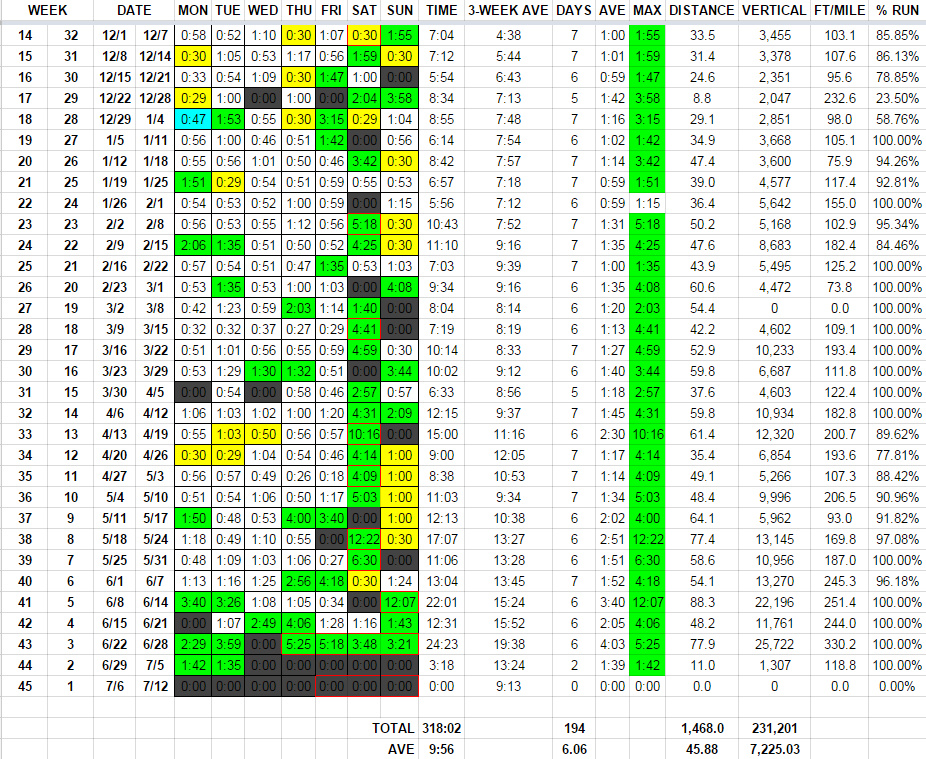
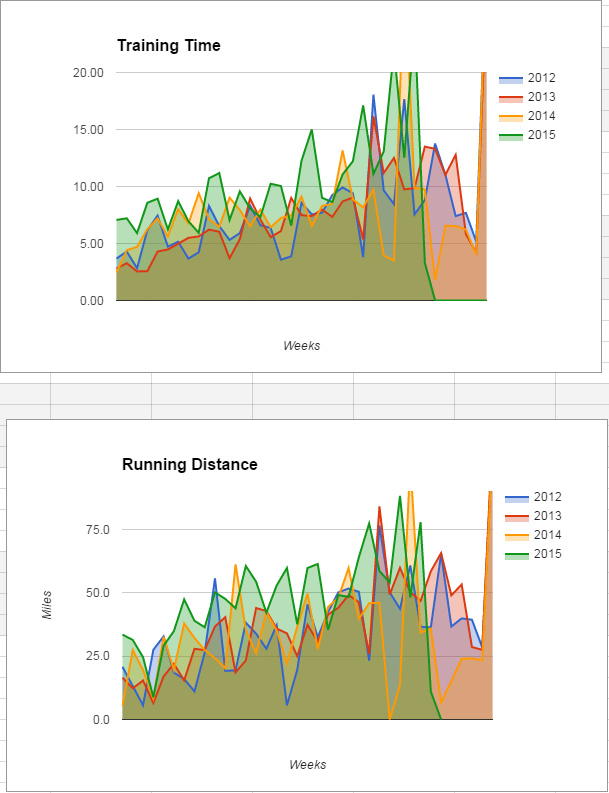
While April got off to a bit of a shaky start at the Grand Canyon, all-in-all I think it was a very solid, consistent month of training for me. Since we arrived back from our family vacation, I've been able to exercise every day-- running when possible, but also hitting the bike trainer when the weather is nasty or my time is short. And this April's weather has been, well... certainly less conducive to running than last year. (But also less conducive to forest fires, so that's good.) Looking at my training log from '12 I can see that I was already running on snow-free trails around town in early April! This year... well, I'm hoping that the lower elevation local trails might melt out by the last week of May? It will probably be even longer before I can run above the Fish Hatchery or up to Native Lake. This morning I brushed 3 inches of fresh snow off of my car while wearing flip-flops. Gotta love Leadville.


A shot of snowy Mt. Princeton, taken on one of my training runs on the CPTR course.

Interestingly, I do think the fact that the snow kept me off the local trails may have actually benefited my training. It pushed me onto (dirt and paved) roads, where I typical run about 1:30 min/mile faster. Though 7th St, 5th St, Cal Gulch, and the Boulevard are getting a little old, I'm also regularly running <8:00 min/miles on the downhills. That's pretty fast for me. Just last week I recorded my second fastest time ever for the Boulevard. My PR was set in early August of 2011, after an entire summer of training. So, that probably says something.

Of course, my #1 training goal this year is simply to stay injury free. So far, so good. That fact alone has enabled me to log one more long run in April than I did last year. Other than that, my weekly mileage has been fairly conservative, but more consistent this year than last. I feel 45 miles/week is about right for me for this time of year. I generally try to increase it by 5 miles/week/month up until August.

April 2012 Training. Last year, the first two weeks of April I was recovering from ITBS.
April 2013 Training. This year, I didn't have much time to run while on vacation. I did manage a 9-hour poopathon, though...

The Collegiate Peaks 25 is always on my mind while I'm training in April. It's certainly served as a reliable benchmark of my early season fitness over the years. As I'm writing this, the race is behind me, so it would facetious of me to pretend to make any uninformed predictions about my performance. However, I will say that I entered the race feeling confident that I had a good chance at setting another PR for the course. I had more long runs under my belt. I have a better nutrition strategy now. And I've stayed injury-free. (Oh, and the race is one week later this year, allowing for that much more training.)

The result? For now, let's just say that much ass was kicked. The course's ass or my ass? Stay tuned...

Wednesday, April 24, 2013

R(2R)2R Report

So, how'd my R2R2R attempt go? I'm glad you asked.

It was miserable.

But let me start at the beginning. After a weekend spent stuffing the car full of camping gear, we set off for Moab and the Grand Canyon on April 1st. Our first stop: Fruita, CO. The kids were very well behaved and survived the car trip without too much fussing. Sierra always loves the tunnels in Glenwood Canyon. The weather was a little iffy, with dark clouds moving quickly across the sky, bringing with them the occasional shower and even some thunder. This made setting up camp a little more exciting than it needed to be. Ethan's first night camping went very well. He only tried to eat the sleeping bag once or twice. We awoke to sprinkles and threats of more rain to come. I believe we set a record for fastest time breaking camp with two little kids. Now safely ensconced in the car, we drove to downtown Fruita to enjoy a leisurely breakfast. We then proceeded to pick up our friends' truck at a nearby trail head. They were mountain biking the Kokopelli Trail from Fruita to Moab and we had volunteered to shuttle it for them. I absolutely love the drive along the Colorado River on Rt. 128 to Moab. So beautiful. It's got to be one of my all time favorite stretches of road. Soon we arrived at Sand Flats and were welcomed by our good friends, who had kindly reserved us a spot. We setup camp again under the threat of rain-- which thankfully never materialized.


During the night I awoke to feelings of nausea. Oh, no... this is just what I had feared. A nasty stomach bug had been moving through our family the previous week. It struck Sierra first, who had to stay home from school for several days. Then it moved on to my wife, Christina, who spent most of Saturday lying in bed, vomiting, and periodically dashing to the bathroom. Despite slathering myself with Purell, and taking every precaution I could think of, now it seemed like it was my turn. The nausea passed uneventfully and I fell back to sleep, but I worried that this was just the beginning...

On Wednesday morning we packed up, said farewell, and headed off for the Grand Canyon. Despite another long day driving, the kids did great. Seeing the Grand Canyon suddenly emerge through the trees was truly breath-taking. It sneaks up on you and has quite a dramatic effect. Since night time temperatures were about 10F lower at the Grand Canyon compared to Moab, we decided it was prudent to take shelter in a hotel room for this leg of the trip. A low of 26F is a little too cold for camping with an 8-month old. We had debated this strategy for months leading up to the trip, but I think we ultimately made the right call.


Thursday was when sh*t hit the fan.

I woke up early Thursday morning to more feelings of nausea. Then came the diarrhea. No, no, no... But, there was no denying it now. I had caught the bug. It was less than 24 hours until I planned to start my R2R2R attempt with my good friend, Alex. We had been planning this trip for months! Why me? Why now? Ugh.

For the rest of the day, while we toured around the south rim, I tried to stay positive and as well hydrated as I could. I ate yogurt in a valiant attempt to reinforce my stomach flora. I drank soda after soda after soda, trying to get some calories in me and replenish fluids. Stomach bugs can pass in 24 hours, right? Maybe there was hope... at least that's what I told myself.

Around noon I got a call from Erin, Alex's wife. They had driven from Boulder to Moab the day before and were now driving to meet us at the canyon. The news: their youngest son, Cedar, had come down with a stomach virus just as they were leaving Boulder and had been throwing up regularly ever since. The drive was epic. They weren't sure if it was wise to continue on and were wondering if there was an urgent care clinic anywhere near the canyon. There was, in fact, and they ultimately decided to press on in hopes that Cedar would soon recover.

But wait, it gets better.

Back at the hotel room, we receive a call from one of our neighbors back in Leadville that our car (which was parked on the street outside our house) has just been involved in an accident. Uh, what? Soon we receive a text message that shows a picture of a car flipped upside down on its roof in the middle of the street directly in front of our house. Apparently some guy got distracted and managed to slam directly into our little Honda Civic and flip over. Flip over? Really? Our car's rear tire, which absorbed the entire force of the impact, looks like a pretzel. I don't have time to deal with this now! I have to run 42 miles in less than 12 hours and I am destroying our poor hotel room's toilet!

I actually manage to eat a reasonable dinner before retreating to our campsite to meet Alex. After wishing us luck, the women and children head back to the hotel. I warn Alex about the current state of my GI tract, but tell him I'm willing to give it a go. He laughs and says he'll probably come down with his son's illness during the run tomorrow. (Cedar was feeling much better at this point.) We quickly organize our gear, set our alarms for 3am, and try to get some sleep.

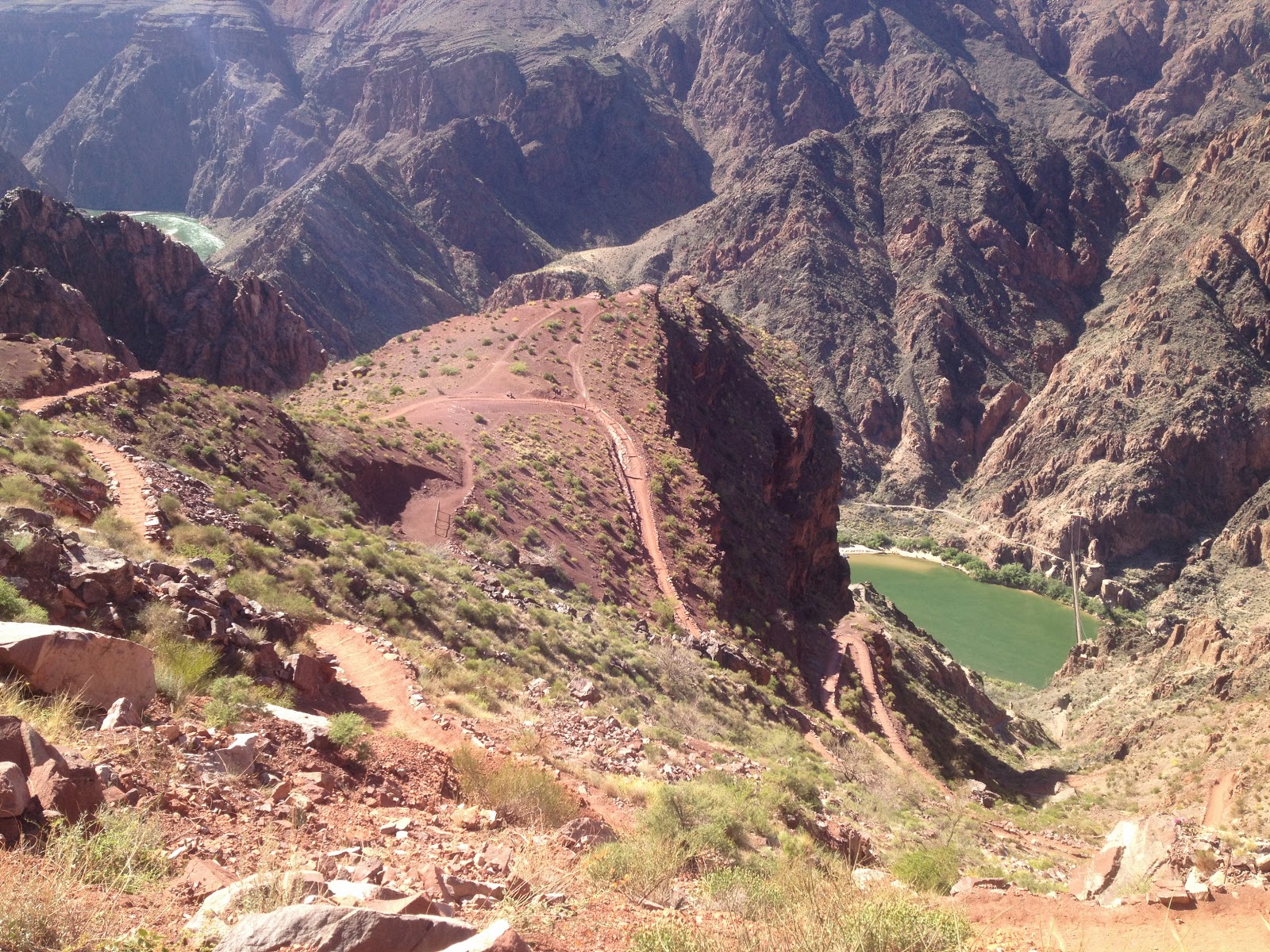
I awake feeling... fine. A little bloated, perhaps, but okay. We set off slowly, bushwhacking to the road and then heading to South Kaibab Trailhead. After about two miles, just as we're reaching the rim, I pull off to the side of the trail and throw up. Ugh. Okay, okay... It's not like I haven't thrown up at the beginning of a race before. I feel better. What the hell. We continue. The descent is fun, but very difficult in the dark. The regularly spaced wooden steps make footing surprisingly difficult. There's a wind that's kicking up dust and obscuring our headlamps. Down, down, down we go, chatting merrily away. Even this early in the morning, it's actually quite warm. We reach the bridge over the Colorado just as dawn begins to break. I can now start to see some of my surroundings. Magnificent. We stop to refill our water bottles and stash some gear. The guests at Phantom Ranch are just waking up and getting ready for the day. We proceed up the gently graded trail, headed towards the north rim. I'm moving slowly and now that we're headed uphill I begin to feel a bit weak. I'm running, but ridiculously slowly given the terrain. I consumed plenty of calories and fluids during our descent. That shouldn't be an issue. I give myself a few miles to see how it goes. Soon I start to feel dizzy. Spacey. That clinches it. I might be able to dismiss fatigue as normal during a run, but this is decidedly more than simple fatigue. My head is swimming. I whistle to get Alex's attention and meet up with him to tell him the bad news: I'm turning around. I feel like crap. I need to summon whatever energy I can to get myself out of this damn canyon. Frustrated, but confident that turning around is my only real choice, I head back to Phantom Ranch. Alex forges ahead. My biggest regret of the trip is that we didn't get more time to spend together.

My run is over.


But, my death march has only just begun...

At Phantom Ranch, the pooping begins. It does not stop for 5 hours.

I try to make the best of it and enjoy the spectacular scenery, but it's difficult when I'm diving behind a rock every few switchbacks, shorts around my ankles. I am plodding up the trail as best I can, rationing my water for what I know will be an eternally long climb. I stop in every patch of shade to rest and regain my strength. Now I know how Sisyphus feels. This was not the heroic run I imagined. Ah, well... I survived. I made it to the top, hydration bladder and GI tract completely empty. It took me 9 hours to run 25 miles. DNF.


Back at the campsite, I don't feel quite as bad. I begin to take in (and actually absorb) some calories. I recount details of my glorious adventure to Christina and Erin. I play with the kids and slowly pack up camp. A few hours later, Alex finishes his fourth R2R2R.

On Saturday, we exchange good byes in the hotel parking lot and head our separate ways. We decide to make the push to Leadville in a single day, driving the southern route through Durango for some variety. It's a beautiful drive and both kids are little angels. I continue to battle a very unhappy stomach off and on during the drive. Sometime around midnight, we carry the sleeping kids past the wreckage of our car, and into our house and put them to bed. I collapse shortly thereafter, so happy to be in my own bed.

In the morning, out of curiosity, I weigh myself. I lost 8 pounds.

Good advice.

Despite all the difficulties we faced during the trip, overall we really did have a good time. I know that may be hard to believe, but it's true. It was exhausting at times, yes, but there were many quiet little moments of joy: Sierra playing in the sand and running, laughing across the slickrock, Ethan crawling around the tent, exploring his new world. On Monday morning at the breakfast table, Sierra exclaimed, "Papa, I want to go camping forever!"

Mission accomplished.


Tuesday, April 23, 2013

Month in Review (March)

3/2010: 109.0 miles
3/2011: 129.6 miles
3/2012: 153.3 miles
3/2013: 174.7 miles

The Midland Trail in BV. A regular spring destination to escape from Leadville's snow.
Well, this post is a bit late. Life has not left me much time for blogging lately, but I wanted to at least record a few thoughts on how my training is going so far this year. March, March... let me see if I can remember what the hell I did in March. Hmm... based on the chart above, it looks like I managed to run a fair bit-- at least for this time of year. In all seriousness, I feel like I had a very solid month of training. I had a 20+ day training streak going until I took a few days off to help prepare for my 40th birthday party. Good times. Of course, the Salida Marathon went surprisingly well. Better yet, I recovered from it quickly. Then, on a business trip to Boston, I was able to squeeze in another 20-miler on the Minuteman Trail. That put me one 20-mile run ahead of where I was at this time last year. I also managed to set PRs on a few local routes that I routinely run in winter (a 6.5 miler out-and-back up 7th St, another 6.5 miler with 1,000 ft of vertical up 5th St to Adelade and back down California Gulch, and the 16-mile Midland Trail loop down in Buena Vista). Not too shabby. These winter PRs aren't quite a stout as my more frequently run summer routes, but I'll take what I can get.

The most important difference from last March was that I survived the month without any IT band problems. It appears that my hip stretching, strengthening, and foam rolling are able to keep in it check. I do feel a little tightness from time to time-- without any apparent pattern-- but perhaps that's a good thing. It keeps me from becoming complacent and slacking off.

All in all, a good month. More to come...

Monday, March 11, 2013

Salida Race Report

In the days leading up to the marathon, I spent more time than usual checking the race day weather forecast. Snow looked imminent, with temperatures somewhere in the mid-30's. Good running weather for Leadville perhaps, but a bit nastier than average for Salida at this time of year. My first taste of spring would have to wait.

My neighbor, Mike, and I drove down from Leadville together, catching up along the way. He's entered Leadman again for the third year in a row-- I believe it's fair to say that he's hooked. I worried about potentially gnarly driving conditions, but our drive down was actually quite nice. An inch or so of fluffy snow had fallen overnight, but I don't think we encountered a single flake as we descended 3,000 ft down the Arkansas valley to Salida. We drove past a large herd of elk grazing on the valley floor. The sage brush was laced with fresh snow, which the rising sun illuminated as it shone through gaps in the clouds that hung on the shoulders of the nearby mountains. Further south, however, the clouds loomed darker and promised more snow to come.

As we milled around the starting area, we bumped into a bunch of other Leadville folks who were also racing that day. We all clustered together at the starting line, smiling, chatting, trying to stay warm, and second-guessing how many layers of clothing we were wearing. There was no snow on the ground at the start, but the steady climb ahead of us seemed likely to change that.

The start of the Salida marathon is an understated event. I never hear any gun or countdown or announcement. We just suddenly take off as a pack. I'm often caught off guard and surprised to find myself running. It's a great laid back way to kick off another season of racing.

My goal for this race-- and what has become my default goal for all races-- is to start conservatively and try to negative split the race. Focus on a maintaining a steady, slow intake of calories. Finish strong. My race last year did not go so well. I really struggled in the second half of the race, slowing way, way down-- especially considering that the second 13 miles of the race are mostly downhill.

This year, I kept things very relaxed for the first 8 or so miles. It was so enjoyable to be able to run on nice, dry single track for a change-- especially after months of training almost exclusively on snowy dirt roads. The only hitch during these early miles was my awkward fumbling around with a ziploc bag full of energy drink powder at the first aid station. I ended up tearing it open and spilling about a quarter of it on the ground. Frustrating. It's funny how little things like that can have such a negative effect on your mental state. It knocks you out of any rhythm. Eventually I shook it off and regained my composure. It's healthy to laugh at yourself-- especially during the early miles of a race.

A few miles into the race...

The next section is the biggest sustained climb of the race, up a dirt road to the halfway point. Since I ran the first section relatively easy, I made up some places on this climb. I felt good, ran the entire way, and passed 20 or so folks on the way up. Slow and steady. The snow started falling as we climbed and it was beginning to accumulate. I didn't find the snow to be a problem, in fact I felt it added to the dramatic atmosphere of the race. Everything felt more... burly. I seemed to have chosen the perfect amount of clothing for the conditions, and I never had to make any major adjustments during the race-- just taking on and off my hat and rolling my sleeves up or down as the conditions warranted. You can't ask for more than that.

I was excited to see that I hit the halfway mark about two minutes faster than I did last year. That surprised me a bit, because I was perfectly willing to run the first half of the race slower, focusing on the second half of instead. I felt good, though, and I didn't think I had pushed too hard. However, I knew all that mattered was the second half and my two minutes meant nothing if I blew up.

One of my sub-goals for the race was to run the hill at mile 21. I succeeded-- just barely.

The second half of the race is mostly downhill, but there are some rollers and one short, but steep climb out of a "sand trap" around mile 21. The trail can definitely get a bit technical at times and it is certainly slower than you might expect, twisting tightly and dropping sharply in spots. I've come to recognize that technical downhills are not exactly my forte, but I do enjoy them.

In contrast to last year, I noticed that I was still passing runners in these later sections of the race. Often on the uphills. I was determined to run the entire course-- never dropping into hiking mode. I find the small uphills provide a good test of my energy level. I gain confidence that my nutrition is where it's supposed to be if I can still maintain a running cadence uphill late in a race. I didn't push too hard on the downhills, trying to save my quads a bit. At this point in the year, I've done very little downhill running. And what little I have done has been a bit restrained due to the potential of slipping on ice. I arrived at the aid station at mile 20 feeling good. Glancing at my watch, I knew I had run the previous section much faster than last year. A PR seemed likely now and the thought gave me a boost of energy. I headed out again and mentally prepared myself for the energy-sapping climb at mile 21. Gritting my teeth, I was able to run every step of it. That was definitely a first for me and worthy of a gasping, panting, quiet "F*ck, yeah!" to myself at the top.

The rest of the race unfolded very smoothly-- I pretty much settled into autopilot mode. I was tired, for sure, but still running everything and picking off runners at regular intervals. The trail weaves in and out of lots of drainages, so you can see a good bit of the course ahead as you look across. I found that I could very accurately predict where I'd eventually pass the runners in front of me: on the gentle rolling uphills as we hopped from one drainage to the next.

As I left the final aid station, I did some quick calculations in my head. It looked like I might be able to finish under 5 hours! I actually groaned to myself because beating a nice, round-numbered time meant that I had to push a bit harder during these final miles rather than just coasting to the finish. Curse you, arbitrary time goals!

I ended up running the last mile of the race almost as fast as I ran the same mile earlier in the race and finished in 4:57:31. Solid! A 37-minute PR for the course! I was psyched.

A comparison of my splits from last year to this year. Shaded rows are aid stations.

So... how in the hell did I run 37 minutes faster this year than last year? I doubt it was due to my training, which was almost exactly the same in terms of total mileage. In fact, it was even a bit less this year-- though I did run two longer runs than I had in '12. Still, that can't possibly account for a 37 minute improvement. After much contemplation, here's how I think my improvement roughly broke down:

  • (22 minutes) Improved in-race nutrition. 300 calories/hour. No excuses.
  • (10 minutes) Hoka Stinson Evos vs. New Balance MT110s.
  • (3 minutes) Starting the race well-rested.
  • (3 minutes) More evenly distributed training miles.
  • (3 minutes) Stronger hips. No knee pain during the race.
  • (2 minutes) Cooler temperatures on race day.
  • (-3 minutes) Fiddling with baggies of energy drink powder at every aid station.
  • (-3 minutes) Carrying/wearing more gear due to weather.

That's just a guess, but it's my best guess. Basically, in retrospect, I blew up last year, barely surviving the race. '12 was more an example of how not to run the race. I know I drone on and on about the importance of in-race nutrition, but I truly think that if it's your weak link, you can see huge performance improvements simply by fixing it-- even if your raw fitness level remains the same. Consuming a steady stream of carbohydrates during a race (50-60 grams per hour) is huge. Huge! This was the concoction I was drinking:

  • 2 scoops of pure maltodextrin (complex sugars) (200 calories)
  • 1 scoop of lemon-lime Gatorade (simple sugars, some electrolytes, flavor) (80 calories)
  • 1/4 scoop of soy protein (protein) (~30 calories)
  • ~20 oz of water

One bottle an hour gives you basically everything you need. Very simple. No chewing required. (And it's very easy to adjust the ingredients up or down to reach the ideal 2 calories per pound per hour rate of consumption.) After trying a variety of products over the years (including "real" food) this is the only fueling strategy that I've been able to maintain consistently for 28+ hours. The taste is fairly subtle-- like diluted Gatorade. Try it. If you've struggled with in-race nutrition in the past, it's like cheating.

I hesitate to give my shoes as much weight as I did in my calculations, but I think I wasn't nearly ready to run 26 miles in my MT110s last year. I had run exclusively in MT101s in '10 and '11 so I didn't give it much thought at the time, but the MT110 is a very different beast than its predecessor. It's much more minimal and I think I paid the price on the downhills. My running form is just not that good-- especially on the downhills. This year I went to the opposite end of the spectrum with my Hoka Stinson Evos. The last time I ran in them was during the 100 in August. My original plan was to run in my Bondi Bs, but the snow made me jump up to a model with a bit more tread. I think they really saved my quads on the downhills, even if the mud stuck to them in a few spots. I still have mixed feelings about Hokas, but I can't argue with the fact that I've had some good results while wearing them. Currently, I only use them for long runs; running all my shorter training runs in more minimalist footwear.

The Salida marathon will always be too early in the season for me to be truly prepared for it. But in contrast to last year, I think I'll emerge from it stronger. While my finishing time was certainly modest, it's more inline with my past race results. (Being in the top 30%-39% of finishers is really good for me, 40%-49% is solid, and 50%+ is mediocre. This year in Salida I came in around 56% vs. 72% last year...) I think I got a really good workout and thoroughly enjoyed the entire experience. It was a lot of fun and a nice confidence boost in the direction my training is heading this year.

Only 3.5 weeks until my next challenge: 42 miles and 11,000 ft of vertical in the Grand Canyon!

Tuesday, March 5, 2013

Month in Review (February)

2/2010: 100.9 miles
2/2011: 111.3 miles
2/2012: 151.9 miles
2/2013: 137.8 miles

Blizzards, Beaches, and Colds! (With a little bit of running.) Oh my!

February began with a business trip to Boston. The frequency of these trips has increased a bit, with me now traveling about once a month. Generally, I fly out on a Sunday afternoon and fly back on a Friday evening. This time, however, a gigantic nor'easter had other plans for me. I desperately tried to reschedule my flight back to Denver earlier in the day in hopes of getting out before the storm hit, but it was all for naught. Everything got canceled before a single flake had fallen. On Friday, I hunkered down in the office until the snow became heavy enough to force me to retreat back to my hotel by mid-afternoon. It snowed for 24 hours straight, winds howling, dumping about 24" of snow in total. The fifth largest storm in Boston's history. I was trapped in Boston until I finally managed to get a flight out on Monday morning. What made this ordeal all the more frustrating was that the original plan was for me to meet my wife and kids in Denver on Friday night. We'd then spend the night at an airport hotel and fly to Florida on Saturday morning. Yeah, not so much. My wife ended up having to juggle both kids by herself. She made it to Florida in one piece-- barely. I spent a good portion of my weekend on hold or talking to representatives from United and Frontier. Christina was helpful enough to text me pictures of herself lounging on the beach (while I negotiated shoulder-high snow drifts on my walk to work-- I didn't dare drive). In the end, I only missed about a day and a half of our family vacation, but... wow, it turned out to be an epic trip. At one point I seriously contemplated driving my rental car to Florida in a last-ditch effort to escape!

The office on Saturday. I was the only one at work.

Meanwhile, Ethan relaxes on the beach. (He looks very concerned that his papa is missing.)
Travel craziness aside, I feel like I more-or-less met my modest February training goals for this year. The only hiccup being a nasty head cold that I came down with on the last weekend of the month. It knocked me out of commission for a few days. My sinuses are still recovering... ugh. Due to my cold (and the fact that it's not a leap year) I came up a few miles short this month compared to last February. However, on the plus side, I did manage to run a 20-miler with my friend Jay in Boston, MA. And I also managed to escape for a 15-mile run during our family's annual vacation to Naples, FL. Both those runs were around an 8:30 min/mile pace, which felt pretty comfortable-- ah, the benefits of running at sea level.

I'm looking forward to the Salida marathon this week. I won't be in particularly good shape for it, but it should be fun nonetheless. First and foremost, Salida provides me with an incentive to train more than I otherwise would in January and February. I need a race as training motivation. If I waited until early May to run my first race, there'd be no way that I'd be running as much.

Salida is also simply a great excuse for me to log an early season long run. And if the weather cooperates (like it has the past two years), it's a refreshing taste of spring when Leadville is still buried under snow. That alone is reason enough to run it! (Unfortunately, the forecast for Saturday looks pretty grim.) Would I like to improve up my time? Certainly. Do I think that's possible? Maybe. Should I stress out about it? Probably not. So far, my training this year hasn't been radically different than last year. I shouldn't expect radically different results. I am training more consistently-- running/riding 5-7 days a week-- though my total year-to-date mileage isn't that different from last year. Will that have an effect? Hard to say. (Probably not.) I really beat myself up last year, jumping up to a 55 mile week in Florida and then running a lot of vertical on the treadmill in Boston the week before the race. It's possible that I might not have fully recovered by race day. The final weeks leading up the race this year have been more regular, without big fluctuations in effort.

When I look at the GPS data from last year's Salida marathon, it seems like I should be able to improve my time by 15 minutes or so. At least that's what I want to believe. While I ran the first half of the race fairly well (which is mostly uphill), I faded significantly in the second half. I was unable to take advantage of the downhills. The question is why did I slow down so much? In my blog entry from last year I complained about the snow and my lack of early season fitness-- mostly the fact that the race was my first 20+ mile run since October. I remember having some minor hamstring issues and feeling my IT band flare up a bit in the final miles. (I'm pretty sure I popped an Advil or two during the final miles of the race.) At the time I brushed it off, but in retrospect I should have taken my IT band pain much more seriously. I would end up being sidelined by it for several weeks after the race. I remember feeling hungry around mile 20. I ran most of the race eating gels and drinking Gatorade. Did I get enough calories? Doubtful, but how much can I blame poor nutrition for my performance? I didn't keep track of my exact calories/hour rate of consumption, so I don't have anything concrete to point my finger at.

Ah, whatever. I'm over analyzing things... It'll be great to get out for a long run on Saturday, no matter what my time ends up being. One thing is for sure: I'm certainly going to be out on the course long enough to get my money's worth!

Since my biggest, overarching training goal this year is simply to stay healthy and injury-free, the most successful running of the Salida marathon would be one that allows me to continue training well throughout the rest of March, putting me in a good position for a solid R2R2R attempt in early April.

Salida will be my last race in the 30-39 year old division. On March 25th, I'm moving up to 40-49! Yee haw!